Bounty Hunting Strategy
How to hunt bounties profitably: valuing a knockout, when to loosen your calls, and how covering a short stack changes every all-in decision.
On this page · 6 sections
Bounty tournaments attach a cash reward to every player’s head. Knock someone out, collect their bounty. That single change turns eliminations into a profit center and rewires how you should value pots, calls, and chip position. Hunting bounties well is about knowing exactly how much a knockout is worth and when chasing it is worth the chips.
What a bounty is actually worth
The core insight is that a bounty is dead money you can only win by eliminating a specific player. In a standard tournament the only reward for winning a pot is the chips. In a bounty event, when you have an opponent covered and all in, winning the pot also delivers their cash bounty. That reward is real money in your pocket regardless of how the tournament finishes.
Because the bounty is only collectable on a knockout, it behaves like extra pot odds that apply exclusively to elimination spots. The bigger the bounty relative to the pot, the more it loosens your calling requirement. A small bounty barely moves the needle; a large one can justify calling with holdings you would fold in a chip-only game.
The covering rule that governs everything
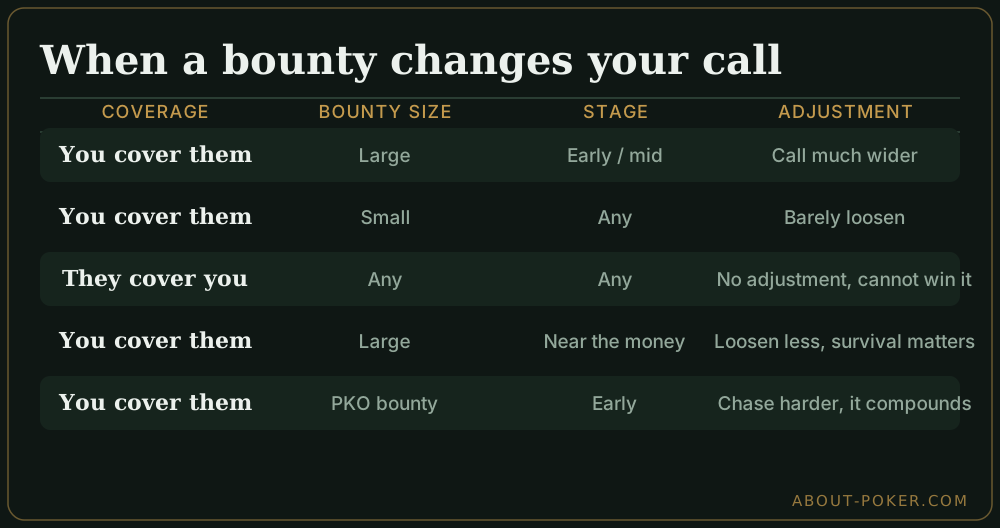
You can only win a bounty from a player you have covered. If they have more chips than you, busting them is impossible, so no bounty adjustment applies to that confrontation. This makes chip position central: the covering stack is the only one who can chase the knockout, which is a strong argument for accumulating and wielding a big stack in these formats.
Practically, this means big stacks should apply pressure to short stacks aggressively, because every all-in they win against a covered short can pay a bounty. Meanwhile a short stack shoving into a big stack gets called wider than normal, so their shoving range should tighten a touch to account for the extra incentive their opponent has to call.
A worked calling example
You cover an opponent who open-shoves for 10 big blinds. The pot when the action reaches you contains 15 big blinds, and calling costs you 10. In a chip-only world you need roughly 10 divided by 25, about 40 percent equity, to call.
Now add a bounty worth the equivalent of 8 big blinds in real money, converted to chip-EV terms for this decision. That 8 acts like extra winnings available only when you bust them. Effectively your reward for winning grows, so the equity you need to call drops meaningfully, often into the low-to-mid 30s depending on how you weight the cash. A hand like KJ suited, marginal in a chip-only call, becomes a comfortable call once the bounty is in play. The exact math depends on how you value the cash versus chips, but the direction is always the same: bounties make you call wider when you cover.
Progressive vs standard bounties
In a standard knockout, each bounty is a fixed amount that leaves the tournament when you collect it. In a progressive knockout (PKO), part of every bounty you win is added to your own head, so busting players early both pays you now and makes you a more valuable target later. This snowball changes strategy: early knockouts compound, so covering and hunting shorts is even more rewarding. The detailed mechanics live in the progressive knockout strategy guide and the broader bounty and PKO overview.
Common bounty-hunting mistakes
The first mistake is over-valuing bounties. A knockout is nice, but it is not worth spewing your stack on thin spots when you do not cover, or when the bounty is small relative to what you risk. Chip preservation still wins tournaments.
The second is forgetting the covering rule and loosening up against players who have you covered, where you cannot win the bounty at all. The third is ignoring ICM late: near the money and on the pay ladder, the value of surviving can outweigh a single bounty, so the loosening effect shrinks as prizes climb. Balance the cash-now incentive of the bounty against the tournament-life cost of the chips.
Bounty decision checklist
Before chasing a knockout, ask: Do I cover this player, so the bounty is even winnable? How large is the bounty relative to the pot and to my stack? Does the extra reward lower my required equity enough to turn a fold into a call? Is it a progressive format where the knockout also grows my own head? And how close are we to the money, where survival value pushes back against loosening? Run those checks and you will collect the bounties worth chasing while skipping the ones that quietly bleed your stack.
Frequently asked
How much extra equity does a bounty add to a call?
It depends on the bounty size relative to the pot, but the bounty acts like extra dead money you win only if you eliminate the opponent. If a bounty is worth roughly a third of the pot, it can lower the equity you need to call an all-in by several percentage points. You only collect it when you actually knock the player out.
Do I have to cover a player to win their bounty?
Yes. You only collect a bounty if you eliminate the player, which means you must have them covered before the hand. This is why chip position matters so much in bounty events: only the covering stack can chase the knockout.
Should bounties change my preflop calling ranges?
Yes, but mainly when you cover a short stack who is all in. The bounty is extra reward available only if you win the pot and bust them, so you can call wider than a chip-only calculation suggests. Against a covering opponent you cannot win the bounty, so no adjustment applies.