ICM on the Bubble in Tournaments
On the bubble, chips aren't worth their face value. Here's how ICM changes bubble play, why you fold winning hands, and a worked short-stack fold example.
On this page · 8 sections
The bubble is the point in a tournament just before the payouts begin — bust here and you earn nothing, survive and you’re in the money. It’s also the single spot where the Independent Chip Model matters most. ICM tells you that on the bubble your chips are not worth their face value, and once you internalize that, your whole approach to bubble play changes.
Chips aren’t dollars
In a cash game a chip is a dollar. In a tournament, chips only convert to money through the payout structure, and that conversion is not linear. Doubling from 20 big blinds to 40 does not double your real-money equity, because there are only so many prize dollars to go around. Meanwhile, busting on the bubble takes you from “about to cash” to “zero.”
That asymmetry is the entire point of ICM. The downside of losing your stack is larger than the upside of winning the same number of chips. So the correct strategy is to avoid marginal all-ins that a pure chip-count strategy would take.
Who feels the pressure
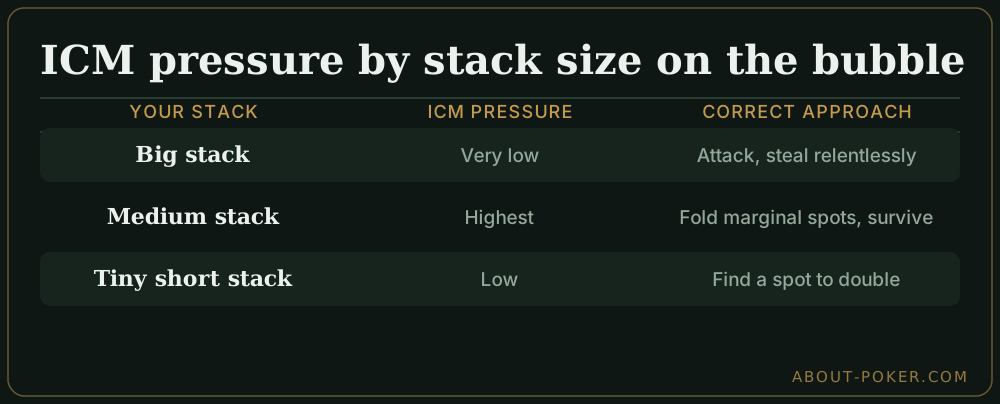
ICM pressure is not shared equally around the table:
- Big stacks feel almost none. They can’t bust on this hand, so they apply maximum aggression and steal relentlessly.
- Medium stacks feel the most. They have real equity locked up and a lot to lose, so they should tighten up dramatically and avoid clashing with the big stacks.
- Short stacks feel relatively little once they’re truly desperate — if you have 3bb, survival folding gains you almost nothing, so you look for spots to double.
Recognizing your role is half the battle. If you’re a medium stack, your job is to fold your way into the money and let other medium stacks take the risks. If you’re the big stack, your job is to pound on the medium stacks who can’t call you. This dynamic sits at the heart of good bubble strategy.
Folding winning hands
The most counterintuitive part of ICM bubble play is folding hands you know are ahead. This is correct because the metric is real-money equity, not the chance of winning the pot. A hand can be a coin flip or even a small favorite in chips and still be a clear fold in dollars, because busting the bubble costs you so much.
Worked example: folding pocket jacks
Nine players left, eight get paid — one off the money. You have 25bb (a medium stack). The chip leader, who covers you, open-jams from the cutoff. You look down at pocket jacks in the big blind.
In pure chip terms, this is an easy call. Against a wide bubble-jamming range, JJ is a big favorite — often 55–60% equity or more. If chips were dollars, you snap-call.
But they aren’t. If you call and lose, you bust one spot short of any payout — a catastrophe worth zero. If you call and win, you become a monster stack, but that extra equity is worth far less than the min-cash you throw away by busting. Run the ICM numbers and against a big stack that covers you, calling off 25bb with JJ on this exact bubble is frequently a fold or extremely close, even though you’re ahead in chips. That gap between “ahead in chips” and “correct in dollars” is ICM in one hand.
Practical bubble adjustments
You don’t need to run an ICM solver at the table. Keep three rules in mind. First, as a medium stack, fold almost everything against a covering big stack — only get it in with premiums. Second, as the big stack, attack the medium stacks who are trying to survive; they’re paying you to fold. Third, once the bubble bursts, immediately loosen back up — ICM pressure eases the moment everyone’s in the money. For the mechanics of when the money kicks in, see what the bubble is.
When ICM barely applies
ICM pressure is a spectrum, not a switch, and it is easy to over-apply it. Two situations flatten it out. The first is a flat payout structure, like a satellite that pays the same seat to everyone who cashes. There, once you have enough chips to lock a seat, extra chips are worth almost nothing and survival is everything — ICM pressure is extreme. The second is the opposite: a steep, top-heavy structure where first place pays many times the min-cash. There, laddering matters less relative to the eventual win, so accumulating chips to contend for the top spots regains value and you can take marginally more risk than a naive bubble read suggests. Always look at the actual payout jumps before deciding how tight to play. A five-dollar pay jump one spot up is worth agonizing over; a five-cent jump is not.
The big stack’s leverage
The flip side of medium-stack caution is big-stack profit, and it is worth understanding in its own right. As the covering big stack, you can open and jam a very wide range against medium stacks because they cannot profitably call — the moment they do and lose, they bust before the money, which is a disaster for them but merely a dent for you. This lets you steal blinds and antes almost at will, growing your stack while everyone else freezes. The correct target is the medium stacks who have the most to lose; leave the truly short stacks alone, since they are desperate enough to call wide. Applied well, big-stack bubble aggression can add 30 to 50 percent to your chip count before a single showdown, which is why chip leaders love the bubble as much as medium stacks dread it.
A short bubble checklist
Before committing chips on the bubble, ask four questions. What is my stack role — big, medium, or short? Does my opponent cover me, and if so, how badly does busting hurt? How big is the next pay jump relative to the risk? And is this a hand strong enough that even ICM math says get it in? If you are a medium stack facing a covering jam with a marginal holding, the answer is almost always fold, no matter how good the hand looks in chips. For deeper mechanics, revisit bubble strategy and the underlying ICM bubble math.
Frequently asked
What is ICM on the bubble?
ICM (Independent Chip Model) on the bubble means valuing your chips by the real-money equity they represent rather than their face count. Because busting one spot before the money earns nothing, survival becomes disproportionately valuable and you play tighter than a chip-EV strategy would suggest.
Why do I fold good hands on the bubble?
Because the money you lose by busting on the bubble outweighs the money you gain by doubling. A hand that is a clear chip-EV call can be a clear ICM fold, especially for a mid-sized stack against a big stack that covers you.
Does ICM affect everyone at the table equally?
No. Big stacks feel the least ICM pressure and can bully; short stacks who are already close to busting feel relatively little; medium stacks feel the most, because they have the most real-money equity to lose by busting before the money.