Min-Cash vs First Place Strategy
Min-cash vs first place strategy: why chasing min-cashes loses money, why top-heavy payouts reward aggression, and how to balance survival with winning.
On this page · 6 sections
Every tournament forces the same tension: do you play to lock a min-cash, or do you play to win? A min-cash is the smallest payout tier, often barely more than your buy-in, while first place typically holds a fifth or more of the entire prize pool. How you weigh those two outcomes shapes every decision from the bubble onward, and getting it wrong is one of the most expensive mistakes recreational players make.
The short answer for long-term profit is clear: play for first, with a few specific exceptions. But the nuance — when survival genuinely outweighs accumulation — is where real skill lives.
Why payouts are top-heavy
Tournament prize pools are deliberately weighted toward the top. A typical structure might pay 15% of the field, but the top three finishers collect close to half the pool, and first place alone can take 18–25%. The min-cash, by contrast, might return just 1.5 buy-ins.
This structure means your expected value is dominated by how often you reach the top spots, not how often you sneak into the money. Reading the payout structure before you play tells you exactly how top-heavy the event is and how hard you should push for the top.
The math against min-cash hunting
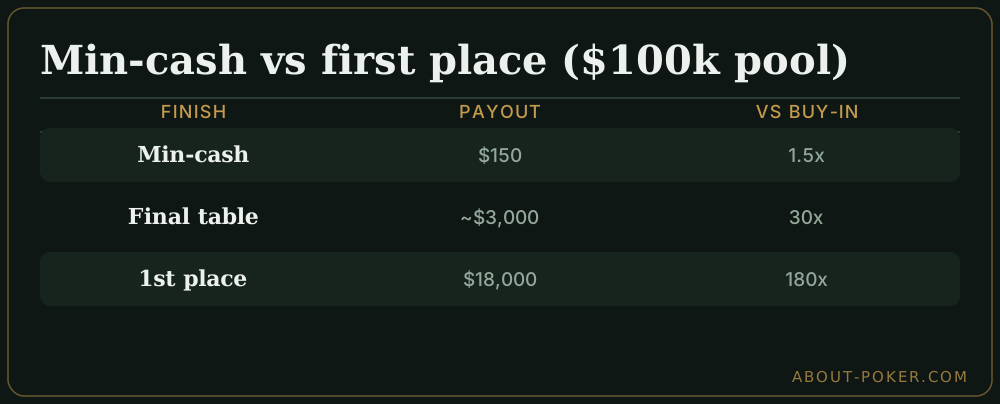
Imagine a $100 tournament of 1,000 players with a $100,000 pool. First pays $18,000; a min-cash pays $150. To profit from min-cashes alone you would need to cash constantly — but tightening up to secure a min-cash actively reduces your chances of ever building the stack needed to reach the top prizes.
Every marginal fold you make to survive the bubble trades a sliver of top-end equity for a tiny bump in min-cash frequency. Because first place is worth 120 times a min-cash, that trade almost never pays. This is the core of chip accumulation vs survival: chips you gather now compound into shots at the big money later.
A worked comparison
You are on the bubble with 20 big blinds and a chance to three-bet shove over a loose opener with a hand like A-J suited. Calling ranges are tight because of the bubble. You estimate the shove is worth +3 big blinds in chip-EV, and folding locks nothing extra beyond the min-cash you are already close to.
A min-cash hunter folds to guarantee the $150. A player playing for first takes the shove: those chips give a real shot at a stack that can win the $18,000. Over a thousand tournaments, the aggressive player pockets far more, because the occasional deep run funds everything. The min-cash hunter caps their upside at the bottom rung.
When survival actually wins
There are real exceptions. In satellites, the only goal is a qualifying seat — finishing first pays exactly the same as scraping in, so pure survival is correct. On a final-table bubble with a huge pay jump and a genuinely short stack, ICM can make survival worth more than a marginal gamble.
And bankroll matters: if a single buy-in is a large fraction of your roll, locking a min-cash to reduce variance is a defensible personal choice even if it costs a little EV. Outside those cases, keep pushing for the top, as detailed in how to win poker tournaments.
Common mistakes
- Nitting up on the bubble in a standard MTT to protect a min-cash worth almost nothing.
- Confusing satellite strategy (survival is everything) with regular MTT strategy.
- Failing to check the payout structure, so you do not know how top-heavy the event is.
- Playing scared with a big stack, when you should be the one applying bubble pressure.
- Treating every cash as a success — a min-cash after a deep run you punted is a loss.
Balancing the two
The winning mindset is simple: accumulate chips relentlessly, respect ICM only when a pay jump is genuinely large and you are genuinely short, and always keep your eyes on first place. Cashes are a byproduct of playing well, not the target. Structure your aggression around the top prizes and let the min-cashes take care of themselves.
Frequently asked
What is a min-cash in poker?
A min-cash is the smallest payout in a tournament, awarded to the players who just barely reach the money. It is usually worth only a fraction more than your buy-in, so building your strategy around securing it leaves most of the prize pool untouched.
Is it better to min-cash or play for first?
For long-term profit, play for first. Tournament payouts are top-heavy, so the top few finishes hold most of the money. Chasing min-cashes trades away your equity in the big prizes, and over many events that lost top-end equity dwarfs the extra min-cashes you lock up.
When does securing a min-cash make sense?
Securing a min-cash makes sense only in specific spots: satellites where any qualifying seat is the whole goal, or when a pay jump is huge relative to your bankroll and you are a genuine short stack on the bubble. Otherwise, keep accumulating chips to reach the top.