Playing a Chip Lead Heads-Up
How to play a chip lead heads-up: apply relentless pressure, exploit a short-stacked opponent, avoid coinflips you don't need, and close out the win.
On this page · 6 sections
Reaching heads-up with a chip lead is one of the best spots in tournament poker — and one of the easiest to fumble. The instinct to protect a lead pushes many players into passive, timid poker that hands the initiative right back to the opponent. Played correctly, a chip lead heads-up is a battering ram: you can put your opponent to decisions for their whole tournament while risking only a fraction of yours. This is where you convert a good run into a title.
Heads-up is already the most aggressive format in poker, since every hand you are in the blinds. Add a chip lead and the pressure you can apply becomes enormous, as covered in heads-up tournament strategy.
Why the chip lead is a weapon
The key asymmetry is survival. When you have, say, a 3-to-1 chip lead, losing a large pot merely shrinks your advantage — losing a pot the same size ends your opponent’s tournament. That means you can put chips in far more freely than they can, because your downside is bounded and theirs is elimination.
Every time you raise, your opponent faces a decision that could cost them everything. That constant threat is why aggression wins heads-up: you are monetizing their fear of busting, the same dynamic that powers final table strategy.
Apply relentless pressure
Raise almost every button. Heads-up, the button is the small blind and acts first preflop but last postflop, a huge positional edge — use it every hand. Open a wide range, continuation-bet frequently, and make your opponent defend a shrinking stack under constant duress.
A short-stacked opponent cannot fight back without risking it all, so they will either fold too much (you steal blinds relentlessly) or call too wide (you get paid with your strong hands). Either way, the pressure compounds. Widen your steals as their stack shrinks, the mirror image of good steal defense.
When to gamble and when to wait
The nuance: avoid unnecessary coinflips that give your opponent a free chance to double, but do not fear all-ins that favor you. If your short-stacked opponent shoves 10 big blinds, you often have excellent pot odds to call wide — and even if you lose, you likely remain in the lead or close to even.
The distinction is who initiates. You generally do not want to be the one flipping for stacks when small ball keeps grinding them down for free. But when they put it in, your price is usually right. Calling a shove where you are 40% is fine when a loss barely dents you and a win ends the tournament.
A worked heads-up example
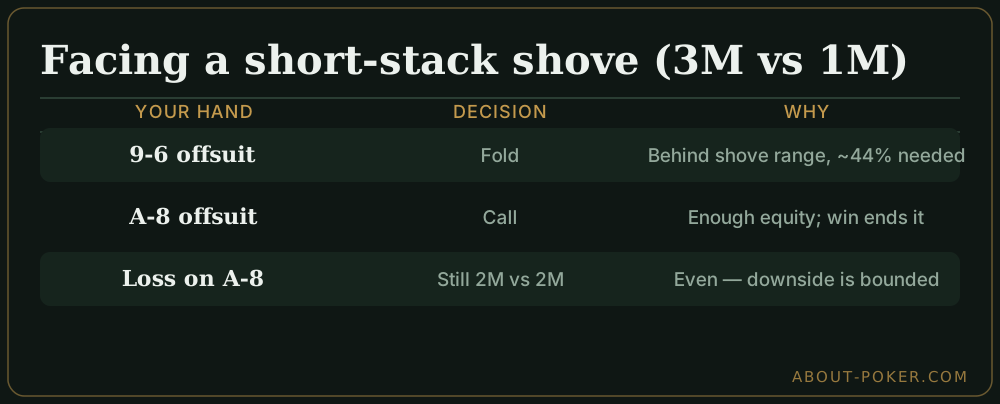
You have 3,000,000 chips; your opponent has 1,000,000. Blinds are 20,000/40,000. On the button you hold 9-6 offsuit. You raise to 90,000. This is standard: you raise nearly every button regardless of cards, because your positional and stack edge means the raise prints even with air.
Your opponent, now around 24 big blinds effective on their side, shoves for 960,000 total. You need to call 870,000 to win a pot of roughly 1,090,000 — you are getting about 1.25-to-1, so you need about 44% equity. With 9-6 offsuit you are behind most shoving ranges, so you fold. But swap your hand for A-8 offsuit and you snap-call: you have the equity, and a win ends the tournament while a loss leaves you at 2,000,000 to their 2,000,000 — still even, still fine.
Common chip-lead mistakes
- Playing passively to “protect” the lead, handing the opponent free initiative.
- Folding the button, throwing away the biggest edge heads-up offers.
- Flipping for stacks unnecessarily when grinding them down is safer and free.
- Refusing good all-in calls out of fear, letting a short stack double for cheap.
- Slowing down when they double once, instead of resuming the pressure immediately.
Closing it out
The winning approach is simple: raise relentlessly, keep the initiative, decline needless coinflips, and take the profitable all-ins when your opponent hands them to you. A chip lead is momentum — press it every hand until the last chip is yours. Do not sit on the lead; use it.
Frequently asked
How do you play a chip lead heads-up?
Apply constant pressure. Raise nearly every button, put your opponent to decisions for their tournament life, and force them to defend a short stack under duress. A chip lead lets you gamble more freely because losing a pot rarely ends your tournament while it can end theirs.
Should you avoid all-ins with a big heads-up lead?
Not entirely. You want to avoid unnecessary coinflips where your opponent gets to double for free, but you should call wide when they shove a short stack because your pot odds are excellent and even a loss leaves you in the game. Pick your all-ins, do not fear them.
What is the biggest mistake with a heads-up chip lead?
Playing passively to protect the lead. Tightening up hands your opponent the initiative and lets them chip back into contention. A chip lead is a weapon to press your advantage, not a cushion to sit on.