Short Stack (Under 15bb) Tournament Strategy
Under 15 big blinds your tournament game changes completely. Here's how to play the short stack: shove-first mindset, re-shoving, and a worked 12bb spot.
On this page · 5 sections
Once your tournament stack drops under 15 big blinds, you are no longer playing the same game as the deep stacks at your table. You can’t open, get flatted, and outplay someone across three streets — you simply don’t have the chips. Short-stack play is about picking the right moments to get all your money in preflop, and doing it before your stack is too small to matter.
The 15 / 10 / 5 framework
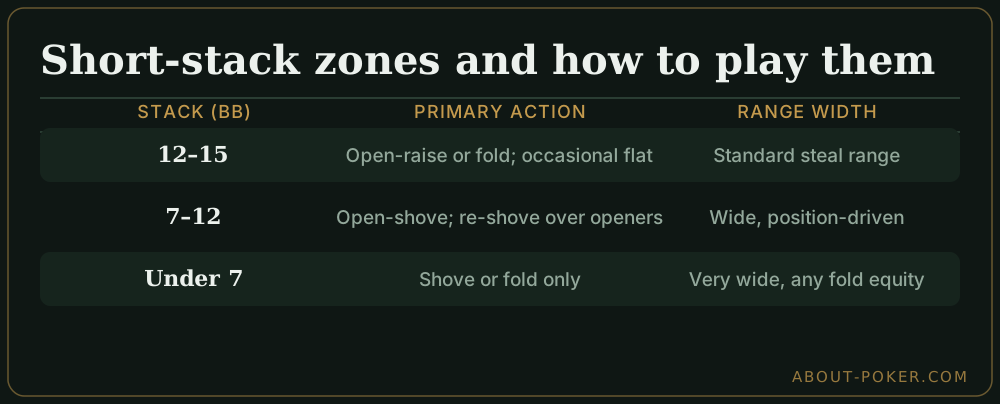
It helps to break the short-stack range into three sub-zones:
- 12–15 big blinds: You still have some flexibility. You can open-raise to 2–2.2bb, and you have enough behind to fold to a re-shove sometimes. You can even flat a raise in position with a hand like a small pair to set-mine, though this gets thin.
- 7–12 big blinds: This is the heart of push-fold territory. Open-shoving becomes your default from most positions. A min-raise here commits so much of your stack that you can’t fold to a jam anyway.
- Under 7 big blinds: You are shoving a very wide range and looking for any spot with fold equity. Waiting costs you more than the marginal hands do.
The single biggest mistake short stacks make is folding down from 12bb to 4bb hoping for aces. Your fold equity — the chance opponents fold and hand you the blinds and antes — disappears as your stack shrinks, because a 4bb shove is a trivial call for anyone.
Shove first, call second
With a short stack, being the one who moves all-in is far more valuable than being the one who calls. When you shove, you win two ways: opponents fold, or you get called and win the pot at showdown. When you call a shove, you can only win at showdown — you’ve given up all fold equity.
That’s why your open-shoving range is wider than your calling range. From the button with 10bb you might open-jam any pair, any ace, most suited kings, and many suited connectors. But if someone jams into you, you tighten up considerably, because now you need real equity against their range rather than fold equity.
Re-shoving over openers
One of the most profitable short-stack plays is the re-shove: an opponent opens to 2.2bb and you move all-in over the top for 11–13bb. This works because the opener is often stealing wide, especially in late-stage tournament play, so your jam picks up their raise plus the blinds and antes when they fold.
Hands that make great re-shoves are ones that play poorly by flatting but have decent equity when called — think Ax, Kx suited, and small-to-medium pairs. You’d rather jam A9o over a button open than flat it out of position.
Worked example: 12bb on the button
Blinds are 500/1,000 with a 1,000 big-blind ante. You have 12,000 chips (12bb) on the button. It folds to you and you hold Kd-Jd.
The dead money in the middle is 2,500 (small blind 500, big blind 1,000, ante 1,000). If you open-jam 12bb and both blinds fold, you pick up 2,500 — a 20% boost to your stack for free. KJs is comfortably ahead of the range that the blinds can profitably call a 12bb jam with, and even when you’re called you often have live cards.
Suppose the big blind calls with A-9o. KJ suited is roughly a 40% underdog there — but you were still correct to jam, because you win the pot uncontested a large share of the time and only get called by a narrow value range. That fold equity is exactly what disappears if you wait until you have 5bb.
Positioning matters most of all
Your shove range widens dramatically as you move closer to the button. Under the gun with 12bb you might only jam premium hands and strong aces, because there are eight players left to wake up with a hand. On the button with the same stack, you can jam nearly half your hands. Always factor in how many players are left to act and whether a big stack behind you is likely to look you up. On or near the bubble, those big stacks call tighter because a bust hurts them too, which widens your shoving range even further.
Frequently asked
What counts as a short stack in a tournament?
Most players treat anything under 15 big blinds as a short stack and under 10 as a critical short stack. In this zone you lose the ability to open, get called, and play three streets postflop, so preflop all-in and preflop folds become your main tools.
Should I always shove under 15 big blinds?
No. Between 12 and 15 big blinds you can still open-raise and even flat in position occasionally, especially deeper in the field. Under 10 big blinds you shift almost entirely to push-fold, where you either move all-in or fold.
Is it better to shove or to wait for a better hand?
Blinding down while waiting for aces is a losing strategy. Antes and blinds erode a short stack every orbit, so you must take slightly marginal spots with fold equity rather than letting your stack shrink below the point where anyone will fold.