Stack Depth Adjustments in Tournaments
How to adjust your poker tournament strategy by stack depth — from 100bb deep play down to sub-10bb push/fold — with concrete ranges and a worked spot.
On this page · 5 sections
Your chip stack is never a fixed number in a tournament — it is a number relative to the blinds, and that ratio changes every level whether you win a pot or not. The single biggest skill jump for developing tournament players is learning to read your stack in big blinds and shift gears the moment you cross a threshold. A hand that is an easy call at 80 big blinds can be a snap-fold at 15, and a limp at 100 can be a shove at 8.
This is why tournament poker plays so differently from cash even with identical cards. Below are the depth bands that matter and how each one changes what you should do.
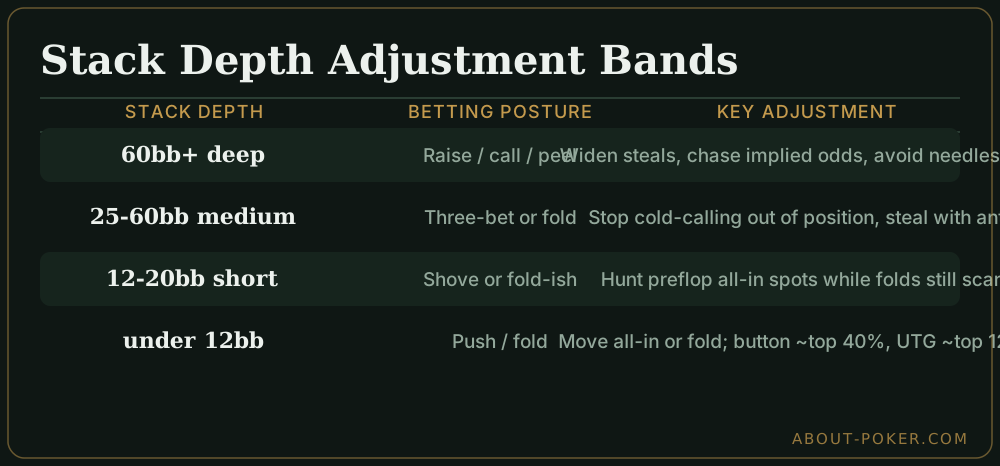
Deep stacks: 60+ big blinds
Early in an event, or any time you are chip leader, you will sit on 60 or more big blinds. This is the only depth where full postflop poker matters — implied odds are real, so speculative hands like suited connectors and small pairs go up in value because stacking someone is possible. Position becomes hugely important because you have room to maneuver on the turn and river.
Deep is not a license to gamble. A big stack’s edge is the ability to apply pressure without risking elimination, so you widen your stealing and three-betting but avoid flipping your whole stack for no reason. For the mechanics of using chips as a weapon, see playing a big stack.
Medium stacks: 25–60 big blinds
This is where most of a tournament is played and where the most mistakes happen. You still have fold equity and can raise-fold preflop, but you no longer have the depth to peel light and float flops. Three-bet or fold becomes your default response to raises rather than flat-calling out of position, because calling bloats a pot you cannot comfortably play to showdown.
Antes kick in during this band, sweetening every pot and making steals more profitable. Open a bit wider on the button, tighten up under the gun, and stop cold-calling raises out of position. The full framework is covered in playing a medium stack.
Short stacks: under 20 big blinds
Once you drop below 20 big blinds, postflop play mostly disappears. You are looking for spots to get all-in preflop while you still have enough chips that folding scares people. Under about 12 big blinds you enter pure push/fold — you either move all-in or fold, because raising to a non-all-in amount just commits you anyway while giving opponents information.
Push/fold ranges are well solved. From the button at 10 big blinds you can profitably shove roughly the top 40% of hands; from under the gun at a full table, closer to the top 12–15%. Memorizing these ranges is the highest-return study a tournament player can do.
A worked spot
You have 18,000 chips, blinds are 1,000/2,000 with a 2,000 big-blind ante. That is a 9-big-blind stack — squarely push/fold. It folds to you on the button and you hold A♠7♣.
At 100 big blinds, A7o is a marginal button open you might fold to a three-bet. At 9 big blinds it is a clear, profitable shove. With antes in the pot you are risking 9 to win about 4.5 before anyone acts, and you only need the two remaining players to fold often enough — or to be behind rarely enough when called — to show a profit. Against a typical small-blind and big-blind pair of ranges, A7o shoved from the button prints money. The exact same hand, same table, same opponents, is a fold if your stack were 40 big blinds and someone had already raised, because now you would be flipping or dominated far too often.
That is the whole lesson: the cards did not change, the depth did.
The one habit that ties it together
Before every hand, glance at the big blind and divide. Say your depth to yourself — “22 blinds,” “8 blinds” — and let that number, not the cards, pick your gear first. Cards refine the decision; depth sets the range. Players who skip this step keep playing 15 big blinds like it is 60, splashing chips into pots they cannot win, and bust well short of the money.
Frequently asked
What stack depth counts as 'short' in a tournament?
Most players call anything under 20 big blinds short, and under 10 big blinds is true push/fold territory where your main decision is whether to shove all-in or fold. Between 20 and 40 big blinds you still have room to raise and fold, but you can no longer play deep-stacked postflop poker.
Why does stack depth matter more in tournaments than cash games?
In a cash game you can rebuy to a full stack whenever you want, so you usually stay around 100 big blinds. In a tournament your stack constantly shifts relative to the rising blinds, forcing you to move through every depth from deep to short over the course of one event.
How do I measure my stack in big blinds?
Divide your chip count by the current big blind. If you have 24,000 chips and the big blind is 1,200, you have 20 big blinds. Many players also track 'M' (chips divided by the total blinds and antes), which captures how many orbits you can survive without playing a hand.