What Is a Reentry Tournament
A re-entry tournament lets you buy in again after busting during a set window. Learn how re-entries differ from rebuys and freezeouts, and how to play them.
On this page · 7 sections
A re-entry tournament is one where, if you bust, you are allowed to buy in again and take a brand-new seat with a fresh full stack — provided you do so within the re-entry window, which is almost always the late registration period. It sits between the classic freezeout (one entry, no reloads) and the rebuy (top up your existing seat), and it has become the dominant structure for large modern tournaments. This page explains how re-entries work, how they differ from rebuys and freezeouts, and how the format should change your strategy.
How a re-entry works
The mechanic is simple. You buy in and play. If you lose all your chips before late registration closes, you can pay the buy-in again and receive a completely new starting stack at a new (usually randomly assigned) seat. Each bullet is a fresh start, not a continuation of your old stack. Once the re-entry window closes, the event becomes a freezeout for everyone still in — bust after that and you are out for good.
The number of allowed bullets varies. “Single re-entry” gives you one extra shot. Some events cap it at two or three. “Unlimited re-entry” lets you fire as many bullets as you like until registration closes.
Re-entry versus rebuy versus freezeout
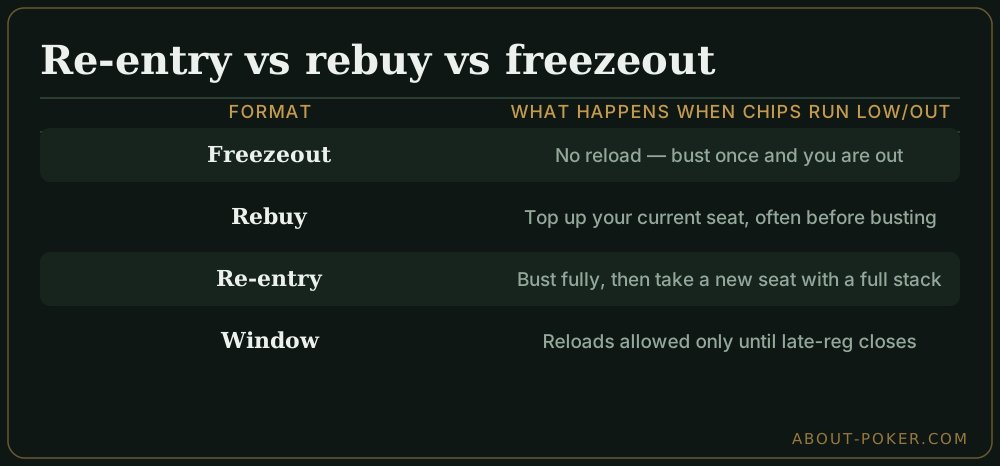
The three formats differ in exactly what happens when your chips run low or run out. The table below compares them across the details that matter most at the table.
The essential distinction: a rebuy tops up your current seat (often while you still have chips), a re-entry requires you to bust completely and then start over at a new seat, and a freezeout gives you a single life with no reloads at all. For a deeper tactical breakdown across both reload formats, see the rebuy and re-entry strategy guide.
Why operators love re-entries
Re-entries boost prize pools and turnout. Players who bust early can jump right back in, so a big field grows even bigger, and the guarantee is easier to hit. That is also why the format rewards well-bankrolled players: someone comfortable firing three bullets has more equity than someone who can only afford one, because they get more chances to build a stack while the field is still soft.
How re-entry changes your strategy
Because you can re-enter, the cost of busting early is not your tournament — it is one more buy-in. That justifies a slightly more aggressive, chip-accumulation-focused approach early, while the re-entry window is open. Taking a thin edge or a high-variance line to build a big stack is defensible when a bust just means firing another bullet.
The critical adjustment is that this only applies while re-entries are available. The moment the window closes, your remaining chips are precious and the event plays exactly like a freezeout — survival and ICM take over. Many players make the mistake of gambling recklessly after the window has shut, treating chips as if they were still replaceable.
A worked example
It is a $200 unlimited re-entry event, still in the first hour with re-entry open. You are 40 big blinds deep and get all-in preflop with A-K against a suited connector — roughly a 60/40 favorite. In a freezeout you might hesitate to stack off 40 blinds so light. In this re-entry, taking that flip to build a stack is fine: if you win you have a monster early; if you lose you simply fire again for $200. Now fast-forward to the same 60/40 flip after registration has closed and you are one of 300 players left. Here it is a genuine tournament-life decision governed by ICM and survival, and you should be far more selective. Same hand, opposite context.
Managing your bullets and bankroll
Fire your bullets with a plan. Decide before the event how many you are willing to shoot and stick to it — the format tempts tilted players into endless re-entries chasing a good start. Use late registration intelligently too: some winning players skip the early levels entirely and register late with one bullet, sacrificing accumulation time for a cleaner freezeout-style approach. Whatever you choose, budget the full cost of your intended bullets against your bankroll, not just a single buy-in.
Bottom line
A re-entry tournament lets you bust and buy in again with a fresh stack during the registration window, blending the extra lives of a rebuy with the clean-slate reset of a new seat. Play more aggressively while the window is open, tighten up the instant it closes, and always know how many bullets you can — and should — fire before you sit down.
Frequently asked
What is a re-entry tournament?
A re-entry tournament lets you buy in again with a fresh full stack after you bust, as long as you do so within the re-entry window (usually the late registration period). Each re-entry is a brand-new seat with a new starting stack, unlike a rebuy where you top up your existing seat.
What is the difference between re-entry and rebuy?
In a rebuy you add chips to your current seat, often only when your stack falls below a threshold, and you keep playing at the same table. In a re-entry you must first bust completely, then you take a brand-new seat with a full starting stack, typically drawn to a random table. Re-entries reset you; rebuys top you up.
How many times can you re-enter?
It depends on the event. Some are single re-entry (one extra bullet), some allow a fixed number, and some are unlimited within the registration window. Always check the structure sheet before you play so you know how many bullets you can fire.