What Is Overlay in Poker
Overlay is free money a site adds when a guaranteed prize pool exceeds the buy-ins collected. Learn how it works, how to spot it, and why it boosts your ROI.
On this page · 6 sections
Overlay is free money. It happens when a poker tournament advertises a guaranteed prize pool and not enough players buy in to cover it, forcing the operator to top up the difference out of its own pocket. When that happens, the players collectively win more than they paid in — a genuinely rare edge in a game where the house normally takes a cut of every entry. Learning to spot overlay is one of the few ways to earn positive expectation before a single card is dealt.
What overlay means
Most tournaments carry a guarantee: the site promises the prize pool will be at least a stated amount, say $10,000 guaranteed. The buy-ins collected are supposed to fund that pool. If enough players register, the pool grows past the guarantee and everything is normal. But if turnout falls short, the operator is contractually bound to pay the full $10,000 anyway. The gap between what players paid and what is actually paid out is the overlay.
A quick example. A $100 tournament with a $10,000 guarantee needs 100 buy-ins to fund the prize pool, ignoring rake. Suppose only 80 players enter. Those 80 contribute $8,000, but the site must pay out $10,000. The extra $2,000 is overlay, added free by the operator and split among finishers according to the payout structure. Every entrant is now competing for more money than the field collectively put in.
Why overlay is a real edge
In a normal tournament the rake makes poker a negative-sum game for the average player — the house skims 5 to 10 percent off the top, so the field as a whole loses that amount. Overlay flips the sign. When the added money exceeds the rake, the field is playing an overlaid, positive-sum event. The average entrant now has a positive expectation just by showing up, before any skill edge is applied.
Stack a skill advantage on top of that and the numbers get attractive. If a $100 event has $2,000 of overlay across 80 entrants, that is $25 of free equity per player before rake. A winning player who already beats the field adds their own edge on top. This is closely related to how freeroll tournaments work — both put money on the table that did not come from the players sitting in it — but overlay appears in ordinary paid events, which is what makes it easy to miss.
How to spot overlay
The key moment is when late registration closes, because that is when the final entrant count locks in and you can compare it against the guarantee. Watch the lobby. Most sites display both the current prize pool and the guarantee; when the guarantee stays fixed while the “prize pool” number lags behind, you are looking at overlay building in real time.
Do the arithmetic yourself: entrants times the buy-in (minus rake) versus the guaranteed number. Overlay shows up most often in a few predictable places. New operators launching aggressive guarantees to attract players frequently miss them. Off-peak schedules — weekday afternoons, holidays, or events that overlap a bigger tournament elsewhere — draw thin fields. And guarantees that were set too optimistically for the site’s traffic recur week after week. Because overlay depends on the final count, late registration strategy matters: you can wait, watch the numbers, and only fire when you confirm the overlay is real.
A worked example
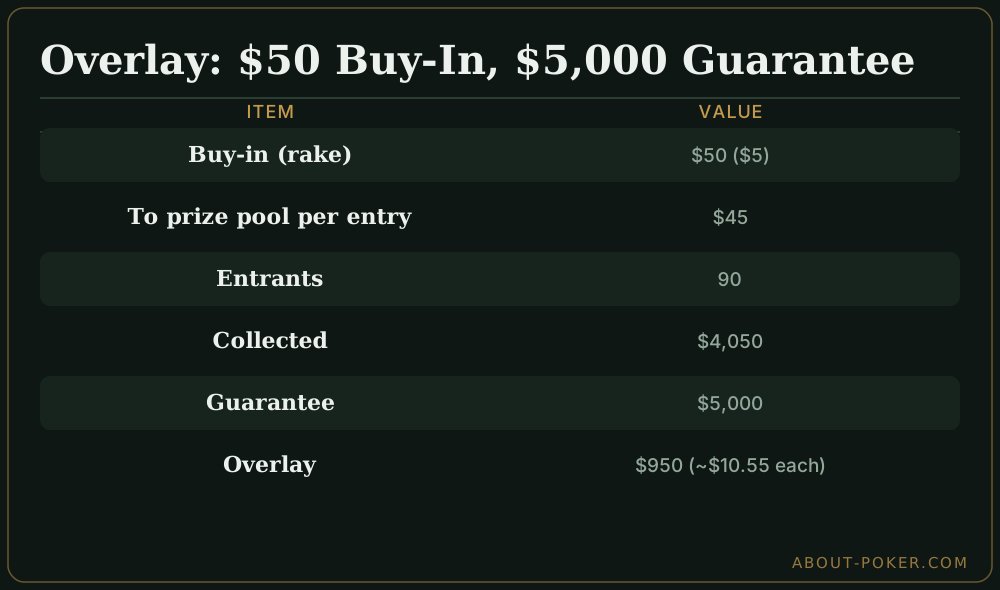
You are eyeing a Tuesday $50 buy-in with a $5,000 guarantee. Rake is $5 per entry, so $45 goes to the prize pool. To fund $5,000 the site needs about 112 players ($5,000 ÷ $45 ≈ 111.1). Late registration is about to close and the lobby shows 90 entrants.
Ninety players contribute 90 × $45 = $4,050 to the pool, but the site must pay the full $5,000. That is $950 of overlay. Spread across 90 entrants, that is roughly $10.55 of free equity each — more than 20 percent of your buy-in handed to you before the flop. If you are a break-even player normally, this event is now clearly profitable; if you are a winning player, it is a spot you should never skip.
Common mistakes and how to think about it
The first mistake is chasing overlay into games you are not rolled for or not good at. Overlay improves your equity, but it does not turn a tough field into an easy one or shrink the variance. Manage your tournament bankroll and variance exactly as you would without the overlay — the swings are identical, only the long-run math has shifted.
The second mistake is playing looser because “it’s free money.” Overlay is a reason to enter, not a reason to gamble. Your strategy inside the tournament should not change at all; the edge is captured simply by being registered. The third mistake is misreading the lobby — some sites show the guarantee in the prize-pool field even before it is funded, so always verify against the actual entrant count.
Quick checklist for overlay hunting
- Target guaranteed events on off-peak days and from newer operators.
- Watch the lobby as late registration approaches its close.
- Compute entrants × (buy-in − rake) and compare against the guarantee.
- If the guarantee is larger, the difference is overlay — enter.
- Do not loosen up: capture the edge just by playing your normal game.
- Stay within your bankroll; overlay changes expectation, not variance.
Frequently asked
What is overlay in poker?
Overlay is the extra money a poker site adds to a guaranteed tournament when the buy-ins collected fall short of the promised prize pool. The operator covers the gap out of its own pocket, so players collectively receive more than they paid in — a rare positive-expectation situation.
How do I find tournaments with overlay?
Watch the lobby as late registration closes. Compare the total buy-ins collected — entrants times the buy-in minus rake — against the guaranteed prize pool. If the guarantee is larger, the difference is overlay. Small guarantees on off-peak days and new operators tend to miss guarantees most often.
Does overlay guarantee I make money?
No. Overlay improves your expected value across all entrants, but any single tournament is high variance. You can still bust with zero return. Overlay tilts the long-run math in your favor; it does not remove the swings, so bankroll discipline still matters.