How Rare Is a Full House
A full house shows up in about 1 in 694 five-card hands, but in Hold'em you make one roughly 2.6% of the time by the river. The real numbers and how boats form.
On this page · 7 sections
The full house — a “boat” — sits near the top of the poker hand rankings, and its rarity is exactly why it wins so many big pots. But “how rare is a full house” has two very different answers depending on whether you mean a single five-card deal or a full seven-card Texas Hold’em hand. Let’s get both numbers straight and then look at how boats actually form at the table.
The five-card answer: about 1 in 694
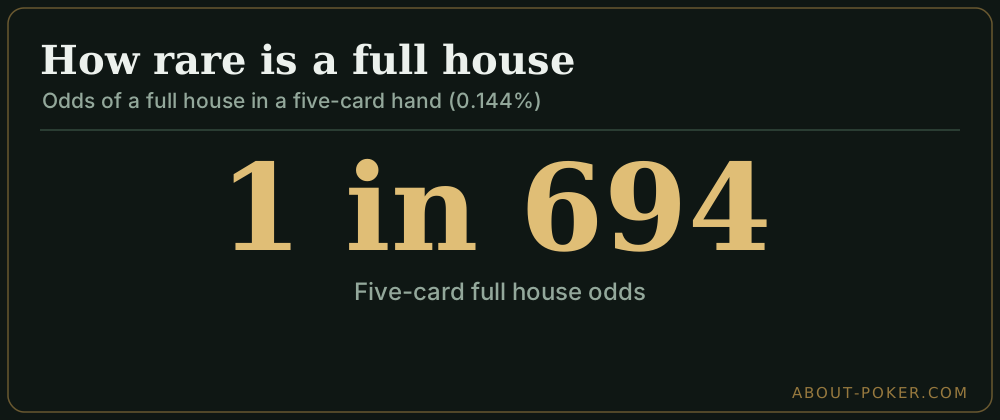
In a plain five-card poker hand, there are exactly 3,744 full houses out of 2,598,960 possible five-card combinations. That works out to about 0.144%, or roughly 1 in 694. Where does 3,744 come from? Choose the rank for your three-of-a-kind (13 ways), pick 3 of its 4 suits (4 ways), choose the rank for your pair (12 remaining ways), and pick 2 of its 4 suits (6 ways): 13 × 4 × 12 × 6 = 3,744.
That places the full house as the fourth-rarest hand, above flushes and straights but below quads, straight flushes, and the royal flush. For the full ranking table and each hand’s frequency, see probability of poker hands.
The Hold’em answer: about 2.6% by the river
Texas Hold’em gives you seven cards to make your best five, and that changes everything. With more cards in play, the odds of eventually holding a boat rise to roughly 2.6% by the river — about 1 in 38. Still uncommon, but dramatically more likely than the 1-in-694 five-card figure. This gap trips people up constantly: the boat feels achievable in Hold’em precisely because seven cards create so many more chances to pair the board on top of a made hand.
How boats actually form
Almost every full house in Hold’em is built one of three ways:
- Set fills up. You hold a pocket pair, flop a set, and the board pairs. A flopped set completes to a full house or quads about 33% of the time by the river — the single most common path to a boat.
- Two pair improves. You hold two pair and one of your pairs (or a board card matching them) trips up.
- Trips on a paired board. The board pairs and you hold a matching third card, then improve.
Worked example: a set filling up
You hold 8c 8d and the flop comes 8s Kh 4c. You’ve flopped a set of eights. Your boat outs are the case eight (1 card, making quads) plus any card that pairs the board — but let’s focus on the full house. To fill up you need the turn or river to pair the board: any king, four, or the runout pairing itself.
Counting cleanly, from the flop your chance to make a full house or better by the river is about 33%. That’s why a set is such a monster: you already have a strong made hand, and a third of the time it becomes nearly unbeatable. For the specific two-pair path, odds of improving two pair to a boat breaks down the smaller number of outs those hands have.
Why the rarity matters strategically
Because full houses are genuinely rare, they are usually the effective nuts — but not always. On a double-paired board (say K-K-4-4-9), a full house can be beaten by a bigger boat, and this is where players lose stacks. The danger spot is holding, for example, a four for the “boat” 4-4-4-K-K when an opponent holds a king for K-K-K-4-4. This is the same trap as set over set: a great hand that is second best.
Common mistakes
- Assuming any full house is the nuts. On paired boards, rank matters — the boat using the higher board card wins.
- Overpaying to draw at a boat. Two pair has only about four outs to fill up; chasing it against big bets is often a losing play.
- Slow-playing a vulnerable boat. On wet boards, a smaller full house should still bet to charge draws and protect against a bigger boat drawing out.
Quick checklist
- Five-card full house: about 0.144%, or 1 in 694 — the fourth-rarest hand.
- Hold’em full house by the river: about 2.6%, or 1 in 38 — much more common with seven cards.
- Sets are the main engine: a flopped set fills up roughly 33% of the time.
- On paired boards, always check whether a bigger boat is possible before committing your stack.
- Two pair has only about four outs to a boat — don’t overpay to chase it.
A full house is rare enough to win most pots it enters, but seasoned players know the exact spots where “just a boat” is a trap. Keep both frequency numbers in mind and read the board texture before you shove.
Frequently asked
How rare is a full house in a five-card hand?
In a straight five-card deal there are 3,744 ways to make a full house out of 2,598,960 total hands, which is about 0.144%, or roughly 1 in 694. That makes it the fourth-rarest hand ranking, beaten only by four of a kind, straight flushes, and royal flushes.
How often do you make a full house in Texas Hold'em?
Using all seven cards (two hole plus five community) you make a full house about 2.6% of the time by the river. Seven cards give many more combinations than five, so the boat is far more common in Hold'em than the raw five-card figure suggests.
What is the most common way to make a full house?
Flopping or turning a set and then pairing the board, or holding two pair and pairing one of them. A set has a strong chance to fill up by the river — about 33% from the flop — which is why sets are such powerful, well-disguised hands.