Odds of Improving Two Pair to a Boat
Two pair has just four outs to a full house — about 16.5% from the flop, 8.7% on the river. The exact math and why two pair is more vulnerable than it feels.
On this page · 8 sections
Two pair looks strong, and it usually is — but its ability to improve to a full house is one of the most overestimated numbers in poker. The reality is that two pair has only four outs to fill up, which makes it a made hand you protect, not a draw you chase. Here’s the exact math and how it should shape your play.
The core answer: four outs
When you hold two pair, only two ranks can improve you to a full house: each of your paired ranks can become three of a kind. For each pair, there are two remaining cards of that rank in the deck. So:
- Pair A → 2 outs to trips
- Pair B → 2 outs to trips
- Total: 4 outs to a full house.
That’s it. Two pair is not a big drawing hand; it’s a strong made hand with a small improvement chance. If counting outs is still shaky, poker outs covers the fundamentals.
The exact odds by the river
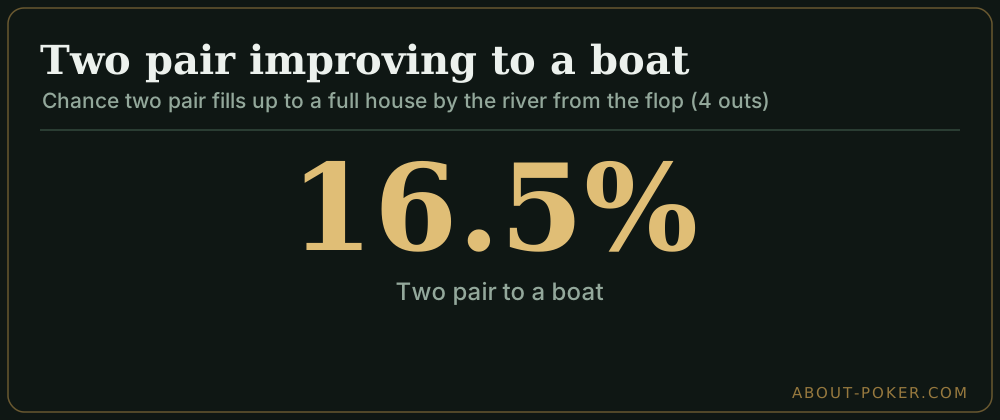
Using four outs:
- From the flop (two cards to come): about 16.5% — roughly 1 in 6.
- From the turn (one card to come): about 8.7% — 4 outs out of 46 unseen cards.
You can confirm the flop number with the rule of 4 and 2: 4 outs × 4 = 16%, essentially the exact 16.5%. On the turn, 4 × 2 = 8%, close to 8.7%.
Worked example
You hold Ah 9h and the flop comes Ac 9d 4s. You’ve flopped top two pair — a very strong hand. Your full house outs are the two remaining aces and the two remaining nines: four outs. From the flop you’ll fill up about 16.5% of the time by the river.
That’s a nice bonus, but it means roughly five times out of six your hand stays two pair. So your plan should not be “call and hope to boat.” Your plan is to bet two pair for value and protection right now, charging draws and worse made hands while you’re ahead. The full house is gravy that occasionally bails you out when a scary card arrives.
Why two pair feels stronger than it is
Two pair beats one pair and top pair, so it wins a lot of showdowns — that’s real. But it is vulnerable in three ways:
- Straights and flushes on coordinated boards can already be beating you.
- Sets have you crushed and share none of your outs.
- Board pairing against you. If the board pairs a card you don’t hold, an opponent with trips can make a bigger full house than yours — or you can make a boat and still lose to a bigger boat.
The fourth-street danger is real: on a board like A-9-4-9, your A9 makes a full house (nines full of aces), but someone holding a nine now has trips that could boat bigger, and someone with A4 or 44 could already be ahead. Understanding how boats form and rank is exactly the material in how rare is a full house.
How the four outs change your decisions
Because two pair has so few improvement outs, it behaves like a made hand, not a draw:
- Bet it. You want value from worse hands and to deny equity to draws that have more outs than your four.
- Don’t slow-play on wet boards. Draws that have you beat when they hit outnumber your improvement chances.
- Be cautious facing big raises. If a passive opponent suddenly raises big on a coordinated board, your two pair is often behind a set or straight, and four outs won’t save you often enough to call large bets.
Common mistakes
- Treating two pair as a draw to a boat. It’s a made hand with a small upside, not a chase.
- Overpaying to “fill up.” At 16.5% from the flop and 8.7% on the turn, calling big bets purely for the full house is a losing play.
- Ignoring board texture. Two pair on a straight- or flush-heavy board is far weaker than on a dry board.
Quick reference
| Situation | Outs | Chance to boat |
|---|---|---|
| Two pair, from flop (river to come) | 4 | 16.5% |
| Two pair, from turn (river only) | 4 | 8.7% |
| Set, from flop (for comparison) | 7+ | ~33% |
Checklist
- Two pair has exactly four outs to a full house — two per pair.
- From the flop you fill up about 16.5% of the time; on the turn about 8.7%.
- Play two pair as a made hand: bet for value and protection.
- On coordinated boards, respect that sets, straights, and flushes may already beat you.
- Never call large bets purely to chase the boat — the odds don’t support it without big implied odds.
Two pair wins plenty of pots on its own merits. Just don’t confuse it with a strong draw: with only four outs, the full house is a rare bonus, not a plan.
Frequently asked
How many outs does two pair have to make a full house?
Exactly four. Either of your two pairs can turn into three of a kind, and each pair has two remaining cards of that rank in the deck, so 2 plus 2 equals four outs to fill up.
What are the odds of two pair improving to a boat by the river?
With four outs and two cards to come from the flop, about 16.5%. If you have two pair on the turn with one card left, the chance drops to roughly 8.7%. So a flopped two pair fills up only about one time in six.
Should I chase two pair to a full house?
Rarely as a primary plan. Two pair is usually a made hand you want to bet for value and protection, not a draw. The four-out full house improvement is a bonus, not something worth calling large bets to chase, because the odds are low unless implied odds are excellent.