KK vs AQ: Preflop Odds & Equity
Pocket kings are about a 70% favorite over AQ all-in preflop — a big pair dominating two overcards. Here are the exact KK-vs-AQ equities and where AQ's outs.
On this page · 7 sections
You hold K♠ K♥ and get it in against A♣ Q♦. Unlike a small pair, kings aren’t in a coinflip — they’re a solid favorite at about 70%, with AQ winning roughly 30%. This is the big-pair-versus-overcards spot, and the gap between it and a true race comes down to how high the pair is.
The headline equity
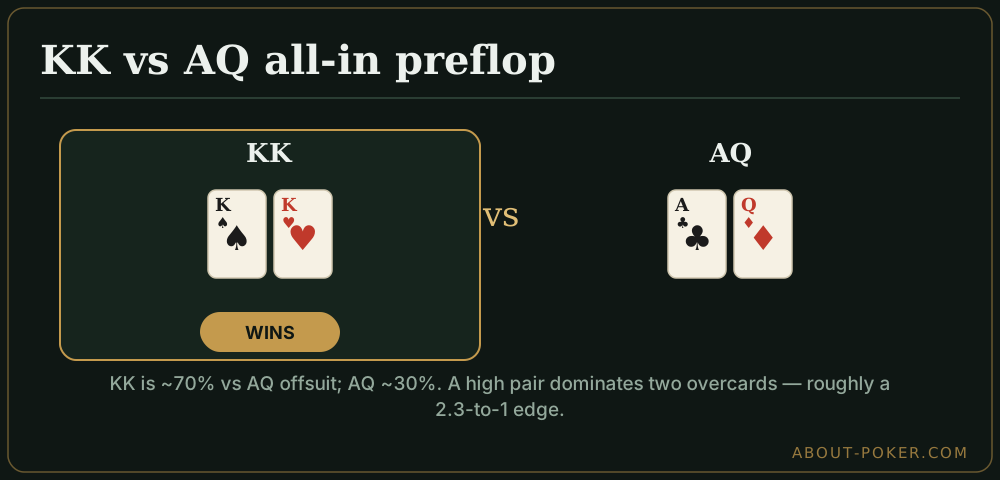
All-in preflop, pocket kings are about a 70% favorite over AQ offsuit, with AQ winning around 30%. Suited AQ picks up flush equity and climbs to roughly 32%, dropping the kings to about 68%.
| Matchup | KK equity | AQ equity |
|---|---|---|
| KK vs AQ offsuit | ~70% | ~30% |
| KK vs AQ suited | ~68% | ~32% |
The anchor: a big pair over two overcards runs about 70/30 — a comfortable favorite, roughly 2.3-to-1.
Where AQ’s 30% comes from
AQ starts behind with no pair and has to improve to win:
- Pair the ace or queen: three aces and three queens remain, giving AQ six clean outs to top pair. Catching one across five community cards is the core of its equity.
- Straights: AQ can complete broadway or catch part of a straight, adding a small slice.
- Flushes: only when AQ is suited — the source of its two-point suited bump.
But even when AQ pairs up, it must also dodge the kings making a set — with two kings live, KK flops a set about 11.8% of the time. Those competing chances net out to AQ’s ~30%. Counting live-but-contested outs like this is the skill behind the poker outs guide.
Why the higher pair matters
Compare this to 88 vs AQ, which is nearly a coinflip. Both spots are pair versus two overcards — so why is KK a 70/30 favorite while 88 is barely ahead? The difference is that eights can be beaten by any pair AQ makes plus higher cards on the board, while kings are only beaten when AQ actually pairs. The higher your pair, the fewer ways your opponent has to draw out, and the closer you get to true dominance. That relationship between pair rank and equity is a core lesson in equity.
A worked example
Effective stacks are 40 big blinds. You open K♠ K♥, an opponent three-bet jams A♣ Q♦, and you snap-call. You’re a 70% favorite for the pot.
If the pot is 82 big blinds after the shove, your call is hugely profitable: 70% of the time you scoop it, 30% of the time you lose. This is a spot you want every session — far better than a coinflip. Recognizing that a big pair against overcards is a 2.3-to-1 edge, not a 50/50 gamble, is exactly what the preflop all-in odds framework makes clear.
How the board changes the number
The 70/30 is the all-in-preflop figure with five cards to come, but the edge does not stay fixed as the board runs out. AQ needs to hit early to keep its chances alive. On the flop alone, AQ pairs the ace or queen a little over 20% of the time; when it misses the flop entirely and does not pick up a straight or flush draw, its equity with two cards to come collapses to only its remaining pair outs, roughly the low-to-mid teens. In other words, if you are the kings and the flop comes low and disconnected — say 8-5-2 rainbow — you are now closer to a 90% favorite, because AQ is down to six outs twice. The flops that scare KK are the ones that bring an ace or a queen, or a coordinated run of cards that gives AQ a straight draw to go with its overcards. That is why the money AQ makes in this matchup is almost entirely front-loaded onto the flop.
Playing both sides of the spot
Holding the kings, the practical lesson is simple: this is a get-it-in-and-be-happy spot preflop, and postflop you keep betting hard on any board that misses the ace and queen. You are protecting a big equity edge, and giving free cards to a hand with six outs is how favorites lose pots they should win. Do not slow-play kings on a dry board hoping AQ improves into a second-best hand — bet, deny equity, and take it down.
Holding AQ, respect what the 70/30 is telling you. Against a range that is only kings, you are throwing money in as a 2.3-to-1 underdog, and the discipline is to fold. The number flips in your favor only when the opponent’s shoving range is wide — full of AK, weaker aces, KQ, and outright bluffs — because then you are often flipping or ahead rather than dominated. Reading which range you actually face is the whole decision; the raw KK-versus-AQ equity is just the worst-case anchor. For neighboring matchups that sharpen this read, compare KK vs QQ and AK vs QQ.
The takeaway
KK versus AQ shows that “pair versus overcards” isn’t one number — it scales with how high your pair is. Kings dominate at about 70/30, while a small pair in the same shape is only a slim favorite. Lock in the anchor — KK is ~70% over AQ — and treat suited AQ as a couple points closer. Build the surrounding skills through equity, counting outs, and the poker odds & math hub.
Frequently asked
What are the odds of KK vs AQ preflop?
Pocket kings are roughly a 70% favorite over AQ all-in preflop when AQ is offsuit, with AQ winning about 30%. Suited AQ improves a couple of points. Kings are a clear favorite, not a coinflip.
Why isn't KK vs AQ a coinflip like 88 vs AQ?
Kings are a much higher pair, so AQ has to pair its ace or queen and hope kings don't make a set. A small pair like 88 can be outrun more easily because its outs and AQ's overlap less. The higher pair is simply harder to beat.
How many outs does AQ have against KK?
Six clean outs to pair up — three aces and three queens — plus straight and, if suited, flush chances. That's about 30% of equity, so AQ wins roughly three times in ten.
Should you get AQ all-in against a likely KK?
Against a known pair of kings, AQ is a 30% underdog and it's a clear fold in a vacuum. But against a wider shoving range that includes AK, worse aces, and bluffs, AQ can be a fine call. The 70/30 only applies once you know it's kings.