AK vs QQ: Preflop Odds & Equity
Ace-king vs pocket queens is a near coin flip — queens are a slight ~56/44 favorite preflop. Here are the exact equities and how the flip really works.
On this page · 7 sections
You get Q♠ Q♥ in, villain shows A♣ K♦, and the table calls it a flip. They’re close: this is a race, and the queens are the slim favorite at about 56/44. Ace-king has two overcards to chase, but a made pair that only needs to survive keeps the edge. The matchup lives or dies on one card: does ace-king pair up?
The headline equity
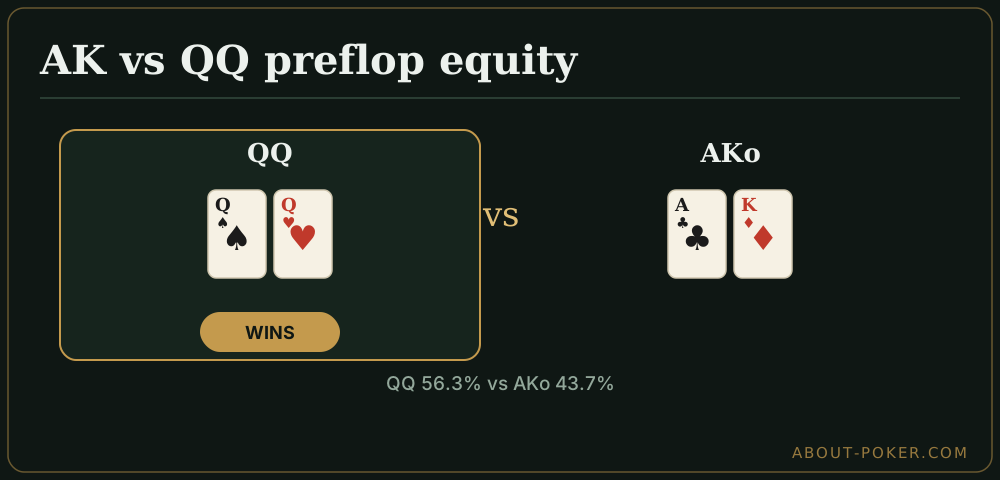
Every figure comes from a full board run cross-checked against a Monte Carlo simulation:
| Matchup | QQ equity | AK equity |
|---|---|---|
| QQ vs AKo (offsuit) | 56.3% | 43.7% |
| QQ vs AKs (suited) | ~54% | ~46% |
Queens win a little over half the time. Suited ace-king narrows it with flush outs, but the pair holds a slight edge in every version.
Why queens stay ahead
Queens are already a made pair; ace-king is not. To win, ace-king has to improve, and to lose, the queens just need the board to brick the big cards. That built-in lead is why a pair ranked below the ace is still favored over ace-king.
Count what ace-king is chasing:
- Pair an ace: three aces remain.
- Pair a king: three kings remain.
- That’s six overcard outs, plus straights and flushes.
Six outs across five board cards has ace-king pairing about half the time — close, but a hair short of overcoming the queens’ head start. The queens also flop a set about 11.8% of the time, which protects them on the exact boards where ace-king pairs.
A worked example
Money in for a 100 big blind pot: queens own about 56.3 big blinds of equity, ace-king about 43.7. Now watch a flop flip it.
Flop K♦ 8♠ 4♥: ace-king pairs top pair and jumps to about 87% — the queens are down to two remaining queens for a set, around 9%. Change the flop to 9♣ 6♦ 2♠, which misses ace-king entirely, and the queens climb to roughly 90% while ace-king has to catch one of six cards on the turn or river. That swing from an even preflop split to 87% one way or 90% the other, all on the flop, is exactly what a race looks like.
Fold equity is the real edge
At 56/44 nobody has a meaningful equity advantage, so the money comes from fold equity — the chance your opponent folds when you apply pressure. If you three-bet ace-king and villain folds a queens-or-worse portion of their range, you win the pot outright with zero showdown risk. When they don’t fold and you race, you’re only a 44% dog and still capturing dead money along the way. That combination is why aggression with ace-king is profitable even though the flip is against it. The fold equity page breaks the math down.
From equity to a decision
Because the flip is nearly even, the surrounding decisions matter more than the cards:
| Situation | Read | Line |
|---|---|---|
| You shove AK, called by QQ | ~44% | Slight dog, fine with fold equity |
| You call off with QQ vs AK | ~56% | Slight favorite; weigh stack depth |
| You three-bet AK, villain folds | — | Best outcome — win without showdown |
Range changes everything
The clean 56/44 number assumes you know the exact hands. At the table you almost never do, and that is what makes the queens comfortable. When you get QQ all in against a typical 4-bet or shove range, you are not facing AK alone — you are facing a bundle that also contains AA and KK (which crush you), AK (the near-flip above), and sometimes JJ or a bluff (which you crush). Blend those together and QQ is usually a solid favorite or at worst a small dog against the whole range, even though it is behind the two bigger pairs inside it. This is why “get queens in preflop” is a fine default: you are pricing in the flips and the dominations you win, not just the one matchup where you are slightly ahead. The mistake is folding queens because you are afraid of the AA/KK slice; against most ranges, that slice is too small to make folding correct.
Reading the flop as a race resolver
Because AK vs QQ hinges on one card, the flop tells you almost everything. If an ace or a king appears, ace-king vaults to roughly 87% and the queens are reduced to their two remaining set outs, about 9% — a near-total reversal. If the flop bricks with all low or middle cards, the queens jump toward 90% and ace-king is left drawing to six outs across two cards, roughly a 24% shot to catch up by the river. There is no comfortable middle ground the way there is in some matchups; the board either hits ace-king or it does not. Practically, that means when you hold ace-king and miss the flop against a likely pair, you should usually give up rather than barrel into a made hand you now trail 90/10 — save the aggression for the preflop fold equity, where your real edge lives.
Lock in the anchor — QQ is a ~56/44 favorite over AKo, ~54/46 vs AKs — and every queens-vs-ace-king spot becomes about the margins: fold equity when you apply pressure, pot odds when you call. The flip itself is nearly a wash. Turn that into a real line with preflop all-in odds, study the pressure side with fold equity, and work through the poker odds & math hub.
Frequently asked
What are the odds of AK vs QQ preflop?
Pocket queens win about 56% of the time against offsuit ace-king, with ace-king around 44%. Suited ace-king narrows it to roughly 54/46. It is a classic race with the pair slightly ahead.
Is QQ a favorite over AK?
Yes, but only slightly — about 56/44. Queens are a made pair that only needs to hold up, while ace-king must pair one of its two overcards to win most boards.
Why do people say AK vs QQ is a coin flip?
Because 56/44 is close enough to even that no one has a real edge. Ace-king pairs up roughly half the time, so the queens' made-hand advantage is thin. Players treat it as a flip in practice.
Should you get QQ all in against AK preflop?
As a favorite, getting queens in against a hand you know is ace-king is fine. In practice you rarely know, and against a range that also contains AA, KK, and worse, queens are usually a comfortable get-it-in.