Poker Probability Basics
The core probability ideas every poker player needs: counting hands, outs, odds versus percentages, and expected value — explained plainly with worked numbers.
On this page · 8 sections
Poker is a game of incomplete information, and probability is how you fill the gaps. You do not need advanced math — just a handful of ideas applied consistently: counting hands and outs, converting outs to odds, and comparing that to what the pot pays. Master these and you will out-decide most opponents at the table.
Counting the deck
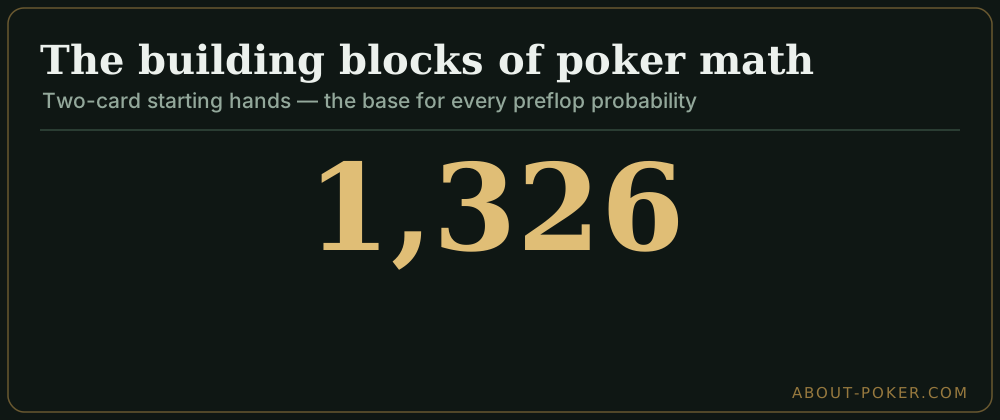
Everything starts with the deck’s fixed structure: 52 cards, and C(52,2) = 1,326 possible two-card starting hands. From that one number you can derive almost any preflop probability. A pocket pair, for instance, is 78 of those 1,326 combos, or 5.9%. A specific hand like ace-king suited is just 4 combos, about 0.3%. Learning to count combinations — the subject of our poker combinatorics guide — is the foundation everything else rests on.
Outs: the engine of postflop math
An “out” is any unseen card that improves you to the winning hand. After the flop, 47 cards are unseen. If you hold a flush draw you have 9 outs; an open-ended straight draw gives 8; a gutshot gives 4. The number of outs, divided by unseen cards, is your chance to hit on the next street:
P(hit next card) = outs ÷ unseen cards
A flush draw on the turn is 9 ÷ 47 = 19%. Simple division, and it drives nearly every drawing decision you will make.
The rule of 4 and 2
Dividing by 47 at the table is slow, so use the rule of 4 and 2. With two cards to come, multiply your outs by 4 for an approximate percentage; with one card to come, multiply by 2. A flush draw (9 outs) is about 36% by the river (9 × 4) or 18% on the turn (9 × 2). The true figures are 35% and 19%, so the shortcut is accurate enough for real decisions and takes a second.
Odds versus percentages
The same chance can be written two ways. A 20% chance is “4 to 1 against” — four losing outcomes for every winning one. To convert a probability p into odds against, compute (1 − p) ÷ p. So 25% becomes 0.75 ÷ 0.25 = 3, i.e. 3 to 1. This matters because bets are usually quoted as odds. When a pot lays you 3 to 1 and your draw is 4 to 1, you are being underpaid and should fold; if the pot lays 5 to 1, you have a profitable call.
A worked example
You hold a flush draw on the turn: 9 outs, about 19% (roughly 4.3 to 1 against) to hit the river. The pot is $80 and your opponent bets $20, so you call $20 to win $100 — that is 5 to 1. Compare: the pot pays 5 to 1, your draw needs only 4.3 to 1. Because you are getting a better price than your odds require, the call is profitable. Over many identical spots you win $100 nineteen percent of the time and lose $20 the rest — 0.19 × 100 − 0.81 × 20 = $2.80 average profit per call. That positive number is your edge, made visible.
Expected value ties it together
Expected value (EV) is the average outcome of a decision repeated many times. Multiply each result by its probability and sum: in the example above, EV = +$2.80. Every good poker decision is simply the option with the highest EV. Probability tells you the weights; EV tells you which choice to make. For turning these percentages into pot-odds calls at speed, see how to use pot odds.
Common mistakes
- Confusing odds and percentages. 4 to 1 is 20%, not 25%. Getting this backwards flips your decisions.
- Ignoring the second street. “35% by the river” only applies with two cards to come; once the turn is out you are on one-street math.
- Counting dirty outs. An out that also improves your opponent is not a clean out — discount it.
- Forgetting implied odds. Direct pot odds are only part of the picture; future betting can justify calls that look marginal.
Quick reference
- Starting hands: 1,326 combos.
- Any pocket pair: 5.9%.
- Outs to percentage (next card): outs ÷ 47.
- Rule of 4 and 2: ×4 (two cards), ×2 (one card).
- Odds from percent: (1 − p) ÷ p.
- Best decision = highest EV.
These six lines are the whole toolkit. Build fluency with them and the rest of poker math — combinatorics, pot odds, equity — becomes routine.
Frequently asked
What probability do I actually need to play poker well?
You need three things: how to count outs, how to turn outs into a percentage or odds, and how to compare that to the pot odds you are offered. Everything else builds on these.
What is the difference between odds and percentage?
They express the same thing. A 20% chance is 4 to 1 against (four ways to lose for every one way to win). To convert, odds against equal (1 − p) divided by p.
What is expected value in one sentence?
Expected value is the average result of a decision if you made it many times — you find it by multiplying each outcome by its probability and adding them up.