Pot Equity Explained for Beginners
Pot equity is your share of the pot right now — your chance to win if all cards were dealt. A beginner's guide to reading it, estimating it, and using it.
On this page · 7 sections
Pot equity is the single most useful number in poker, and it’s simpler than it sounds. It’s your share of the pot right now — the percentage of the time your hand would win if the hand were dealt all the way to showdown, many times over, from this exact spot. If you’re a 60% favorite, you have 60% pot equity. In a $100 pot, that’s $60 that’s “yours” on average. Learn to read this number and estimate it quickly, and most poker decisions start to answer themselves.
Equity as a slice of the pot
The word “equity” just means “your fair share.” Picture the pot as a pie. Your pot equity is the slice you’d win if you played this exact situation a thousand times and averaged the results.
Say the pot is $200 and you have 45% equity. Your slice is:
0.45 × $200 = $90
The remaining 55% — worth $110 — belongs to your opponent on average. Nobody actually splits the pot on a single hand; someone wins the whole $200. But across many identical spots, the money divides in proportion to equity. That long-run truth is what all poker math is built on, and it’s covered in more depth in our guide to what equity is in poker.
A worked example: flush draw on the flop
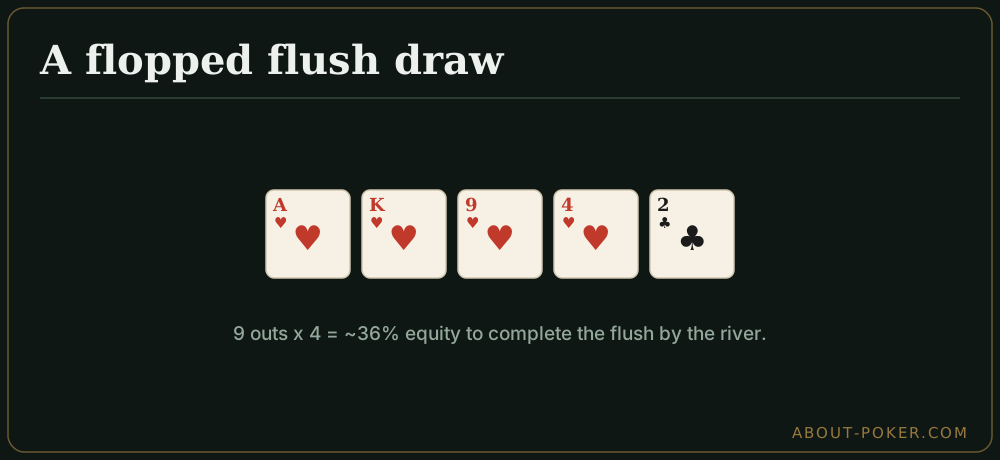
Here’s the situation every beginner should be able to read. You hold two hearts, and the flop brings two more hearts. You have a flush draw: any heart completes your flush.
Step one is to count your outs — the cards that make your hand. There are 13 hearts in the deck; you can see 4 of them (two in your hand, two on the board), leaving 9 hearts unseen. So you have 9 outs. (Learn to count these reliably with our guide to poker outs.)
Step two is to turn outs into equity with the rule of 4 and 2:
- On the flop, with two cards still to come, multiply outs by 4:
9 × 4 = 36%. - On the turn, with one card to come, multiply by 2:
9 × 2 = 18%.
So a bare flush draw on the flop has roughly 36% pot equity — you’ll complete it a little more than a third of the time by the river. That single estimate, done in your head in seconds, is the foundation of the decision you’re about to make. (The rule is a fast approximation; see the rule of 4 and 2 for its small margin of error.)
Turning equity into a decision
Equity alone doesn’t tell you to call — you compare it to the price the pot is charging you. That price is your pot odds.
Back to the flush draw. The pot is $100 and your opponent bets $50, making the pot $150. To call, you’re risking $50 to win $150. Your call needs to win often enough to justify the price:
$50 ÷ ($150 + $50) = $50 ÷ $200 = 25%
You need 25% equity to break even on the call. You have about 36% with your flush draw. Your equity comfortably beats the price, so calling is profitable. That comparison — your equity vs. the price — is the engine behind almost every call, bet, and fold in poker.
Why beginners should master equity first
- It’s universal. Equity applies preflop, on the flop, and everywhere else. AA vs. KK preflop is about 82% to 18% — that 82% is pure pot equity.
- It’s fast. With the rule of 4 and 2, you can estimate it at the table without a calculator.
- It anchors every other concept. Pot odds, expected value, fold equity, and implied odds all build on top of your basic equity read.
Start by getting comfortable counting outs and converting them to a percentage. Everything else in poker math grows from that habit.
Not all outs are worth the same
The rule of 4 and 2 assumes every out makes you the winner, and that is often not true. Two adjustments separate a beginner’s estimate from a realistic one.
Discount tainted outs. Some cards that “complete” your hand also complete a better hand for your opponent. If you are drawing to a straight but the card that fills it also puts a third flush card on the board, that out may win you the pot only to lose to a flush. Count those outs as half, or drop them entirely against a range that has the flush. A raw eight-out straight draw can be worth closer to six real outs on a wet board.
Add hidden equity. The reverse also happens. A flush draw that also holds two overcards can win by pairing an ace or king, not just by hitting a flush. Those extra pair outs lift your true equity above the flat 36% the flush draw alone suggests. The rule of 4 and 2 gives you the floor; your read on which extra cards also win tells you how far above it you really are.
The habit to build: estimate with the rule, then ask “which of these outs actually win, and are there outs I forgot to count?” That one question turns a mechanical number into a sound decision.
A second example: the flush draw goes cold
Take the same flush draw, but now the turn is a blank and your opponent bets big into you. On the turn you have one card to come, so your nine outs are worth about 9 × 2 = 18% equity. If the pot is $100 and the opponent bets $100, your price to call is $100 ÷ ($100 + $100 + $100) = 33%. Now your 18% equity is well short of the 33% the pot demands, so a pure call loses money. The draw that was a clear call on the flop is a clear fold on the turn against a big bet — same hand, same nine outs, but only one card left and a worse price. Reading that shift is exactly what pot equity trains you to do. When implied odds are strong — deep stacks and a hidden draw — you can sometimes continue anyway, but on raw pot equity alone this is a fold.
The bottom line
Pot equity is your share of the pot right now — how often your hand wins if all the cards come out. Count your outs, discount the tainted ones and add any hidden pair outs, apply the rule of 4 and 2 to get a percentage, and compare that percentage to the price the pot is charging you. When your equity beats the price, you keep playing. Master that one loop and you’re already thinking like a winning player. Go deeper with what equity is in poker and counting outs.
Frequently asked
What is pot equity in poker?
Pot equity is your share of the pot right now — the percentage of the time your hand would win if the hand were played to showdown from this exact spot, over many repetitions. If you're a 60% favorite, you have 60% pot equity, worth $60 of a $100 pot on average.
How do you calculate pot equity as a beginner?
The fastest way is to count your outs — the cards that improve you to the best hand — and use the rule of 4 and 2. Multiply your outs by 4 on the flop and by 2 on the turn to estimate your equity as a rough percentage.
What's the difference between pot equity and pot odds?
Pot equity is how often you win; pot odds are the price you're paying to keep playing. You compare the two: when your equity is higher than the price the pot is charging you, calling is profitable in the long run.