TT vs AK: Preflop Odds & Equity
Pocket tens are a slight favorite over ace-king preflop — about 57% vs offsuit AK and 54% vs suited. Here are the exact equities and why it's a coinflip.
On this page · 7 sections
You raise T♠ T♥, get shoved on, and villain tables A♣ K♦. This is the hand every player has flipped a hundred times, and the popular wisdom is right: it’s a coinflip. But it’s not a dead-even flip. The pair is ahead. The exact numbers are ~57% for TT vs offsuit AK and ~54% for TT vs suited AK — small edges, but real ones that add up over a career of getting it in.
The headline equities
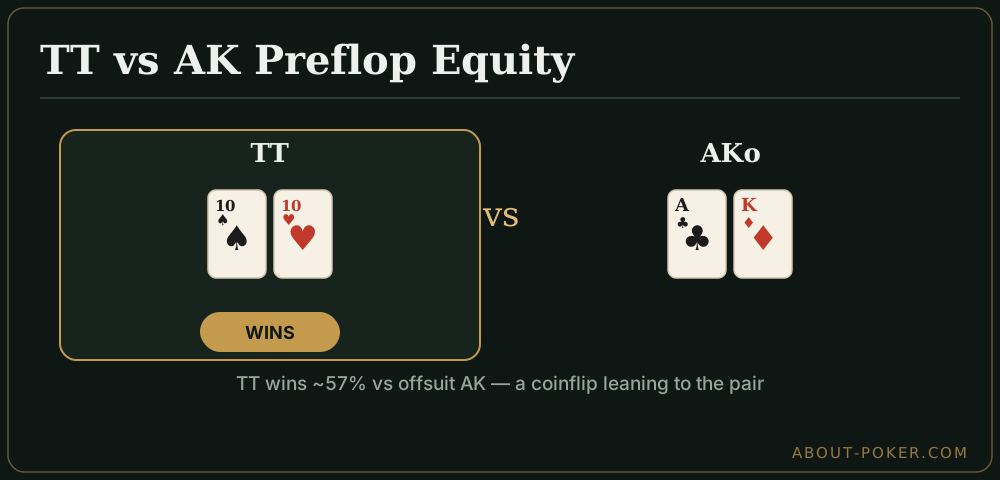
Every figure below comes from running the matchup across all possible five-card boards and cross-checking with a Monte Carlo simulation:
| Matchup | TT equity | AK equity |
|---|---|---|
| TT vs AKo (offsuit) | 57.0% | 43.0% |
| TT vs AKs (suited) | 54.3% | 45.7% |
| TT vs AK (mixed avg) | ~56% | ~44% |
Against offsuit ace-king you win a little better than four times in seven. Against suited, the gap narrows but you’re still the favorite. Nothing here is close to the 80/20 blowouts you get when a pair runs into a dominated holding — this is a genuine flip that just happens to lean your way.
Why the pair is ahead
Pocket tens have a made hand right now; ace-king has nothing but potential. For AK to win, it usually has to pair up. Count what it’s actually drawing to:
- Pair the ace: three aces live.
- Pair the king: three kings live.
- That’s six clean overcard outs, hit across five board cards.
Six outs twice over five streets sounds like a lot, and it is — it gets AK to roughly 43–46%. But “usually has to improve” is the key phrase. If the board bricks out with low and middle cards, the tens simply hold. The pair wins by default whenever ace-king misses, and ace-king misses more often than beginners expect. The same made-hand-versus-overcards logic drives KK vs AK, except there the pair is so far ahead it becomes a 70/30 favorite instead of a flip.
The suited premium is flushes
Suited ace-king does about three points better than the offsuit version, and every bit of that comes from flush outs. A♠ K♠ can back into a spade flush that A♠ K♥ never makes. Those extra runner-runner and four-flush run-outs are the entire reason the matchup shifts from 57/43 to 54/46. The aces, kings, and straight chances are identical between the two versions — only the flush changes.
A worked example: 100 flips
Suppose you get TT all in against a random AK exactly 100 times for 20 big blinds each, and treat it as the 57% offsuit case with no dead money.
- You win 57 pots of 40bb each (your 20 plus villain’s 20) = 57 × 20bb net profit = +1,140bb.
- You lose 43 pots of 20bb each = −860bb.
- Net: +280bb over 100 flips, or about +2.8bb per flip.
That’s the whole point of understanding equity: a “coinflip” that’s really 57/43 prints money when you take it repeatedly. Turning that equity into a call-or-fold decision is exactly what the preflop all-in odds page covers, and the underlying idea is unpacked on what is equity.
The range problem
The trap with TT is assuming villain always has AK. Against a raiser’s full shoving range, your tens face a mix — and the hands that hurt are the bigger pairs. TT crushes AQ, AJ, and lower pairs, flips with AK, but is an 81/19 dog to any of JJ, QQ, KK, or AA.
So the real question is never “how do I do against AK” — it’s “how much of villain’s range is JJ+ versus everything I beat or flip with.” Against a wide, aggressive shove full of AK, AQ, and small pairs, tens are a comfortable call. Against a tight nit who only jams the top of his range, the JJ+ combos pile up and tens quietly become marginal.
Playing the flop when you get called instead
Not every TT-vs-AK confrontation is an all-in. Often you 3-bet or call preflop and see a flop, and now the equity story becomes a board story. AK flops a pair of aces or kings about one time in three (roughly 32% to hit at least one of its six outs on the flop). That single number should shape how you play tens on the flop:
- Low, disconnected flop (say 8-5-2): your tens are almost certainly best. AK has whiffed two-thirds of the time, so you can bet for value and protection. If AK barrels, you usually have a comfortable call because their range is heavy with air.
- Ace or king high flop: this is the danger board. When AK is in villain’s range and an ace or king flops, your overpair-that-isn’t collapses to a one-pair bluff-catcher. Slow down, control the pot, and be willing to fold to sustained pressure.
- Broadway or coordinated flop (Q-J-9): AK now has both overcards and straight equity, narrowing your edge. Proceed cautiously.
The lesson: preflop tens are a favorite, but a favorite that hates ace-high and king-high flops. Knowing AK connects about a third of the time tells you two-thirds of flops are good news for the tens.
Common mistakes and edge cases
- Assuming it’s a dead-even flip. Beginners round TT vs AK to 50/50 and pass up a real 7-point edge over offsuit AK. The pair is favored — take the flip when the money’s right.
- Forgetting the suited discount. If you can see villain has AKs (or their range skews suited), shave your edge from 57% to about 54%. It rarely changes the decision, but it’s the honest number.
- Ignoring dead cards. If an ace or king already folded from another hand, AK has fewer outs and TT’s edge grows. Card removal matters in real spots even though the headline numbers assume a fresh deck.
- Over-flatting instead of shoving. Because TT plays awkwardly on ace and king high flops, jamming preflop against a shove often realizes your equity better than calling to navigate a tough board out of position.
Lock in the two anchors — 57% vs AKo, 54% vs AKs — remember the pair is favored, and then let villain’s range tell you whether to snap it off. Build the surrounding skills through equity, the preflop all-in odds guide, and the poker odds & math hub.
Frequently asked
What are the odds of TT vs AK preflop?
Pocket tens are a small favorite: about 57% against offsuit ace-king and about 54% against suited ace-king. It's the classic pair-versus-two-overcards coinflip, tilted slightly toward the pair.
Why is TT vs AK called a coinflip?
Both hands win close to half the time. The pair is made now but AK has two live overcards plus straight and flush chances, so their equities land near 50/50 — usually stated as roughly 55/45 in the pair's favor.
Does it matter if the ace-king is suited?
Yes, a little. Suited AK picks up extra flush outs worth about three points of equity, moving the matchup from about 57/43 (offsuit) to about 54/46 (suited). The pair is still ahead either way.
Should I get all in with TT against AK?
In most preflop all-in spots, yes. As a slight favorite you profit whenever you have any pot odds edge or fold equity. The bigger question is whether villain's range also contains bigger pairs like JJ+ that dominate you.