PLO Wrap Draws
A wrap is the monster straight draw that makes PLO explosive. Learn how to count wrap outs, which wraps are favorites over a set, and how to play them aggressively.
On this page · 7 sections
The wrap is the hand that defines Pot-Limit Omaha. In Hold’em the best straight draw you can flop is eight outs. In PLO, four hole cards let you wrap around the board and flop draws of 13, 17, or even 20 outs, big enough to make you a favorite over a made set. Understanding wraps, how to count them, and how to play them aggressively is one of the highest-leverage skills in the game.
What a wrap actually is
A wrap happens when two or more of your hole cards surround board cards so that many different ranks complete a straight. Instead of needing one specific card at each end like an open-ender, you have cards filling gaps above and below the board, and any of a long list of ranks makes your straight. The more of your cards that connect around the board, the more outs you have. For the fundamentals, start with what is a wrap in PLO.
Counting wrap outs
The key wrap sizes are worth memorizing. A 13-card wrap hits a straight about 48 percent of the time by the river. A 17-card wrap hits around 60 percent. A 20-card wrap, the maximum, hits roughly 70 percent of the time from flop to river. Compare that to an eight-out open-ender in Hold’em, which hits only about 31 percent. This is why wraps are so powerful: even the smaller ones are big favorites to improve, and the biggest ones are favorites over made hands.
A worked example
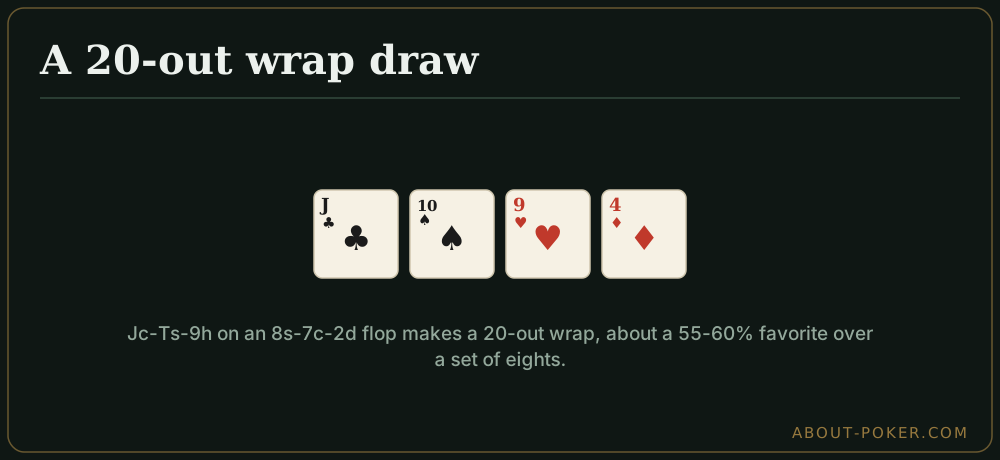
You hold Jc Ts 9h 4d and the flop comes 8s 7c 2d. Count your straight outs. Any 6 makes 6-7-8-9-10, any 10 makes a higher straight, any 9 makes a straight, any J makes a straight, and a 5 completes with your existing cards. Working through the ranks, you have a 20-out wrap. Against a flopped set of eights you are actually the favorite, holding roughly 55 to 60 percent equity because you complete a straight about 70 percent of the time and only lose when the board pairs and gives them a full house.
That is the whole point: this is a hand you want to play fast, potting or raising, because you either have the equity lead outright or a hand strong enough to get maximum value when you hit and fold equity when you miss.
Playing wraps aggressively
Big wraps play best with aggression. Because you often hold more equity than the made hands you face, betting and raising both builds the pot for when you complete and denies your opponent the ability to realize their hand cheaply. Semi-bluffing a 17 to 20 out wrap is one of the most profitable plays in PLO. With smaller 9 to 13 out wraps you calibrate to price, position, and whether you also hold a flush draw. The general framework lives in playing PLO draws.
When to slow down
Not every wrap is a monster. A wrap that draws to the ignorant end, meaning the low end of the straight, can complete into a bigger straight for an opponent and cost you a stack. A wrap on a monotone or paired board is dangerous because a flush or full house can be out already even when you hit. And a small wrap out of position facing heavy multiway action may not have the equity to justify a big pot. The details of good versus bad wraps are covered in wraps explained.
Common mistakes
The first leak is undervaluing wraps and just calling with a hand that should be raising for value and fold equity. The second is the opposite: stacking off with a small or dominated wrap that is drawing to the wrong end of the straight. The third is forgetting to reassess when the board pairs or brings a flush, at which point even a completed straight may be no good.
Quick checklist for wraps
Count your outs first: is this a 9, 13, 17, or 20 card wrap? Are you drawing to the nut end of the straight or the ignorant end? Do you also have a flush draw for extra equity and blockers? What is the board texture, and is a bigger draw or made hand likely out there? A big nut wrap heads-up is a hand to play as fast as you can. A small dominated wrap out of position multiway is one to play cheaply or fold. Master the count, and wraps become the most reliable source of aggression and profit in PLO.
Frequently asked
What is a wrap draw in PLO?
A wrap is a straight draw that uses two or more of your hole cards to wrap around board cards, giving you far more outs than a simple open-ended draw. The biggest wraps have up to 20 straight outs, which can make them a favorite even against a flopped set.
How many outs does a wrap have?
It depends on the exact cards, but wraps commonly have 13, 17, or 20 straight outs. A 20-out wrap, such as holding J-T-9 on an 8-7-x board, hits a straight roughly 70 percent of the time by the river and is a favorite over most made hands.
Is a wrap better than a set in PLO?
Often yes. A big 17 to 20 out wrap is frequently a favorite over a flopped set, especially if it also holds a flush draw. This is why sets in PLO must bet for protection rather than slow-play, and why aggressive wrap play is so profitable.