Avoiding Online Poker Tilt
A practical system for avoiding online poker tilt: spotting your triggers early, a hard stop-loss, a between-hands reset, and how to quit before variance costs you.
On this page · 7 sections
Tilt is the most expensive leak in poker because it doesn’t cost you one bad decision — it costs you a string of them, fired off faster than you can catch yourself. Online, where you can play a hand every fifteen seconds across several tables, a single cooler can metastasize into a lost session in minutes. Avoiding tilt isn’t about being calm by nature. It’s about building a system that catches you before the calm runs out.
Tilt is a decision problem, not a mood
The useful way to think about tilt: it’s the gap between how well you know how to play and how well you’re actually playing. That gap opens when emotion hijacks judgment. You don’t need to eliminate the emotion — you need to stop it from reaching your mouse. Everything below is about inserting friction between feeling frustrated and acting frustrated, because variance guarantees the frustration will come; your only job is to keep it from touching your decisions.
Know your triggers before you sit
Tilt has fingerprints. Most players’ triggers fall into a few buckets:
- Bad beats — losing a big pot as a favorite.
- Coolers — set over set, aces cracked, second-nuts vs nuts.
- Bad play — beating yourself, then punishing yourself further.
- Running bad — a long stretch with no traction.
- Specific opponents — the one regular who always seems to get you.
Name yours. The player who knows “I tilt when a fish sucks out on me” can catch the feeling the instant it starts. The player who thinks they don’t tilt is the one who plays three buy-ins deep before noticing.
The stop-loss is your seatbelt
The single most valuable habit is a hard stop-loss: a fixed number of buy-ins you’ll lose before you quit, decided before you sit down, when you’re calm and rational. Three buy-ins is a reasonable line for most cash players. The power of the stop-loss is that it removes the decision from the moment you’re least equipped to make it. When you’re down three and every fiber wants to reload and get it back, you don’t deliberate — the rule already decided. Write it on a sticky note if you have to.
A worked example
You sit down with 100 big blinds at a cash game and your stop-loss is three buy-ins. Early on you get it in with Ks Kh against As Ah — you’re a roughly 82% underdog and, correctly, you lose; nothing wrong with the play. An hour later you flop a set, get stacked by a runner-runner flush, and you’re down two buy-ins. Here is the moment. You feel it: the tightness, the urge to open wider, to bluff the next fish into oblivion. This is where the system earns its keep. You take the between-hands reset (below). If you’re still steaming, you’re one buy-in from your stop, so you sit out and quit — down three, not down eight. The player without a stop-loss is the one who wakes up tomorrow having lost a week’s win rate in one night.
The between-hands reset
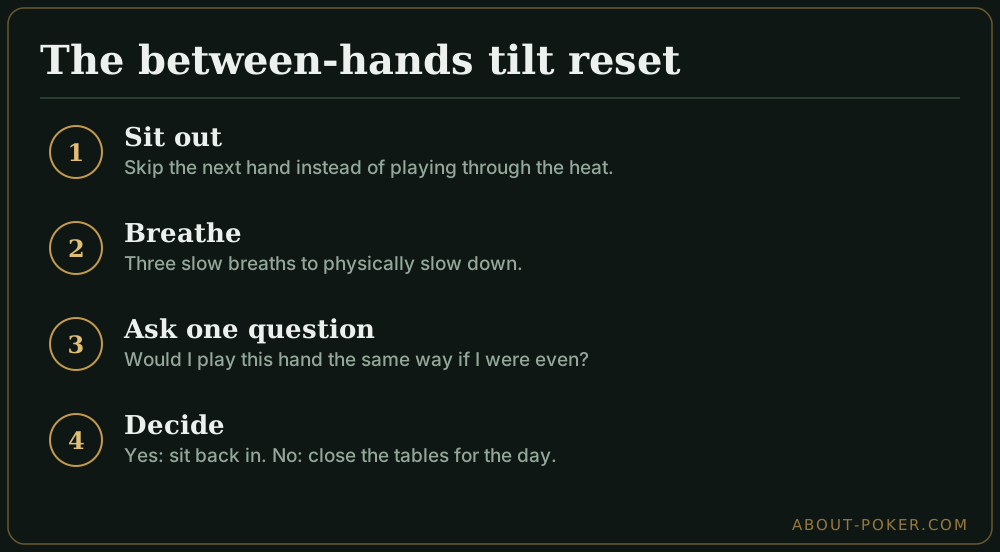
Online you don’t get a natural pause, so build one. When you feel a trigger fire:
- Sit out of the next hand — don’t play through the heat.
- Take three slow breaths. Physically slow down.
- Ask one question: “Am I about to play the next hand the way I’d play it if I were even?”
- If yes, sit back in. If no, quit for the day.
That’s it. Four steps, thirty seconds. It works because it forces the conscious brain back online before the reflexive, tilted brain acts. If you want a structured version, a paced breathing routine does the same job.
Reduce the surface area for tilt
You can also make tilt less likely in the first place:
- Play fewer tables when fragile. More tables, more beats per hour.
- Play within your bankroll. Money you can’t afford to lose amplifies every swing.
- Separate results from decisions. Judge sessions by whether you played well, not whether you won — this is the core of staying focused.
- Session, don’t marathon. Quit while sharp; fatigue and tilt feed each other.
When a break isn’t enough
Learn the difference between frustration and a spiral. A break — stand up, water, a walk — resets mild frustration. But if you’re deep in it, if you’re playing to get even rather than to play well, no break fixes that. The only move is to close the tables for the day. There’s no shame in it; quitting a tilted session is one of the most profitable decisions in poker. The tables will be there tomorrow, and so will your bankroll if you protect it now.
Frequently asked
What is tilt in online poker?
Tilt is playing worse than you know how to play because of emotion — usually frustration after losing pots you should have won. Online it's especially dangerous because the fast pace lets you fire off dozens of bad decisions in minutes, turning one bad beat into a losing session.
How do I set a stop-loss?
Pick a fixed number of buy-ins you're willing to lose in one session before you quit — three buy-ins is a common, conservative choice. Write it down before you sit, and treat hitting it as a non-negotiable stop, not a suggestion. The point is to remove the decision from the moment you're least able to make it well.
Is a short break enough to fix tilt?
A break helps reset mild frustration, but if you're deeply tilted the only reliable fix is to stop playing for the day. Standing up, breathing, and drinking water can pull you back from the edge; it can't undo a genuine emotional spiral. Know which one you're in.
Does multi-tabling make tilt worse?
It can, because more tables mean more bad beats per hour and less time to process each one. If you tilt easily, drop to fewer tables until your emotional control is solid, then add tables back one at a time.