Playing Your First Mixed Game
Playing your first mixed game: what to expect, how the rotation works, which round to fear least, and the beginner mistakes that quietly cost you chips.
On this page · 6 sections
Your first mixed game feels like sitting down at five different tables that keep swapping under you. One orbit you are playing Hold’em, the next it is Razz, and somewhere in there you are being asked to make the worst five-card hand on purpose. It is disorienting — but it is also one of the most beatable environments in poker, because most of the people at the table are only truly comfortable in one or two of the games.
This guide walks you through what to expect and the handful of adjustments that keep you from bleeding chips while you learn.
Start with a fixed-limit mix
For your very first session, pick a fixed-limit mix — HORSE is the classic choice. Because every game is capped-limit, you can never lose more than a few big bets in a single hand, no matter how badly you misplay it. That safety net is the whole reason HORSE is the standard beginner mix. Read the HORSE poker rules once end-to-end before you sit, so the running order (Hold’em, Omaha hi-lo, Razz, Stud, Stud hi-lo) is not a surprise.
Avoid big-bet mixes (pot-limit or no-limit rounds) until you have real reps. A single mistake in a no-limit round can cost your whole stack; the same mistake in fixed-limit costs one bet.
What actually changes when the game rotates
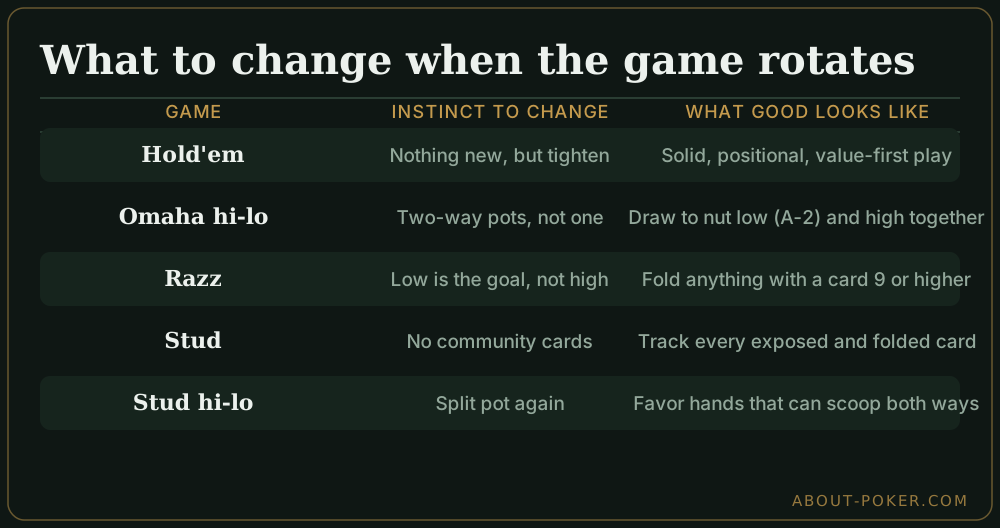
The game switches at a set point — usually once per orbit. Only the variant changes; the button and posting keep moving hand-by-hand as normal. The big mental shift is that your instincts have to change with the game.
| Game | The instinct to change | What good looks like |
|---|---|---|
| Hold’em | Nothing new — but tighten, limit rewards value | Play solid, positional poker |
| Omaha hi-lo | Two-way pots, not one | Draw to the nut low (A-2) and high together |
| Razz | Low is the goal, not high | Fold anything with a card 9 or higher |
| Stud | No community cards | Track every exposed and folded card |
| Stud hi-lo | Split pot again | Favor hands that can scoop both ways |
For the full timing edge on when to switch gears, see mixed game rotation tips.
The one game beginners fear most
Razz — where the lowest hand wins — is where Hold’em players leak the most, and it is also the fastest to fix. In Razz, an ace is a low card (great), and pairs are bad. The classic beginner error is playing hands with a high card, hoping to “improve,” when improvement in Razz means catching more low cards.
Worked example: you are dealt (Ad 3s) 5c in Razz. That is a beautiful start — three unpaired cards, all 5 or lower, headed toward a strong low. Now compare (Kh 4d) 6s. The king is dead weight; you already need to catch three more low cards just to beat a made 8-low. Fold the king hand and raise the A-3-5. Learning to muck high cards on third street is the single biggest improvement most beginners make. The Razz strategy basics guide drills this until folding kings becomes automatic.
You don’t have to be great at everything
Here is the freeing truth: mixed-game profit comes from having no glaring weakness, not from being a genius in any one round. If you play clean, disciplined poker in all five games while opponents spew in the two or three they never studied, you win. A tight, correct fold in Razz beats a fancy play in Hold’em.
So your first goal is not to master Omaha hi-lo — it is to stop making obvious errors: no chasing non-nut lows, no playing high cards in Razz, no forgetting there are no community cards in the stud rounds.
Beginner mistakes to avoid
- Same range every game. Your Hold’em opening range is meaningless in Razz or Omaha hi-lo. Adjust every round.
- Playing high cards in Razz. If your down cards include a 9 or higher, you are usually already behind.
- Chasing one-way lows in the split games. A weak low that does not make the nuts loses to a better low and wins nothing high.
- Forgetting stud has no board. In Stud and Stud hi-lo there are no community cards — read the exposed cards instead.
- Playing scared. Fixed-limit caps your loss; do not fold every hand. Play your good starts firmly.
Your first-session checklist
- Choose a fixed-limit mix (HORSE) so mistakes stay cheap.
- Learn the rotation order before you sit.
- Tighten hardest in the games you know least.
- In Razz, fold anything with a card 9 or higher.
- In the two split games, aim to scoop, not just split.
- Watch which round each opponent gets uncomfortable in — that is your profit.
Play your first mixed game to learn, not to crush. Keep the buy-in small, focus on clean folds over hero plays, and treat every unfamiliar round as a cheap lesson. Within a few sessions the rotation stops feeling like chaos and starts feeling like a rolling series of edges.
Frequently asked
What is the easiest mixed game to start with?
HORSE is the standard on-ramp because all five games are fixed-limit, so you can never lose more than a few big bets in one hand. That betting cap makes early mistakes cheap and turns your first sessions into affordable lessons rather than stack-ending disasters.
Do I need to be good at all the games to play a mixed game?
No. You need to play solid, near-mistake-free poker and avoid glaring leaks. Most beginners profit simply by folding correctly in the games they know least while opponents keep splashing chips in rounds they never studied.
What is the most common beginner mistake in mixed games?
Playing every game with the same instincts you use in Hold'em — especially playing high cards in Razz, chasing non-nut lows in the hi-lo split games, and forgetting that stud games have no community cards. Adjusting your ranges per game fixes most early leaks.