Half-Pot Bet Strategy
The half-pot bet is poker's Swiss-army sizing. Learn what a 50%-pot bet accomplishes, the fold equity and pot odds it creates, and when to reach for it.
On this page · 6 sections
The half-pot bet is the size most players reach for when they’re not sure what else to do — and that instinct isn’t wrong. A 50%-pot bet is a balanced, flexible tool that does a little of everything: it applies real pressure, gets value from medium hands, and doesn’t over-commit the stack. But “does a little of everything” is also its weakness. Understanding exactly what a half-pot bet accomplishes lets you use it on purpose instead of by default.
What a Half-Pot Bet Actually Does
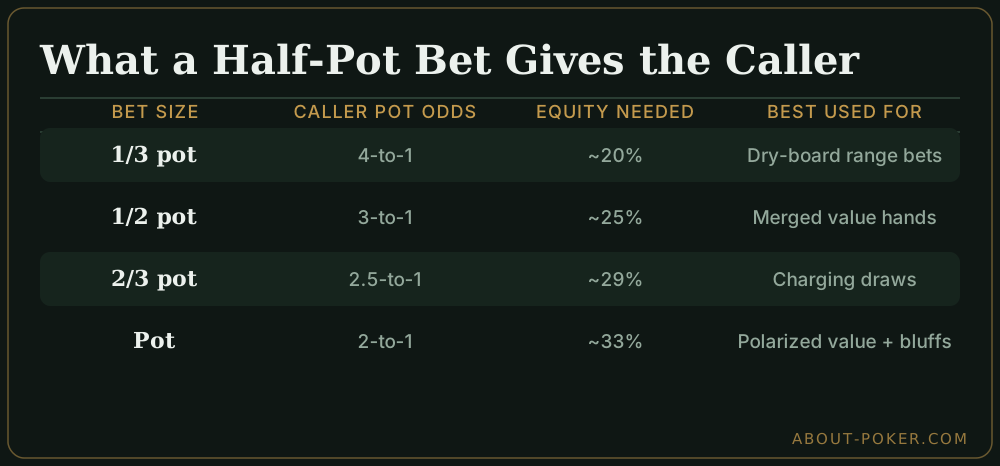
A half-pot bet risks 50% of the pot to win it. As a bluff, the pure risk-reward means it needs to succeed just over one-third of the time to break even: you risk half a pot to win a whole pot, so the breakeven fold frequency is 0.5 ÷ (1 + 0.5) ≈ 33%. That’s a modest ask — most bluffs clear it comfortably.
On the calling side, a half-pot bet lays your opponent 3-to-1 pot odds. They risk half the pot to win the pot plus your bet (1.5 pots), so they need about 25% equity to continue. That’s the number to memorize: half-pot = caller needs 25%. It’s enough pressure to fold out true air but cheap enough that draws and second pairs will often stick around.
The Value-Betting Sweet Spot
Where half-pot genuinely excels is as a merged value bet. When you hold a strong-but-not-nutted hand — top pair good kicker, an overpair on a slightly wet board — you want a size that gets called by worse. A pot-sized bet might blow those worse hands off the pot; a tiny bet leaves money on the table. Half-pot threads the needle, keeping second pairs and weak top pairs in while still building the pot. This is the core idea behind value betting: size to the hands you beat, not to the hands that beat you.
A Worked Example
You raise from the button with A-J offsuit and the big blind calls. The flop comes A-8-4 rainbow, a dry board where you’re clearly ahead of the calling range. The pot is $60. You could range-bet small, but A-J wants a bit more from worse aces and eights, so you fire $30 — half pot.
The big blind calls with A-6, getting 3-to-1 and holding a dominated ace they can’t fold. The turn is a 2. Pot is now $120; you bet $60 again. A-6 is now paying a second 3-to-1 price with 3 outs at best. By the river you’ve extracted two clean value streets from a hand that would have folded to a pot-sized flop bet. That’s the half-pot bet working as designed — milking the second-best hand rather than scaring it off.
When Half-Pot Is the Wrong Size
Half-pot is a compromise, and compromises leave value on both ends. On a bone-dry board like K-7-2 where you want to bet your entire range, a one-third-pot stab is more efficient — you deny the tiny equity your opponent has for less risk. Read more on matching size to texture in c-bet sizing by board texture.
At the other extreme, when your range is polarized — you hold either the nuts or a bluff and nothing in between — half-pot under-charges. A polarized range wants a large bet or overbet so that your value hands win a big pot and your bluffs generate maximum fold equity. Betting half-pot with a polarized range simply prices your opponent in too cheaply.
Half-Pot and Pot Control
Because a half-pot bet doesn’t balloon the pot the way a pot-sized bet does, it dovetails naturally with a controlled, medium-pot game plan. With a hand that’s good enough to bet but not strong enough to want a three-street shove — think a marginal overpair on a coordinated board — a single half-pot bet takes value and information without committing you to a huge pot on a bad runout. This restraint is the essence of pot control: choosing a size that keeps the pot proportional to your hand’s real strength.
A Quick Decision Checklist
- Merged value hand (top pair good kicker, sound overpair): half-pot is a strong default.
- Dry board, whole range betting: prefer a smaller one-third-pot stab.
- Polarized range (nuts or air): size up to two-thirds, pot, or an overbet.
- Marginal hand, want to cap the pot: one half-pot bet, then reassess.
- Facing a half-pot bet: you need ~25% equity to call — draws and pairs usually clear it, pure air doesn’t.
The half-pot bet earns its reputation as the reliable middle option, but its real strength is knowing when the middle is exactly where you want to be — and when it’s costing you money.
Frequently asked
What does a half-pot bet mean?
A half-pot bet is a wager equal to 50% of the current pot. If the pot is $100, a half-pot bet is $50. It's a middle-of-the-road size that sits between small stab bets and larger polarizing bets.
What pot odds does a half-pot bet give the caller?
A half-pot bet lays the caller 3-to-1: they risk $50 to win the $150 pot after the bet, so they need about 25% equity to call profitably. That's a meaningful price without being punishing.
Is half-pot a good default bet size?
It's a reasonable all-purpose size, but it's rarely the theoretically best one. Solvers tend to prefer smaller bets on dry boards and larger bets on wet or polarized spots. Half-pot shines as a merged value size and in medium-strength situations.