C-Bet Sizing by Board Texture
The right c-bet size depends on the board. Learn the small-on-dry, big-on-wet framework, why it works, and a practical texture-by-texture sizing guide.
On this page · 7 sections
Ask a strong player how big to c-bet and they won’t give you a number — they’ll ask what the board looks like. C-bet sizing isn’t a fixed habit; it’s a decision that flows directly from board texture. Get the framework right and every flop tells you your size before you’ve even thought about your hand.
The Core Framework: Small on Dry, Big on Wet
The single most useful rule in flop betting is small on dry boards, big on wet boards. Dry, disconnected flops like K-7-2 rainbow get a small bet — around one-third pot — fired across a very wide range. Wet, coordinated flops like 9-8-7 two-tone get a large bet — two-thirds to full pot — from a tighter, polarized range.
The logic comes down to what a bet is trying to do. A c-bet either denies the opponent equity or extracts value. On a dry board the opponent has almost no equity to deny (no draws) and no strong hands to pay you off big, so a small, cheap bet does everything you need — this is the full case made in c-betting dry flops. On a wet board the opponent is loaded with draws worth 30–35% equity, and denying that equity requires a real price — the argument laid out in c-betting wet flops.
Why Small Bets Work on Dry Boards
A one-third-pot bet risks 33% of the pot to win it. As a bluff it only needs to succeed about 25% of the time to profit, and on a board your opponent missed, folds come easily. As a value bet it keeps their weak pairs and floats in the pot to pay you. Because the board is safe — few turn cards change anything — you don’t need to overcharge draws that don’t exist. The efficiency of a small bet across a wide range is why solvers “range bet” the driest textures at close to 100% frequency.
Why Big Bets Work on Wet Boards
On a coordinated board, a small bet is a gift. A flush draw with 35% equity happily calls one-third pot and realizes its equity cheaply. To make draws pay, you size up: a three-quarters-pot bet gives a flush draw pot odds of roughly 3-to-1, worse than its true odds to hit, so it’s paying too much every time it calls. Big bets also let you get more value from your strong made hands before a scary turn arrives, and they build the pot toward stacking off on the boards where your value hands want a big pot.
A Worked Example
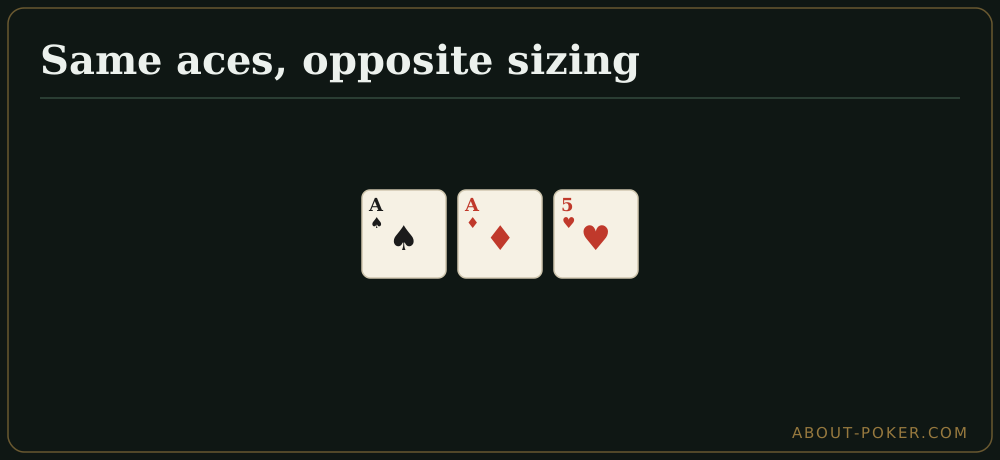
You raise the same hand — A♠A♦ — on two different flops in a 5.5bb pot.
On K♦7♣2♥ (dry): your aces are a huge favorite and nothing threatens you. Bet one-third pot (1.8bb). A big bet would fold out the worse hands that give you action; a small bet keeps kings, weak pairs, and ace-high in the pot to pay you off, and you’re not worried about being outdrawn.
On 9♥8♥5♠ (wet): your aces are still ahead but vulnerable — any heart, 6, 7, T, J, or a paired board can flip the hand. Bet three-quarters pot (4bb). Now you’re charging the flush draws and straight draws a steep price and building a pot with a hand you’re happy to stack off. Same hand, opposite sizing, all because the texture changed. This texture-first thinking is the backbone of a strong continuation bet strategy.
A Practical Texture-by-Texture Guide
Dry rainbow, high card (K-7-2, A-8-3): one-third pot, very wide range. Paired dry (K-K-4, 7-7-2): one-third pot, wide range — see c-betting paired boards. Monotone (K♥9♥4♥): one-third pot, moderate frequency, blocker-driven bluffs. Two-tone connected (J-T-8, 9-8-7): two-thirds to full pot, polarized. Middling connected rainbow (8-7-6 rainbow): a middle size, around half pot, since there are straights but no flush draw. The pattern is clear — the more equity the board hands your opponent, the bigger you bet and the tighter you go.
Sizing Across Streets
Texture doesn’t stop mattering after the flop. If a dry flop turns a flush or a straight card, your correct turn size can flip from small to large or from a bet to a check. Generally, sizes grow across streets on boards where you’re building toward an all-in, but each decision keys off the current texture and how it changed. A c-bet size chosen on the flop is not a commitment to the same size on the turn.
Common Mistakes
The top leak is one-size-fits-all betting — using the same half-pot bet on every flop, which overbets dry boards and underbets wet ones. The second is betting big on dry boards and killing your own value. The third is betting small on wet boards and letting draws in cheap. Let the texture pick your size, and both your bluffs and your value bets will earn more.
Frequently asked
How big should a c-bet be?
It depends on the board. Dry, disconnected boards call for a small bet around one-third pot with a wide range; wet, coordinated boards call for a larger bet of two-thirds to full pot with a tighter, polarized range.
Why do you bet small on dry boards and big on wet boards?
On dry boards you don't need a big bet to deny equity because the opponent has little to draw to, so a cheap bet across your whole range maximizes profit. On wet boards you must charge draws a real price, which requires a larger bet.
Should c-bet size change between the flop, turn, and river?
Yes. Sizing generally grows across streets on boards where you're building toward stacking off, but each street's size still keys off the current texture and how the board has changed. A dry flop that turns a flush completely changes the correct turn size.