MTT 40bb Opening Ranges Chart
MTT 40bb opening ranges by position, explained. Learn the correct RFI sizes and hand selection for a 40 big blind stack in tournaments.
On this page · 7 sections
Forty big blinds is one of the most common stack depths in multi-table tournaments. It’s deep enough to open-raise and play real postflop poker, but shallow enough that you can’t flat every speculative hand and hope to realize equity. This chart and the reasoning behind it will keep your raise-first-in (RFI) ranges accurate at 40bb.
Why 40bb ranges differ from 100bb
At 100bb you have deep implied odds: hitting a small pair or a suited connector can win a huge pot. At 40bb the reward for those hands shrinks because the effective stack behind is thinner. That pushes your opening ranges tighter than a cash-game 100bb chart, particularly from early positions.
Antes are the other major factor. In almost all modern MTT structures, an ante is posted each hand, inflating the pot before any action. That extra dead money rewards stealing, so late-position ranges actually widen relative to a no-ante game. The net effect: early position gets tighter, late position stays aggressive.
Opening ranges by position at 40bb
Here are solid solver-aligned RFI ranges for a nine-handed table at 40bb with antes. Percentages are of all starting hands.
- UTG (~14%): 66+, ATs+, KQs, KJs, QJs, AJo+, KQo
- Middle position (~17%): 44+, A9s+, KTs+, QTs+, JTs, T9s, ATo+, KQo
- Cutoff (~26%): 22+, A2s+, K9s+, Q9s+, J9s+, T8s+, 98s, 87s, A9o+, KTo+, QTo+, JTo
- Button (~42%): 22+, A2s+, K5s+, Q7s+, J8s+, T8s+, 97s+, 86s+, 76s, 65s, A7o+, K9o+, Q9o+, J9o+, T9o
- Small blind (~35%): a mix of raise-first and some limping; a common raising strategy is 22+, A2s+, K7s+, Q9s+, J9s+, T9s, A8o+, KTo+, QJo
For a broader view of how these shift as stacks change, see opening ranges by stack depth.
Worked example: A5s on the button at 40bb
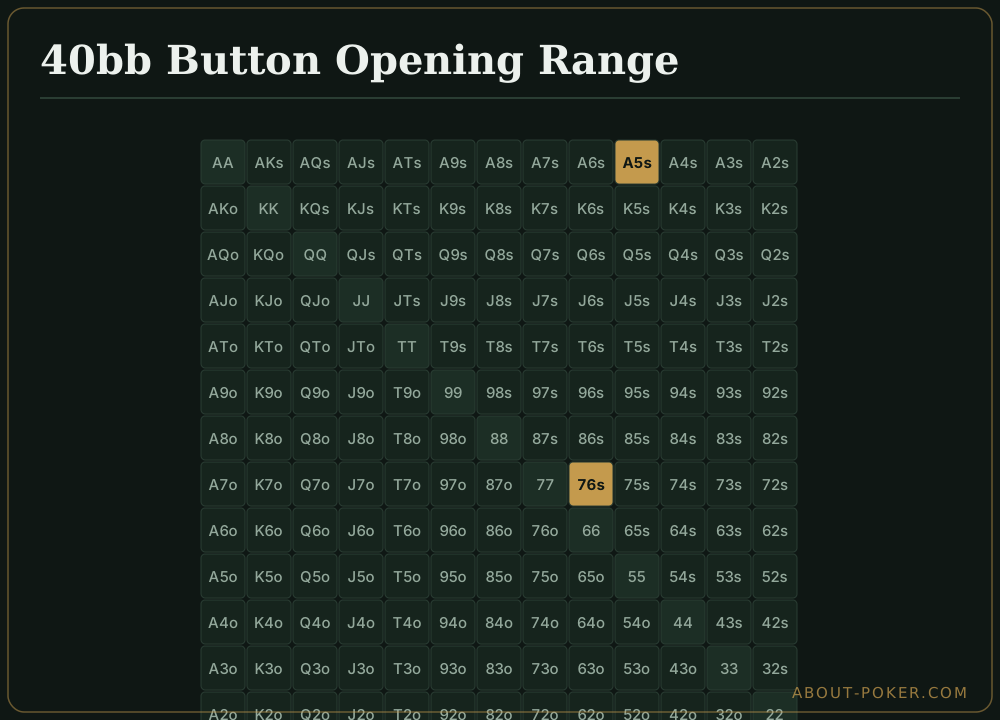
You’re on the button with A5s. Folds to you. Effective stacks are 40bb, antes are in.
A5s is a clear open here. It plays two roles well: it flops flushes and wheel draws, and the ace gives you a blocker to strong ace-x hands the blinds might use to 3-bet or continue with. Raise to 2.2x. If the big blind 3-bets small, A5s is a comfortable call at 40bb because you have position and a hand that flops equity in many textures. If the big blind jams over your open, A5s is close but generally a fold at 40bb depth — the shove is uncapped and you’re often flipping or dominated.
Contrast that with A5o from UTG. It’s not in your 14% opening range: it’s dominated too often and can’t flop enough to justify entering out of position. Fold it and wait for a better spot.
Adjusting your sizing
The 2.2x–2.5x open is the workhorse at 40bb. Some players min-raise (2x) from late position to steal cheaply, which is fine when the field folds a lot. From early position, a slightly larger 2.5x tightens the field and protects your stronger holdings. Read more on choosing sizes in open-raise sizing and how this fits into overall tournament opening ranges.
Common leaks at 40bb
The biggest mistake is playing 40bb like a 100bb cash game: opening too many offsuit broadways and weak suited gappers from early position. The second is over-flatting 3-bets out of position — at 40bb the stack-to-pot ratio after a 3-bet gets awkward, so you should either fold or 4-bet more of your continuing range rather than call and guess postflop.
Memorize position-by-position and adjust for antes, and your 40bb game becomes one of the most reliable phases of any tournament.
Facing a 3-bet at 40bb
The stack depth changes 3-bet strategy sharply compared to 100bb. Do the arithmetic: you open to 2.2bb, a player 3-bets to around 7bb, and you have roughly 33bb behind. If you call, the pot is about 15bb and you have a stack-to-pot ratio of just over 2 — awkwardly shallow for a flat, since you’ll frequently be committed on any decent flop with a hand you can’t fold.
That math pushes you toward a 4-bet-or-fold approach with much of your range:
- 4-bet for value: QQ+, AK, and often JJ and AKs become jam-or-large-4-bet hands. At 40bb a 4-bet to about 16bb commits a big share of your stack, so you’re usually 4-bet/calling a shove with these.
- 4-bet as a bluff (sparingly): hands like A5s and KQs make reasonable light 4-bets because they block the 3-bettor’s value combos (aces, ace-king) while retaining an ace-high or broadway backup if called and flat.
- Fold the rest: middling suited hands and offsuit broadways that were fine opens are simply folds against a 3-bet — flatting them out of position at this depth burns chips.
In position, you can flat a tighter, more connected band (pairs that set-mine profitably, suited broadways) because you realize equity better, but even there the shallow SPR means you’re committing quickly.
How 40bb sits between deep and short
It helps to see 40bb as the hinge point of tournament stack depths. Above it, at 60bb–100bb, you play a fuller postflop game: more speculative flats, more multi-street maneuvering, wider implied-odds hands. Below it, from about 25bb down, you slide toward shove-or-fold and shed the hands that need three streets to pay off. At 40bb you keep conventional raising and real postflop play, but every decision carries the awareness that the stack behind is finite. Compared with a cash-game 100bb chart, your early-position opens are noticeably tighter, while antes keep your late-position steals aggressive. Knowing exactly where 40bb falls on that spectrum — and how the ranges here flex as you drift up toward 50bb or down toward 30bb — is covered in opening ranges by stack depth, and it’s the single fastest way to stop misplaying the most common stack in the tournament.
Frequently asked
What raise size should I use at 40bb in MTTs?
A 2.2x to 2.5x open is standard at 40bb. Smaller sizes than the classic 3x work well because antes are usually in play, which sweetens the pot and lets a small raise still win a healthy amount when everyone folds.
Is 40bb still a deep stack in tournaments?
It sits in the middle. At 40bb you have room to play postflop and use fold equity on later streets, but you cannot flat-call and speculate as loosely as at 100bb. Your ranges are tighter than cash-game 100bb charts, especially from early position.
How different is 40bb from 20bb opening?
Meaningfully. At 20bb you shift toward push-fold and shove-heavy play, and you drop most weak suited connectors. At 40bb you still open-raise conventionally and keep more of your range, since you retain postflop maneuverability.