Preflop Limp-Reraise Range Chart
The limp-reraise is a rare, deceptive play best reserved for very deep or specific live games. See when to use it, what to limp-reraise, and the risks.
On this page · 5 sections
The limp-reraise is one of poker’s most theatrical plays: you enter the pot for the minimum, wait for an aggressive player to raise behind you, and then spring a re-raise. Done right against the right table it can win a huge pot with a monster. Done wrong — or in the wrong game — it’s a leak that costs you value and telegraphs your hand. This page covers exactly when the limp-reraise makes sense, what to limp-reraise with, and why solvers almost never do it.
What the limp-reraise actually is
The move has three steps. First you limp (just call the big blind) rather than open-raising. Second, a player behind you raises to isolate the limper — a standard iso-raise against limpers. Third, you re-raise (limp-reraise, sometimes written limp-3-bet). The goal is to disguise a premium hand behind a passive-looking limp so that an aggressive opponent inflates the pot for you.
Compare this to a normal open. When you open-raise AA and get 3-bet, the story is clear — strong hands raise. The limp-reraise flips that story: you look weak or trapping, so opponents who over-attack limps walk into a re-raise with hands they’d never stack off against an open.
When it works — and when it doesn’t
The limp-reraise is fundamentally an exploitative live play, not a GTO one. Solvers building balanced ranges almost never limp their strong hands from most positions, because open-raising captures more value and denies free flops to the field. If your opponents fold correctly and don’t over-isolate, limping AA just lets three players see a cheap flop against your aces — the worst outcome.
It only becomes profitable when a specific condition holds: there’s a player behind you who raises limps aggressively and predictably. In a loose live cash game with one or two hyper-aggressive “iso every limp” regulars, limping AA from early position and re-raising their inevitable iso can win a stack you’d never get with a standard open. The exploit lives entirely in their tendency to attack.
If nobody behind you raises limps, the play does nothing — you just limped a premium and gave up value. So the read has to come first.
What to limp-reraise
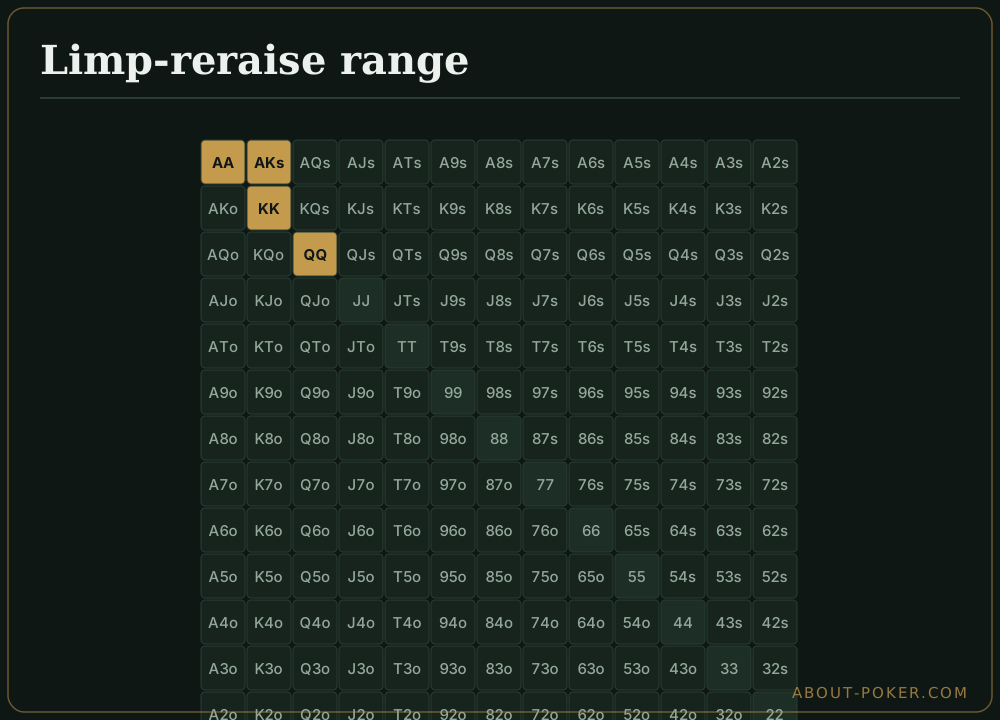
Keep the range razor-thin and value-heavy:
- Always: AA, KK. These dominate any hand that would raise your limp and stack off.
- Sometimes: QQ, AK. Only against very aggressive isolators, since these can be behind a wide 4-bet-happy opponent.
You do not limp-reraise medium pairs, suited connectors, or “trap-y” speculative hands. The line’s entire purpose is to get money in with a dominating hand. Limp-reraising 99 or ATs turns a marginal spot into a bloated pot out of position with a hand that’s often flipping or behind.
A worked example
You’re in the hijack of a loose live $1/$2 game with AA. There’s a known aggressive player on the button who isolates practically every limp to $15. You limp for $2.
As expected, two players limp behind you, and the button raises to $18. The small blind folds, the big blind folds, and the other limpers call $16 each. Action’s back on you. You re-raise to $70.
Here’s the payoff: the button, holding something like AJs, reads your limp-reraise as a squeeze and calls, and one limper tags along with a suited connector. You’ve now built a $200+ pot preflop with the best hand and position information, entirely because the button’s auto-iso tendency let you trap. Against a standard open to $12, the button likely folds AJs and you win $8.
The bottom line
Treat the limp-reraise as a rare, table-specific tool — not a default. In online or tough games, open-raise your premiums and use a normal 3-bet range instead; the deception isn’t worth the value you sacrifice and the free flops you give away. In a soft live game with an over-aggressive isolator behind you, it’s a legitimate, high-EV trap you can deploy a few times a session with AA and KK. Read first, limp second.
Frequently asked
What is a limp-reraise in poker?
A limp-reraise (also called limp-3-bet or limp-reraise) is when you limp in preflop, wait for someone behind you to raise, and then re-raise them. It's a deceptive line designed to disguise a very strong hand and trap aggressive opponents into building a big pot.
Is limp-reraising a good strategy?
In modern GTO play it's almost never used — open-raising is more profitable with your strong hands. It's mainly a live-game exploit against tables full of aggressive isolators who will raise your limp, letting you trap them. Off the felt in solver play, it barely exists.
What hands should I limp-reraise with?
Only your very strongest hands: primarily AA and KK, occasionally QQ or AK. The whole point is to get all-in or build a huge pot with a hand that dominates, so you don't limp-reraise speculative or medium holdings.