All-In Betting Rules
The complete all-in betting rules in poker: when you can go all-in, how table stakes protect you, side pots, under-calling a raise, and showdown order.
On this page · 7 sections
Going all-in means committing every chip you have in front of you into the current pot. It’s one of the most dramatic moves in poker and also one of the most misunderstood by newer players. The rules around it are actually protective: they exist so a short stack can never be forced out of a pot just because they can’t match a bigger bet, and so nobody can bet money that isn’t already on the table.
The foundation: table stakes
Every all-in rule flows from one principle — table stakes. You can only wager the chips you have in front of you at the start of a hand. You cannot reach into your pocket mid-hand, and no opponent can bet an amount you’re required to match beyond your stack. This is what makes all-in a right, not a trap: if someone bets more than you have, you simply put in everything you’ve got and you’re all-in for that amount. The full principle is covered in the table stakes rule explained.
Because of table stakes, you’re never “priced out” of seeing a showdown for lack of chips. You contest as much of the pot as your stack can cover, and the rest is handled with side pots.
When you can go all-in
You can move all-in whenever it’s your turn to act on any betting round. It can take three forms:
- All-in as a bet or raise — you push your whole stack in to open or increase the wager.
- All-in as a call — an opponent bets more than you have, so you call for your entire remaining stack.
- All-in when you can’t cover a blind or ante — you post what you can and are all-in for the hand.
You cannot go all-in when it’s not your turn (that’s acting out of turn), and you can’t add chips from your pocket to go all-in for more.
Short all-ins and reopening the betting
A common point of confusion: an all-in for less than a full raise does not reopen the betting. Say the bet is $100 and a player moves all-in for $130 — only $30 more. Because $30 is less than a full raise (which would be another $100), players who already called the $100 can call the extra $30 or fold, but they cannot re-raise. The short all-in is treated as a call plus incomplete raise. A full-sized all-in, by contrast, reopens the action normally. This detail matters most in no-limit betting spots where stacks are uneven.
Side pots: a worked example
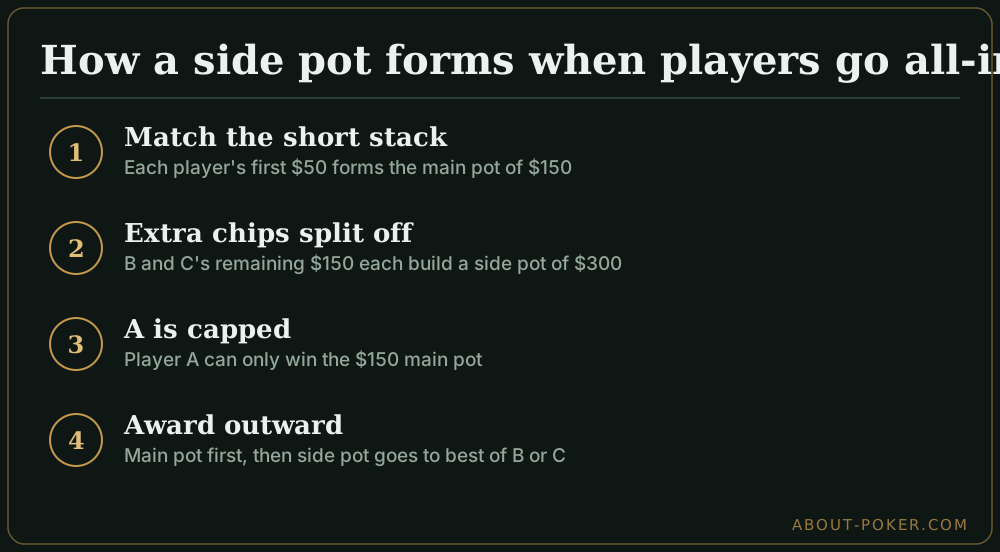
This is where all-in rules earn their keep. Suppose three players see a flop and get it all-in:
- Player A has $50 and is all-in.
- Player B has $200 and is all-in.
- Player C has $200 and calls.
Player A can only win what they matched. So the main pot is $50 from each of the three players = $150, which A is eligible to win. B and C each put in $150 more ($200 − $50). That extra money forms a side pot of $300 ($150 from B + $150 from C) that only B and C can win.
At showdown, if Player A has the best hand, A wins the $150 main pot — but the $300 side pot goes to whoever is better between B and C. A cannot touch the side pot because A never contributed to it. If B has the best hand overall, B scoops both pots. This layered structure is explained further in all-in and side pots explained and in what happens if two players go all-in.
Showdown rules when players are all-in
Once all betting is complete and at least one player is all-in with callers, the hands are turned face-up and the remaining community cards are dealt without further betting. This is different from a normal showdown where players choose whether to show. When action is all-in, there’s nothing left to bet, so cards are exposed to prevent collusion and the board runs out for everyone to see. Pots are then awarded from the smallest (main pot) outward, side pot by side pot.
Common mistakes to avoid
- Saying “all-in” and then adding pocket money. You can’t. Only chips already on the table count.
- Assuming a small all-in lets you re-raise. If someone’s all-in for under a full raise and you’d already acted, you usually can only call the difference.
- Thinking a short stack can’t win the whole pot. They can win the main pot; they just can’t win side pots they didn’t contribute to.
- Forgetting to protect your all-in hand at showdown. In all-in situations dealers typically turn everyone’s cards up automatically, but always keep your cards visible until the pot is awarded.
Quick reference checklist
- All-in = pushing your entire on-table stack; you can’t add more.
- You can go all-in as a bet, raise, or call, on your turn only.
- An all-in under a full raise doesn’t reopen betting.
- Uneven stacks → side pots; you only win pots you paid into.
- All-in with callers → cards turned up, board runs out, no more betting.
The through-line is fairness: all-in rules make sure the size of your stack decides how much you can win, never whether you get to play the hand out.
Frequently asked
Can you go all-in at any time in poker?
You can go all-in on any betting round when it is your turn to act, as long as your chips are on the table. Under table stakes you can only wager the chips in front of you, so going all-in simply means pushing your entire stack into the pot as a bet, call, or raise.
Does going all-in for less than a bet count as a raise?
No. If you go all-in for an amount smaller than a full bet or raise, it is treated as a call for the amount you can cover, and it does not reopen the betting to players who have already acted. A short all-in only reopens action if it meets the minimum-raise threshold in the room's rules.
What happens if two players go all-in for different amounts?
A side pot is created. The main pot contains only what everyone contributed up to the smallest all-in stack, and the extra chips from larger stacks go into a separate side pot. A player can only win chips from pots they contributed to.