What Is the Flop in Poker
The flop is the first three community cards in Hold'em, dealt after preflop betting. Here's what it means, how it's dealt, and how to read and play it.
On this page · 7 sections
The flop is the first three community cards in Texas Hold’em and Omaha, dealt face-up together in the center of the table. Everyone still in the hand shares these cards, combining them with their two hole cards to build a five-card hand. The flop arrives after the first betting round and is a huge moment: in one instant you go from seeing two cards to seeing five of the seven you’ll ever have, and most of your hand’s value is decided right here.
Where the flop fits in a hand
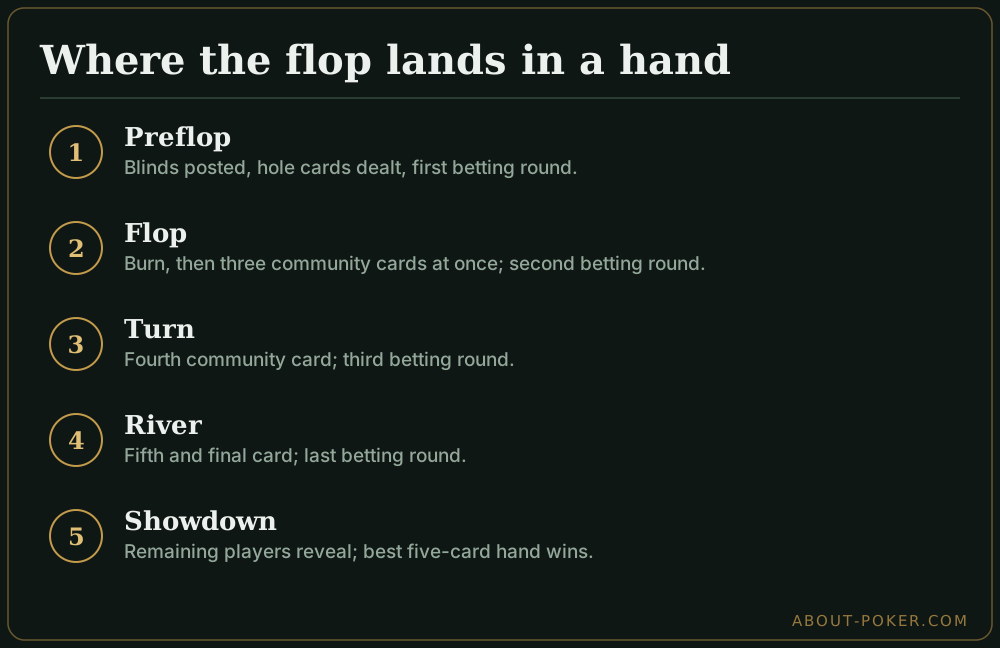
A Hold’em hand always runs in the same order: preflop, then the flop, then the turn, then the river, then showdown. The flop is the second stage and the first time community cards appear. If you want the full sequence laid out, see how a hand of poker plays out.
How the flop is dealt
Once preflop betting is settled, the dealer takes one card off the top of the deck and sets it aside face-down — the burn card — then turns over the next three cards at the same time. All three land together; they aren’t dealt one at a time. That burn-then-deal pattern repeats on the turn and river with a single card each. The burn exists mainly to protect against anyone reading marks on the top card.
The flop betting round
After the flop appears, the second betting round begins. In flop-and-later rounds, action starts on the first remaining player to the dealer’s left — unlike preflop, where it starts left of the big blind. Players choose in clockwise order from the usual actions:
- Check — pass with no bet, if no one has bet.
- Bet — put chips in.
- Call — match the current bet.
- Raise — increase it.
- Fold — give up the hand.
In fixed-limit games, the flop uses the smaller bet size (the “small bet”); it doubles later on the turn. In no-limit, you can bet up to your whole stack.
Reading the flop
The flop’s texture drives everything that follows. A few things to notice immediately:
- Did it pair you? A hole card matching a board card gives you a pair. Matching the highest card gives you top pair.
- Is it coordinated or dry? A flop like Jh Th 9h is “wet” — flushes and straights are already threatened. A flop like Kd 7c 2s is “dry” — few draws are possible.
- Do you have a draw? Two cards of one suit plus one of yours can be a flush draw; four cards to a straight is a straight draw.
The concept of “hitting” versus “missing” the flop lives here. With two random hole cards you completely miss the flop more often than you hit it, which is why folding on the flop is so common and correct.
A worked example
You hold Qs Qh and raise preflop; one player calls. The flop comes Qd 8c 3h. That’s a dream: you’ve flopped three of a kind (a set) on a dry board with no flush or straight threats.
This is a spot to bet. You’re almost certainly ahead, and betting builds a pot while charging any weaker hand — a pair of eights, an ace-high, a lone overcard hoping to improve — to keep playing. Because the board is dry, you don’t need to panic about being outdrawn; there’s no flush possible and only a very specific runout makes a straight.
Now contrast it. Same Qs Qh, but the flop is Ah Kh 5h. Suddenly your overpair is in trouble: an ace or king beats you, and three hearts mean a flush may already be made. Here you’d proceed carefully — often checking or making a small probe — because the flop hit a lot of hands that beat you. Same starting hand, opposite plans, all decided by the flop.
Common flop mistakes
- Overvaluing top pair on wet boards. One pair is fragile when straights and flushes are live. Bet it, but be ready to fold to real pressure.
- Chasing weak draws for too much. A gutshot straight draw completes only about 1 in 6 by the river. Paying big bets to chase it loses money.
- Never continuation betting. If you raised preflop, betting many flops even when you miss is a standard, profitable play because your opponent usually missed too.
- Slow-playing everything. Trapping with monsters has its place, but checking strong hands on draw-heavy flops just gives free cards to hands that can beat you.
Quick checklist for the flop
- Did the flop pair me, give me a set, or a strong draw?
- Is the board wet (draw-heavy) or dry?
- Was I the preflop raiser, making a continuation bet natural?
- If drawing, do my odds justify continuing?
- What range did my opponent call preflop with, and how does this flop hit it?
The flop is where hands are truly made or broken. Read the three cards for what they did to you, what they did to your opponent’s likely range, and how safe the board is — and the rest of the hand becomes far easier to navigate.
Frequently asked
How many cards are in the flop?
The flop is three community cards dealt face-up at the same time. They are shared by every player still in the hand and, with the later turn and river, make up the five-card board.
Does the flop come before or after betting?
The flop is dealt after the first betting round, called preflop. Once preflop action is complete, the dealer burns one card and turns over three cards together, which opens the second betting round.
What does 'hitting the flop' mean?
Hitting the flop means the three community cards improve your hand — for example pairing one of your hole cards, making a set, or giving you a strong draw. Missing the flop means the cards did nothing for your hand.