What Is the Turn in Poker
The turn is the fourth community card in Hold'em, dealt after the flop and before the river. Here's what it means, how the betting works, and how to play it.
On this page · 6 sections
The turn is the fourth community card in Texas Hold’em and Omaha. The dealer places it face-up in the middle of the table after the flop’s three cards, and it kicks off the third of four betting rounds. Because it’s the fourth card to hit the board, players also call it fourth street — a leftover term from stud poker where every card is a “street.” By the time the turn is out, you can see six of the seven cards you’ll ever have access to: your two hole cards plus four on the board. Only the river remains.
Where the turn fits in a hand
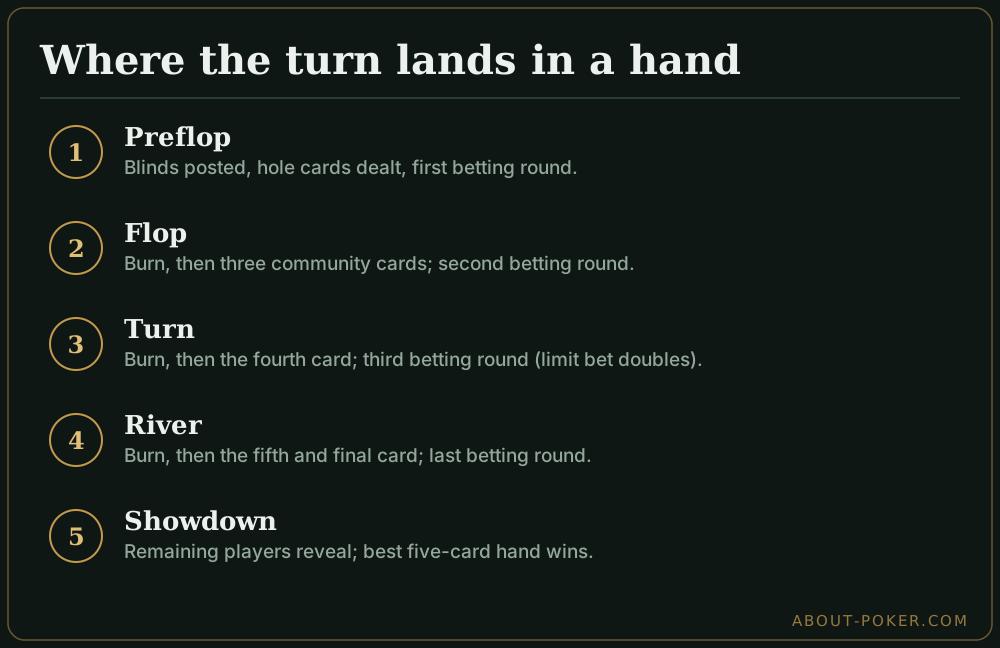
A Hold’em hand runs through a fixed order every time, and the turn is the second-to-last stage. It goes preflop, then the flop, then the turn, then the river, then showdown. If you’re still learning the overall sequence, the full walkthrough in how a hand of poker plays out sets the stage.
Mechanically, the turn is dealt like this: the dealer takes one card off the top of the deck and sets it aside face-down — the burn card — then flips the next card into the middle next to the flop. So the deck loses two cards each street (one burned, one dealt) even though only one new card appears. Once it’s out, action opens on the first remaining player to the dealer’s left, exactly as on the flop.
The turn betting round
The turn brings a full betting round. Every player still in the hand gets the standard options in clockwise order:
- Check — pass the action along with no bet, if nobody has bet yet.
- Bet — put chips in when the action is checked to you.
- Call — match the current bet.
- Raise — increase the bet.
- Fold — surrender the hand.
In no-limit, you can bet anything from the minimum up to your whole stack on the turn. In fixed-limit games, the turn is where the bet size jumps to the “big bet” — double the flop’s amount. In a 4/8 limit game, flop bets are 4 and turn bets are 8. That doubling is the single biggest structural feature of the turn in limit poker and it changes how much pressure a bet applies.
Why the turn matters strategically
The turn is a decision point where pots get big and mistakes get expensive. Two things make it distinct. First, there’s only one card left to come, so your equity is much more “locked in” than it was on the flop. A flush draw that missed the flop and the turn now has just one card — the river — to complete, so its chance drops sharply.
Second, the turn is where the story of the hand either confirms or contradicts itself. A player who bet the flop and bets again on the turn — a “double barrel” — is representing real strength. Someone who bet the flop and then checks the turn is often giving up or slowing down. Reading that shift is a core skill.
A worked example
You hold Ac Kd. The flop comes Ah 9s 4c, giving you top pair with the best possible kicker. You bet, one opponent calls. The turn is the 7d. The board is now Ah 9s 4c 7d.
Nothing scary changed. There’s no completed flush (only two clubs, and now a lone diamond) and no obvious straight. Your top pair is still very likely ahead. This is a clear spot to bet again — a second barrel — because a worse ace, a middle pair, or a stubborn draw will often pay you off. If instead the turn had been the Jc bringing a third club, you’d slow down: a flush might now be live, and your one-pair hand is far less safe.
The key habit is asking on every turn: did this card change who’s winning? A “blank” that misses all the draws lets you keep betting your strong hands. A “scare card” that completes an obvious draw should make you cautious.
Common turn mistakes
New players trip over the turn in predictable ways:
- Barreling into scare cards with nothing. Firing a bet on a flush-completing turn when you have air often just gets called by the hand you were scared of.
- Giving up too easily. Checking the turn with a strong hand out of caution lets opponents draw for free and lets bluffs off the hook.
- Ignoring pot odds on draws. With one card to come, a flush draw hits roughly 1 time in 5. If the bet you must call is more than about a fifth of the resulting pot, chasing is a losing play unless you have extra ways to win.
- Forgetting the limit doubling. In limit games, people call turn bets on autopilot at the smaller flop mindset. The bet is twice as big now — treat it that way.
Quick checklist for the turn
Before you act on fourth street, run through this:
- Did the turn card complete a flush or straight?
- Am I ahead of the range that called my flop bet?
- If I’m drawing, do my pot odds justify a call with one card left?
- Is this a limit game where the bet just doubled?
- What does my line so far tell the opponent — and is that the story I want?
Answer those and the turn stops being a guessing game. It’s the street where careful players separate themselves from careless ones, precisely because the pot is large and only one card remains to bail anyone out.
Frequently asked
Is the turn the third or fourth card?
The turn is the fourth community card on the board. It comes after the three flop cards and before the single river card. Together with your two hole cards, it gives you six of the seven cards you'll ultimately use.
Why is the turn called fourth street?
Poker inherited the term from stud, where each dealt card is a 'street.' The turn is the fourth card exposed on the board in Hold'em, so players nickname it fourth street. The river is fifth street by the same logic.
Is there a betting round after the turn?
Yes. After the turn card is exposed, there is a full betting round with the same options as the flop — check, bet, call, raise, or fold. In limit games, the bet size doubles on the turn.