33 Poker Nickname & Meaning
Pocket threes (33) is nicknamed 'Crabs' and 'Treys.' Here's where the names come from and how this small pocket pair actually plays preflop.
On this page · 6 sections
Pocket threes (33) is one of the smallest pocket pairs, and it carries a couple of easy-to-remember nicknames. The most common is “Crabs,” because a 3 turned on its side looks a little like a crab’s pincers. Players also simply call them “Treys,” since “trey” is the traditional card term for a three. The names are pure table color, but they’re part of the language you’ll pick up the longer you play.
Where the nicknames come from
“Crabs” is a shape joke: rotate a 3 and the two humps read like a crab’s claws snapping shut. “Treys” is more literal — “trey” comes from the old French and Latin words for three, and it’s been the standard name for the card in gambling for centuries, so a pair of them is just “treys.” A few tables also call the hand “the threes” or, jokingly, “crab legs.” As always with pocket-pair nicknames, none of this affects strategy; it’s cosmetic slang sitting next to the rest of the vocabulary in poker slang explained.
Where 33 ranks as a starting hand
Among the 169 possible starting hands, 33 sits near the very bottom of the pocket pairs — only pocket twos are lower. It’s still technically ahead of every unpaired hand before the flop, but its unimproved value is minimal: a lone pair of threes is beaten by any higher pair and by essentially every board that brings an overcard, which is almost all of them. That gives threes the extreme version of the small-pair profile:
- Preflop, it edges out unpaired hands, but only barely and only when nobody has a bigger pair.
- Postflop, it nearly always needs to improve. With overcards on the vast majority of flops, threes are second-best almost immediately. The one bright spot is flopping a third three for a well-hidden set.
How 33 plays preflop
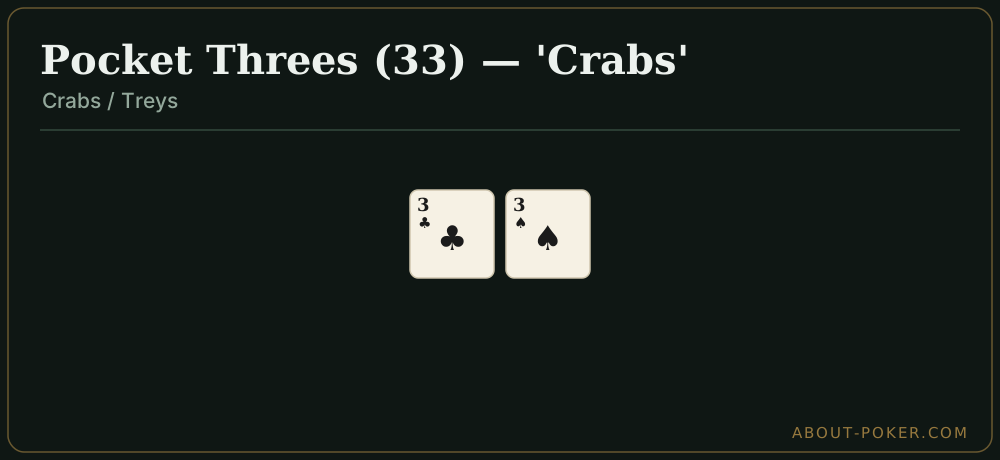
Threes are a marginal open from late position and a call against a single raise only when stacks are deep. The relevant numbers:
- Any pocket pair flops a set or better about 11.8% of the time — roughly once every 8.5 flops.
- All-in preflop, 33 is about a 4-to-1 underdog to any higher pair.
- Against two overcards like A-K, 33 is a slight favorite, around 52%.
Because threes almost never win unimproved, their entire case rests on set-mining, and set-mining requires depth. A common guideline: only call a raise to set-mine when the effective stack is at least 10 to 15 times the price of your call, so a single set can win enough to cover the roughly seven flops out of eight where you miss and fold.
Worked example: the set-mine payoff
You’re on the button with 3♣ 3♠. A loose player opens to 3 big blinds, and effective stacks are a deep 150 big blinds. You call for 3.
The flop comes 3♦ Q♥ 7♣. You’ve flopped bottom set — nearly invisible on a board where your opponent is far more likely to have a queen than a three. They bet with A♠ Q♦ for top pair, you call, the turn is the J♠, and you raise. With top pair top kicker, they call or even push, and the deep stacks let you win a huge pot with just three little crabs. One flop like this pays for many misses, which is exactly why deep money makes threes worth a cheap call — and shallow money makes them a fold.
Common mistakes with 33
- Set-mining shallow. If you can’t win at least 10 to 15 times your call when you hit, folding threes is correct. The one-in-eight set rate simply can’t cover the misses otherwise.
- Bluff-catching with an unimproved pair. A lone pair of threes beats almost nothing that’s betting into you on an overcard board. Let it go.
- Playing them from early position. Threes are hard to realize their value out of position and against strong ranges. Save them for late position and the occasional cheap defense.
Keep going
Pocket threes are about as small as pairs get, but they still turn into monsters on the roughly one-in-eight flops where they hit a set. Learn how that works in the set explainer, pick up more table shorthand in poker slang explained, and browse the full poker terms glossary to keep building your vocabulary.
Frequently asked
What is the nickname for 33 in poker?
Pocket threes (33) is most often called 'Crabs,' because a 3 turned sideways looks a bit like a crab's claws. It's also plainly known as 'Treys,' since a three is called a trey in card terminology.
Is 33 a good starting hand?
Pocket threes is a small pocket pair — playable but rarely a winner unimproved. Its value comes almost entirely from set-mining, which requires deep stacks to be profitable.
How often does 33 flop a set?
Pocket threes flops a set or better about 11.8% of the time, roughly once in every 8.5 flops. That number is identical for every pocket pair and is what makes set-mining possible.
Should I fold 33 preflop?
Often, yes. Against tight early-position raises, 3-bets, or shallow stacks, folding threes is usually correct. They shine only when you can call cheaply with deep stacks and a good chance to get paid on a set.