68 Poker Nickname & Meaning
68 — six-eight — is a one-gap suited connector. What players call it, why the gap changes how it plays, and how to handle 68 before the flop.
On this page · 7 sections
68 — six-eight — is a one-gap suited connector: two cards separated by a single rank (the missing seven). It doesn’t carry a famous nickname, but it’s a well-understood category of speculative hand, and knowing how the gap changes its value will keep you out of trouble.
What players call it
Like most low non-face hands, 68 has no colorful slang name. You’ll hear it described functionally:
- Six-eight suited — the standard way to say it.
- A one-gapper (or one-gap connector) — because there’s exactly one rank between the six and the eight.
- A speculative hand — a holding you play for its drawing potential, not its raw strength.
Players reserve the memorable nicknames for the premiums and the face cards; workhorse hands like 68 just get called what they are.
Why the gap matters
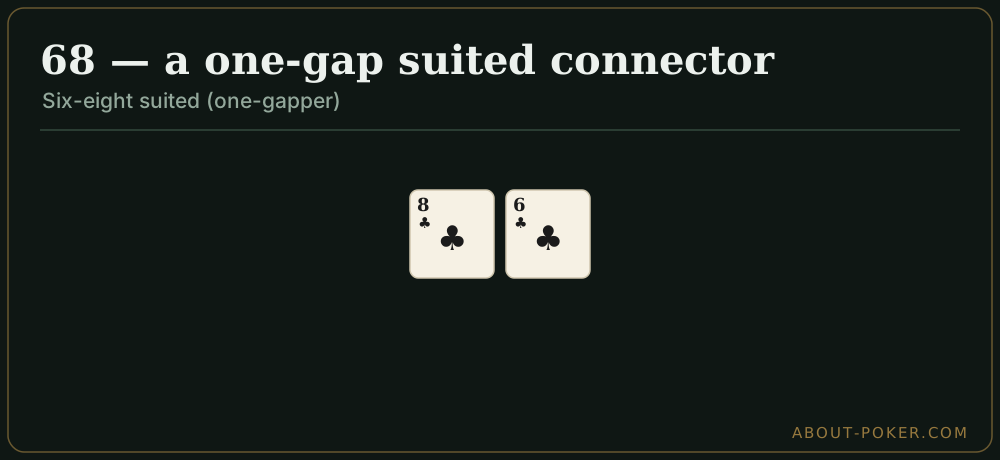
A true suited connector like 78 can complete four different straights. A one-gapper like 68 completes fewer, because the missing seven removes one of those straight structures. In practice that means 68 flops a made straight or open-ended draw a little less often than 78 does — a small but real downgrade.
It’s still a legitimate hand, though. 68 suited retains its flush potential and plenty of straight equity through gutshots and open-enders, and it disguises well because opponents rarely put you on it. Play it from middle and late position, defend it selectively from the blinds, and be a bit more willing to fold it than you would a gapless connector.
Worked example: turning a gutshot into a draw
You call from the big blind with 8♣ 6♣ and the flop comes 7♦ 5♥ 2♣.
You’ve flopped an open-ended straight draw — any four or nine makes your straight, which is eight outs. With two cards to come you’ll complete roughly 32% of the time, and because the straight is well hidden you can often get paid when you hit. Notice how the seven you were “missing” preflop showed up on the board and glued your hand together. Now compare a flop of 9♥ 4♦ 2♠: here you have only a gutshot (a seven for the straight — four outs) and little else, a spot where you’d usually check and give up. The gap makes both outcomes a bit more common than they’d be with a true connector, which is exactly why you play 68 with a little more discipline.
See the full breakdown in how to play eight-six suited.
Using the term at the table
You’ll hear it in lines like “flopped the open-ender with six-eight suited and got there on the turn,” or “folded the one-gapper out of position, no reason to bloat the pot.” Say “six-eight suited” or “one-gapper” and experienced players will know the type of hand you mean.
The lesson: 68 is a useful speculative hand as long as you respect the gap. Play the suited version in position, chase the strong draws, and don’t overvalue the weaker offsuit form. See how to play eight-six suited for the complete approach.
One-gappers versus connectors: the numbers behind the gap
It is worth putting rough figures on why the gap matters, because “a little less often” is easy to hand-wave. A true connector like 78 can be the middle of four different straights: 4-5-6-7-8, 5-6-7-8-9, 6-7-8-9-T, and 7-8-9-T-J. A one-gapper like 68 sits inside fewer of those structures — the missing seven means it can only anchor straights that route through both the six and the eight, so it makes a made straight or open-ended draw on the flop noticeably less often. In practical terms, a suited connector flops some kind of straight draw around a fifth of the time, and a one-gapper a bit less than that. The flush side is unaffected — 68 suited makes a flush draw on about one flop in eight, exactly like any two suited cards.
That single-gap downgrade is small enough that 68 suited stays firmly in the playable category, but real enough that you should not treat it as identical to 78 suited. The gap also slightly weakens its blocker value: 68 removes fewer of the straight combinations your opponent might hold, so it bluffs a touch less effectively as a pure card-removal play.
Two-gappers and where the line is
The natural follow-up question is how far the gap can stretch before a hand stops being worth playing. A two-gapper like 58 or 69 has two missing ranks and completes still fewer straights, which is why hands like 58s are near the bottom of most speculative ranges and 68s sits comfortably above them. The general rule: gapless connectors are the strongest speculative shape, one-gappers are a small step down but still solidly playable in position, and two-gappers are marginal and position-dependent. When you are deciding whether a low suited hand is worth a call, count the gap first — it is the fastest read on how much straight potential the hand actually has.
Keep going
68 is a one-gap suited connector — no nickname, but plenty of playability when handled right. Learn more vocabulary in the poker terms glossary, explore colorful table talk in poker slang explained, and get the strategy in how to play eight-six suited.
Frequently asked
What is the nickname for 68 in poker?
Six-eight doesn't have a single famous nickname. It's usually just called 'six-eight' or, when suited, described as a one-gap (or one-gapper) suited connector.
What is a one-gapper in poker?
A one-gapper is two cards two ranks apart, like 68, 79, or T8. There's a single 'gap' rank between them. Suited one-gappers can still make straights and flushes but flop slightly fewer straights than true connectors.
Is 68 a good poker hand?
68 suited is a solid speculative hand — a one-gap suited connector with straight and flush potential. 68 offsuit is weak and usually a fold outside of the blinds and the button.
How does the gap affect 68?
The gap means 68 makes fewer straights than a true connector like 78, but it still hits open-ended and gutshot draws. It also blocks fewer of your opponent's hands, so play it a touch more carefully.