TT Poker Nickname & Meaning
TT — pocket tens — is nicknamed Dimes, Tension, or Boxcars. Here's where the names come from and how strong pocket tens really are before the flop.
On this page · 8 sections
TT is poker shorthand for pocket tens — two tens in the hole. It’s the strongest pair below the “face-card” pairs and a hand that sits right on the line between a premium holding and a speculative one. Naturally, it has a few nicknames.
Dimes — and the other names
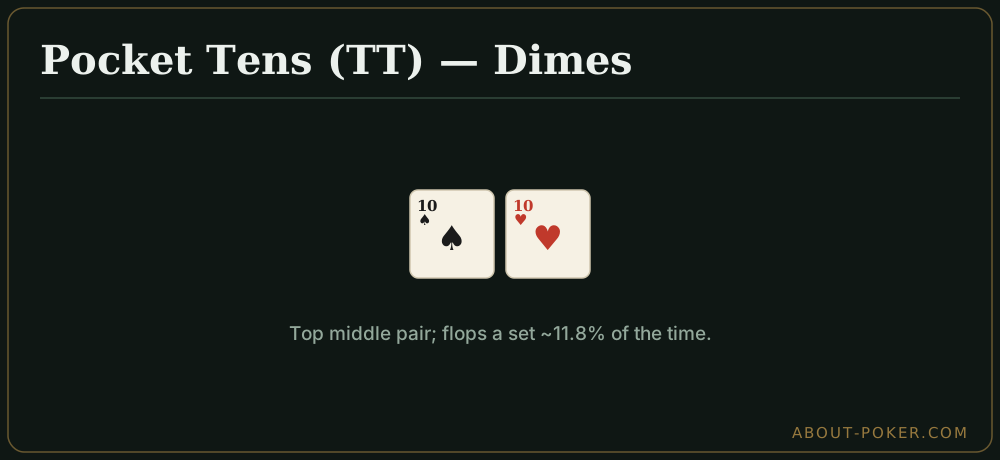
The go-to nickname for TT is Dimes. The logic is neat: a dime is worth ten cents, and the hand is a pair of tens. Other names you’ll come across:
- Tension — a pun on “ten-ten.”
- Boxcars — borrowed from dice slang, though it more often means double sixes; some tables use it for tens.
- The Tens — plain and always understood.
Dimes is the most widely used and the one you’ll hear most often.
How strong is TT, really?
Pocket tens is a strong pair. It beats every lower pair, dominates unpaired hands, and wins about 75% of the time against a random holding. What separates it from queens, kings, and aces is the number of ranks above it: there are four — jack, queen, king, and ace.
With four overcard ranks live, at least one higher card will hit the flop roughly 63% of the time when an opponent could hold those cards. So like jacks, tens flop an overpair less than half the time — meaning much of your value comes from either flopping a set or playing carefully on high boards.
Worked example: set-mining with tens
You call a raise in position with T♣ T♦. The flop comes T♠ 6♥ 2♣ — you’ve flopped a set of tens, a near-invisible monster on a dry board. This is the dream outcome, and it happens about 11.8% of the time you hold any pocket pair.
Now compare a more typical flop: K♦ 9♠ 4♥. Here your tens are an underpair to the king. If your opponent bets into you and shows real strength, your hand is often just a bluff-catcher. The difference between these two flops — a hidden set versus a vulnerable underpair — is the whole story of playing tens well.
Because tens don’t flop an overpair often, deciding when to build a big pot (you have a set or the board is low) versus pot control (an overcard flopped) is the core skill. The full framework lives in how to play pocket tens.
Using the term at the table
You’ll hear Dimes in lines like “flopped a set with the Dimes and stacked him,” or “had ten-ten and the board came all broadway, ugly spot.” Say “tens” or “Dimes” and everyone knows the hand.
Tens are the pair that rewards good post-flop judgment. Raise them confidently, set-mine when the price is right, and respect high boards. For the complete strategy, see how to play pocket tens, and browse more table talk in the poker slang guide.
Keep going
TT is the highest of the “middle” pairs — strong, flexible, and fun to set-mine. Learn more vocabulary in the poker terms glossary, explore colorful table talk in poker slang explained, and master the play in how to play pocket tens.
Where tens sit in the pecking order
It is worth being precise about where TT lands among the pairs, because the nickname can make it feel more casual than it is. There are thirteen possible pocket pairs, and tens are the fifth-strongest, behind only aces, kings, queens, and jacks. That puts TT firmly in the top handful of starting hands out of the 169 distinct combinations in Hold’em. Against a single random hand it wins about 75% of the time; against a lone overcard hand like ace-king it is a small favorite, roughly 55% to 45%, because those two live overcards give the opponent so many ways to catch up. The takeaway is that Dimes is a raising hand almost every time you look down at it — the only real question is how to navigate the flop.
The four-overcard problem in plain terms
The single fact that defines pocket tens is that four ranks beat a pair of tens outright: jacks, queens, kings, and aces. When any of those lands on the board, your tens are no longer the best possible pair, and you have to slow down. Because there are so many of these cards in the deck, at least one overcard shows up on a large share of flops. That is why experienced players talk about tens with a note of caution even though the hand is strong preflop. A clean, low flop like 8-5-2 is a green light to bet for value; a flop with a queen or king in it is a yellow light that turns your overpair dreams into a careful, pot-controlling hand-read. Knowing which flops help you and which ones threaten you is the entire art of playing Dimes, and it separates players who win with the hand from players who lose stacks overvaluing it.
The bottom line on the nickname
Call them Dimes at the table and everyone will know exactly what you mean — it is the standard, and it beats “ten-ten” for speed. Tension and Boxcars are fun to sprinkle in, but Dimes does the job. More importantly, remember what the name represents: a genuinely powerful pair that rewards aggression before the flop and disciplined reading after it.
Frequently asked
What is the nickname for pocket tens (TT)?
The most common nickname is Dimes, since a dime is worth ten cents. You'll also hear Tension (a play on 'ten-ten') and Boxcars.
Why are pocket tens called Dimes?
Because a dime is worth ten cents, and the hand is a pair of tens. The value-of-ten link made Dimes the natural nickname.
How strong is TT in poker?
Pocket tens is a strong, top-tier pair that beats all lower pairs and every unpaired hand before the flop. It's almost always worth raising, though it must dodge the four higher ranks after the flop.
Is TT better than AK?
Before the flop, pocket tens is a slight favorite over ace-king — about 55%. It's close to a coin flip because AK's two overcards give it many ways to improve.