What Is Aggression Factor in Poker?
Aggression Factor (AF) is the ratio of postflop bets and raises to calls. Learn how to calculate it, what a good AF is, and how to exploit passive and.
On this page · 6 sections
Aggression Factor (AF) is a HUD stat that tells you, in a single number, whether an opponent drives the action after the flop or mostly tags along calling. It is the ratio of how often they bet and raise to how often they call. Learn to read it and you can predict whether a player will fire the turn, fold to a raise, or call you down light.
What aggression factor measures
AF answers one question: after the flop, does this player push chips in on their own initiative, or do they wait and call? A high AF means an aggressive, betting-and-raising style. A low AF means a passive, calling style. Because it only counts postflop actions, AF is a pure read on how someone plays flops, turns, and rivers — it says nothing about how loose or tight they are before the flop. For that you read VPIP and PFR, covered in poker HUD stats explained.
How to calculate aggression factor
The formula is simple:
AF = (bets + raises) ÷ calls
Only postflop actions count. Checks and folds are ignored entirely. Suppose over a session you watch a player make 20 bets, 10 raises, and 15 calls after the flop. Their AF is (20 + 10) ÷ 15 = 30 ÷ 15 = 2.0. That is a healthy, standard aggressive number.
The obvious weakness: if the denominator is tiny, the ratio explodes. A player who bet once and never called shows an AF of infinity, which is meaningless on a small sample. That is why many regulars prefer aggression frequency, which uses all actions in the denominator and stays more stable.
What counts as a good AF
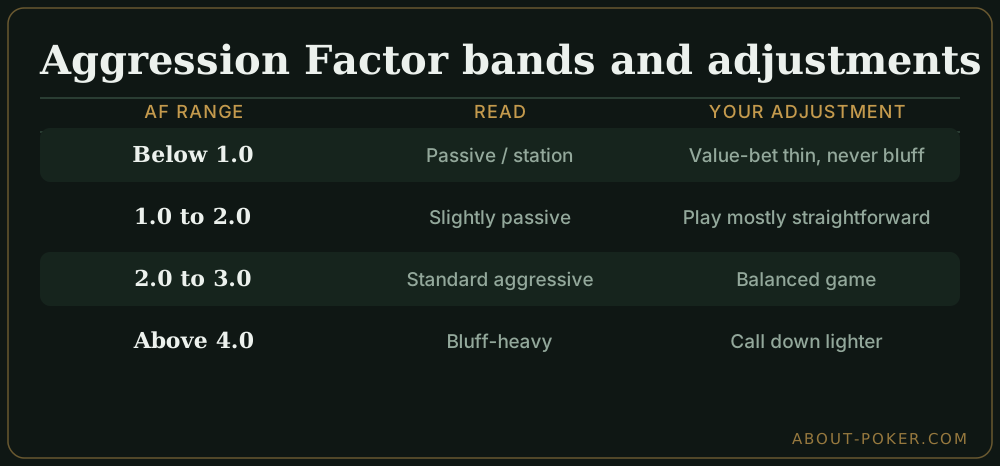
Here are the practical bands most players use for postflop AF:
- Below 1.0 — passive. This player calls more than they bet or raise. Value-bet them relentlessly and stop bluffing them.
- 1.0 to 2.0 — slightly passive to balanced.
- 2.0 to 3.0 — standard aggressive, typical of a solid winning regular.
- Above 4.0 — hyper-aggressive or bluff-heavy. You can call down lighter and let them barrel into your medium-strength hands.
These bands assume a reasonable sample — at least a few hundred hands. On 40 hands, AF is noise.
A worked example at the table
You are heads-up on the turn against a player whose HUD shows AF 0.8 over 900 hands. The board is Kh 9d 4s 2c. You hold Ah Qh — ace-high, no pair, a backdoor flush that just died. You bet the flop, they called; you bet the turn, they called again.
Against an AF of 0.8, calling twice almost never means a monster this player would have raised. But it also means they will not fold to a third barrel, because passive players call to showdown. The correct adjustment is to give up: check the river and fold to a bet. Your ace-high has showdown value against their missed draws, but firing a third barrel into a calling station is lighting money on fire. Against an AF of 3.5 in the same spot, a river bluff becomes far more attractive, because that player folds their own weak pairs and floats.
Common mistakes reading AF
The biggest error is trusting AF on a small sample. The second is reading it street-blind. A player can have a high overall AF but be timid on the river specifically, or vice versa. If your tracker supports it, break AF out by street — turn and river aggression matter far more than flop AF, because flop c-bets are near-automatic for most regulars. Learn the full workflow in how to read and use a poker HUD.
A third mistake is confusing AF with total aggression. A nit with AF 3.0 who only reaches the turn with the nuts is not “aggressive” in a way you should fear folding to — they are simply value-heavy. Always cross-reference AF against how many hands the player takes past the flop.
Quick checklist for using AF
- Confirm the sample is 200+ hands before trusting the number.
- AF below 1: value-bet thin, never bluff.
- AF 2 to 3: play a standard, balanced game.
- AF above 4: call down lighter, let them bluff into you.
- If possible, read turn and river AF separately from flop AF.
- Cross-check with how often they see showdown to avoid mislabeling a value-heavy nit as “aggressive.”
Read this way, AF becomes one of the fastest population reads on any HUD — a single glance tells you whether to bet for value, bluff, or simply get out of the way.
Frequently asked
What is a good aggression factor in poker?
For a solid postflop player, an AF between 2 and 3 is standard. Below 1 means the player mostly calls rather than bets or raises, which flags a passive station. Above 4 to 5 usually means the player is over-bluffing and you can call down lighter.
How is aggression factor calculated?
AF = (bets + raises) ÷ calls, measured across all postflop streets. Checks and folds are not counted. If a player made 30 bets and raises and 15 calls, their AF is 30 ÷ 15 = 2.0.
What is the difference between AF and aggression frequency?
AF is a ratio of aggressive actions to calls, so it can be distorted by a low call count. Aggression frequency is a percentage of all postflop actions that are bets or raises, which many players find more stable and readable.