What Is Total Hands Sample in Poker?
Total hands sample is the count of hands your HUD has on a player. Learn how big a sample each stat needs before its numbers are trustworthy.
On this page · 6 sections
Total hands sample is the count of hands your tracking software has recorded on a particular player, displayed somewhere on your heads-up display (HUD). It is the least glamorous number on your screen and the most important, because every other stat is only as trustworthy as the sample behind it. A gorgeous-looking 8 percent 3-bet means nothing if it is drawn from 15 hands. Learning to read sample size is what separates players who use a HUD well from players who get fooled by noise.
Why sample size governs everything
Each HUD stat is a statistical estimate. You are trying to learn a player’s true tendency from a limited number of observations, and small samples carry huge margins of error. Think of flipping a coin: after four flips you might see three heads and conclude the coin is biased, but after four hundred flips the estimate converges on the truth. Poker stats behave the same way. The total hands sample tells you how close to the truth each number is likely to be. This is closely related to how you judge a win rate, where variance means even a large sample can mislead.
How many hands each stat needs
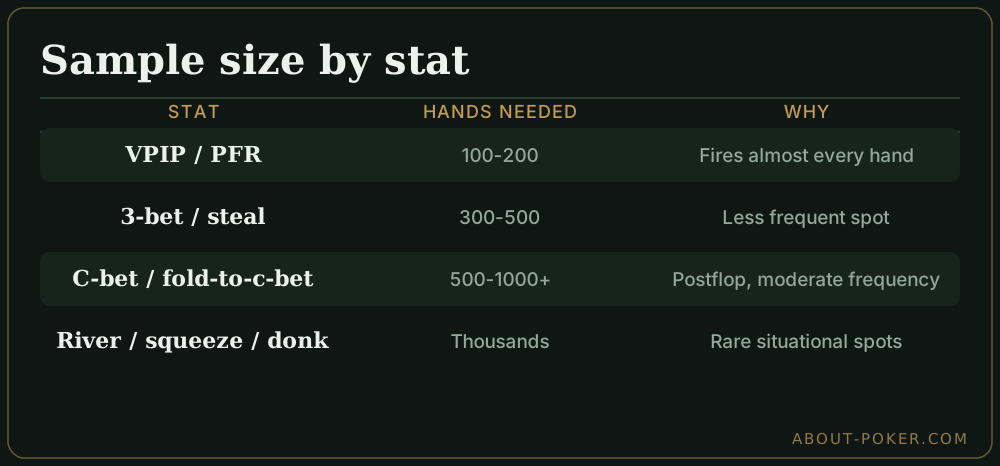
Different stats stabilize at very different rates, because they measure situations that occur at different frequencies. A rough guide:
- VPIP and PFR: Usable at 100 to 200 hands. These fire on almost every hand, so the sample builds quickly.
- 3-bet and fold-to-3-bet: Need roughly 300 to 500 hands. The spot is less frequent.
- Steal and fold-to-steal: A few hundred hands, since they depend on late-position situations.
- C-bet and fold-to-c-bet: Need several hundred to a thousand-plus hands.
- River bet, check-raise, squeeze, donk bet: Thousands of hands. These are rare, situational spots, and their numbers swing wildly at low samples.
The pattern is simple: the rarer the situation the stat measures, the bigger the total sample you need before it means anything.
A worked example
You sit down with a new player and after 40 hands your HUD shows them at VPIP 30, PFR 25, 3-bet 0. What can you actually conclude?
The VPIP and PFR, even at 40 hands, give you a directional read — this person is playing loose and aggressive preflop, roughly a loose-aggressive style. You can act on that, cautiously. But the 3-bet of 0 percent is nearly useless. Over 40 hands the player may simply not have faced a single good 3-bet spot; a 0 percent reading here is entirely consistent with a normal 8 percent 3-bettor who has not had the cards or position yet. If you tighten your opens because you think they “never 3-bet,” you are reacting to noise. The correct move is to trust the fast-stabilizing stats a little and default to population tendencies for the slow ones until the sample grows. Understanding this is central to how you read and use a poker HUD without fooling yourself.
How to display and use the sample
Always put the total hands count on your HUD, ideally right next to the player’s name. Many players color-code it: red under 100 hands, yellow up to 500, green beyond. That way a glance tells you how much weight to give the whole panel. A green sample of several thousand hands means you can trust even the situational stats; a red sample means lean on defaults and live reads.
When the sample is small, blend the HUD number with what most players in the pool do. If the population 3-bets around 7 percent and your 30-hand sample says 0, your working estimate should be close to 7, not 0. As hands accumulate, shift weight from the population default toward the observed number.
Common mistakes
The biggest mistake is treating all stats at one sample size as equally reliable — a 300-hand sample makes VPIP solid but leaves squeeze percentage meaningless. The second is over-adjusting to extreme readings from tiny samples, like folding to a “70 percent c-bettor” whose number comes from three hands. The third is forgetting that even large samples can lie about win rate because of variance, which is why sample size for tendencies and sample size for results are different questions. Read the total hands count first, every time, before you interpret any other number on your HUD panel.
Quick checklist
- Total hands sample is the count of recorded hands on a player.
- Preflop stats stabilize fastest; situational stats need thousands of hands.
- Display and color-code the sample so you know how much to trust the panel.
- Blend small-sample numbers with population defaults.
- Never over-adjust to extreme readings from tiny samples.
Frequently asked
How many hands do I need before HUD stats are reliable?
It depends on the stat. Preflop stats like VPIP and PFR stabilize fastest and are usable around 100 to 200 hands. 3-bet and steal stats need a few hundred. Postflop and situational stats like river bet or squeeze percentage may need thousands of hands before you should trust them.
Why does sample size matter so much for HUD stats?
Every stat is an estimate from a limited sample, and small samples are noisy. A 3-bet percentage of 0 percent over 10 hands tells you almost nothing, because the player simply may not have had a good spot yet. Larger samples shrink the margin of error and let you act on the number with confidence.
Can I use HUD stats on a player with very few hands?
You can use raw preflop tendencies cautiously, but treat everything as tentative and lean more on live reads and default population tendencies. With a small sample, weight your reads toward what most players do and update as the sample grows.