What Is Went To Showdown in Poker?
Went To Showdown (WTSD) is the share of flops a player carries all the way to showdown. Learn how it works, good ranges, and how to exploit stations and folders.
On this page · 6 sections
“Went To Showdown,” usually abbreviated WTSD, is the HUD stat that tells you how often a player, having taken a flop, ends up showing their hand at the river. It is the single clearest measure of how sticky an opponent is — whether they cling to hands and call you down or fold to pressure and let pots go. Once you can read it at a glance, you know whether to value-bet thin or lean on the bluff button.
What “went to showdown” measures
The stat is conditional: it only looks at hands where the player saw a flop, and asks how many of those reached showdown. It is a pure measure of postflop stickiness. A high number means the player refuses to fold and drags hands to the river; a low number means they surrender to aggression. Because it ignores preflop folds entirely, even a very tight nit can post a perfectly ordinary went-to-showdown figure. For where this fits among the other core numbers, see poker HUD stats explained.
How it is calculated
Went To Showdown = (hands reaching showdown ÷ hands that saw the flop) × 100
If a player saw 250 flops and 65 of those hands went to showdown, the stat reads 65 ÷ 250 = 0.26, or 26 percent. The denominator is flops seen — never total hands dealt — which is why the stat is insensitive to how loose or tight someone is before the flop.
What is a good number
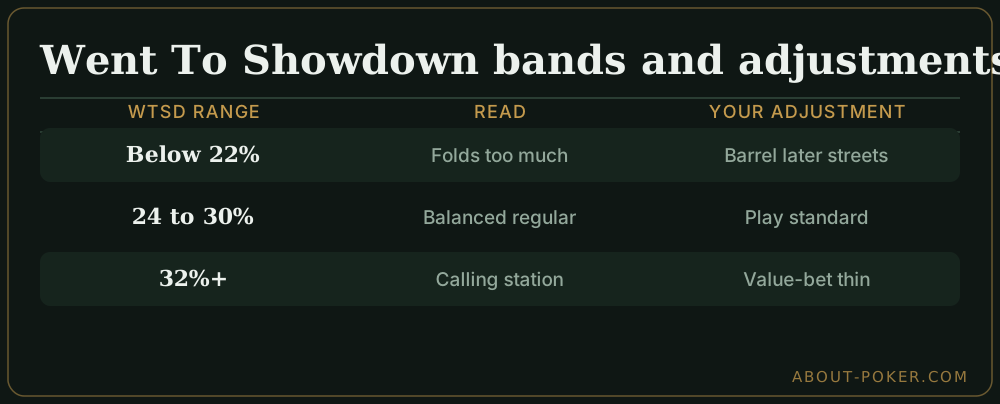
For no-limit six-max cash, the practical bands are:
- Below 22 percent — a folder. This player gives up too often before showdown, so barreling later streets prints money.
- 24 to 30 percent — balanced and standard, the range for solid regulars.
- 32 percent and above — a calling station. They drag too many weak hands to showdown, so you value-bet thin and stop bluffing.
Remember that a high figure alone is not “bad” — it depends on what they win. A player who reaches showdown often and wins often is simply seeing cheap showdowns; the leak is high WTSD paired with low won-at-showdown.
A worked example
You raise, get one caller, and the board comes 9h 6d 3c. Your opponent’s HUD reads WTSD 20 over 800 hands — a folder. You hold Ah Kh, two overcards and a backdoor flush, but no pair. You c-bet, they call. The turn is the 2s and you still have nothing but ace-high.
Against a WTSD of 20, a second barrel on the turn is highly profitable. This player reaches showdown in only one flop in five, which means they are folding the other four-fifths of the time — including plenty of weak pairs and missed draws that beat your ace-high right now. Firing the turn turns your air into a profitable bluff. Against a WTSD of 33 station in the same spot, that turn barrel is a mistake: they call with any pair and you should give up.
Common mistakes
The most frequent error is reading went-to-showdown without its partner, won-at-showdown. Together they classify a player instantly: 27/54 is a strong opponent, while 33/44 is a losing station. See what is won at showdown in poker for the other half.
The second mistake is trusting the stat on small samples. Showdown numbers stabilize slowly; a couple of memorable hands can distort the figure until you have 300 to 500 hands logged. The third is treating a tendency as a certainty — even a folder occasionally calls you down, so a single failed bluff does not mean the read was wrong.
A fourth, quieter mistake is failing to weigh it against the player’s aggression. A folder with a low went-to-showdown who also has a high aggression factor is not simply passive — they are folding when they have nothing and betting hard when they connect, which means their river bets deserve respect even though their overall stat says “bluffable.” Read the number as one input, not a verdict.
Quick checklist
- Require a 300+ hand sample before leaning on it.
- Below 22: barrel later streets, they fold too much.
- 24 to 30: play a standard, balanced game.
- 32+: value-bet thin, retire the bluffs.
- Always read it beside won-at-showdown, never solo.
- High went-to-showdown plus low won-at-showdown equals a losing station.
Read alongside aggression and won-at-showdown, “went to showdown” tells you before you act whether the player across from you can be bluffed or must be value-bet — the two most important questions on every river.
Frequently asked
What does went to showdown mean in poker?
It is the percentage of hands, out of those where a player saw the flop, in which they reached showdown and had to show their cards. It measures how often an opponent calls or bets all the way to the river instead of folding earlier.
What is a normal went to showdown percentage?
For six-max cash, roughly 24 to 30 percent is standard. Below 22 percent means the player folds too readily before showdown, while above 32 percent flags a loose calling station.
Does went to showdown count preflop folds?
No. The stat is conditional on seeing the flop. Hands folded before the flop are excluded from both the numerator and the denominator, so a very tight preflop player can still show a normal went-to-showdown figure.