Final Table Deal-Making
How final table deals work: ICM vs chip-chop methods, when a deal is +EV, how to negotiate leftover money, and a worked three-handed example.
On this page · 6 sections
A final table deal is a private agreement among the last players to split the remaining prize pool differently from the posted payouts. Instead of letting all-in coolers decide who takes the biggest jumps, the players lock in money now. Deals are legal and common at most live and online final tables, though the tournament staff or site must usually approve and process them.
The core reason deals exist is variance. Near the top of a tournament, the pay jumps are enormous, and a single flip can swing tens of thousands of dollars. A deal lets everyone convert some of that gamble into cash. Understanding the two main math methods — and when a deal is actually good for you — is a real edge.
Chip-chop versus ICM
There are two standard ways to price a deal. A chip-chop simply divides the remaining money in proportion to chip stacks. It is fast but wrong: chips are not linearly valuable this deep, because you cannot win more than first place no matter how many chips you hold. A chip-chop systematically overpays the chip leader and underpays the short stacks.
The ICM deal (Independent Chip Model) fixes this. ICM converts each stack into its share of tournament equity by summing the probability of finishing first, second, third, and so on, then multiplying by each payout. Short stacks come out ahead of their raw chip percentage because they still have a live claim on the top prizes even with few chips.
Most experienced players insist on ICM. If you are short, a chip-chop robs you; if you are the leader, you can sometimes talk the table into a chip-chop or a hybrid that pays you extra. Knowing which method favors you before you speak is half the negotiation.
A worked three-handed example
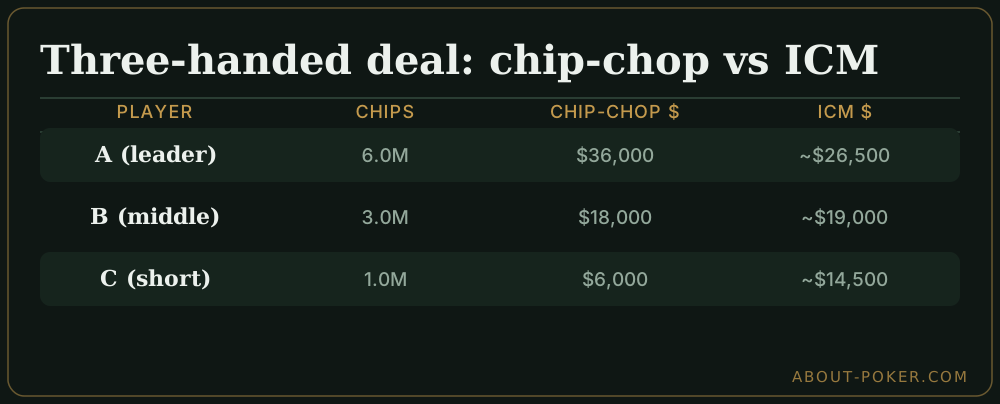
Say three players remain with $30,000, $18,000, and $12,000 left to play for. Payouts are first $30,000, second $18,000, third $12,000 — total $60,000. Chips are: Player A 6,000,000, Player B 3,000,000, Player C 1,000,000 (10,000,000 total).
A pure chip-chop pays A 60% of the pool = $36,000, B 30% = $18,000, C 10% = $6,000. But C is guaranteed third money ($12,000) just by sitting down, so $6,000 is absurd — no one accepts that.
Under ICM, C’s equity is close to $13,000–$14,000 because they lock third and have a real shot at second. A lands around $26,000–$27,000, and B around $19,000. The leader “loses” roughly $9,000 versus the chip-chop, which is exactly the money a chip-chop wrongly stole from the short stacks. This is why the payout structure and stack sizes drive every deal.
How deals get negotiated
Real deals rarely land on the exact ICM number. A common move is to run an ICM calculation, then leave the difference between the top two payouts — or a few thousand dollars — on the table to still play for. This preserves a competitive incentive and satisfies staff who want a “winner.”
If you are the chip leader with a large skill edge, push for a chip-chop or ICM-plus-a-premium, since your true equity may exceed ICM because you will outplay opponents. If you are short but confident, you can decline entirely; your fold equity and shove leverage are still worth chips, as covered in final table strategy.
When a deal is the right call
Take a deal when the remaining pay jumps are large relative to your bankroll and the field is tough. Locking in equity is simply good risk management — the same logic behind laddering up the payouts. Also take it when you are the short stack and someone offers you ICM or better.
Decline when you hold a decisive skill edge, when the offer underpays your stack, or when you specifically value the title and the top prize. A big stack against weak opponents should often play on.
Common deal-making mistakes
- Accepting a chip-chop while short-stacked — you are handing the leader your equity.
- Agreeing verbally without staff confirming the numbers and holding the money.
- Forgetting the trophy, points, or leaderboard value that a deal cannot capture.
- Letting an aggressive table captain rush you; you can always ask to run the ICM math first.
- Ignoring blind level and stack depth — with 8-big-blind stacks, ICM and chip-chop nearly converge, so the fight is smaller than it looks.
Quick deal checklist
Before you shake hands, confirm: the exact remaining pool, each current stack, which method is being used, whether staff will process it, and how much (if any) is left to play for. Run the ICM numbers, compare them to your honest read of your edge, and only sign when the figure beats what you would expect by playing it out.
Frequently asked
What is a final table deal in poker?
A final table deal is an agreement among the remaining players to redistribute some or all of the remaining prize money instead of playing it out for the posted payouts. It locks in a chunk of the pool so variance no longer decides how much everyone earns.
What is the difference between a chip-chop and an ICM deal?
A chip-chop divides the money in proportion to each player's chip stack, which overpays the leader. An ICM deal weights stacks by their real tournament equity, giving short stacks more than their raw chip share because they still have a claim on the top prizes.
Should I always take a deal?
No. Take a deal when the numbers are fair for your skill edge and the swings are large relative to your bankroll. Decline when you are a clear best player, when the offer underpays your stack, or when leaving money on the table for first place matters to you.