Min-Cashing vs Going for the Win
Min-cashing vs going for the win: how ICM, payout structure, and your edge decide when to protect a cash and when to build a stack that can win it all.
On this page · 5 sections
Min-cashing versus going for the win is one of the most misunderstood decisions in tournament poker. The instinct to lock up a cash is strong, but the math is clear: in almost every standard tournament, the payouts are steeply top-heavy, so a strategy built around protecting min-cashes leaves the vast majority of the prize pool on the table. Your job is to know the rare spots where survival genuinely outweighs upside — and to play for the win everywhere else.
The confusion comes from mixing two different currencies: how it feels and what it is worth. Busting shy of the money feels terrible, so players overweight survival. But the trophy and the top prize are where the value concentrates, and disciplined aggression toward that goal is what separates winning players from break-even ones.
Where the money actually is
Look at a typical MTT payout. The min-cash is often a little more than your buy-in, while first place can be hundreds of times the buy-in. The top three or four spots frequently hold half or more of the entire prize pool. That distribution means the chips that carry you from a min-cash to a deep finish are worth enormously more than the chips that merely get you into the money.
This is the core of chip accumulation versus survival. Early and in the middle stages, chips are close to linear in value, so building a stack that can contend for the win is simply the highest-EV plan. Playing scared to protect a cash you have not even reached yet is backwards.
When ICM says protect the cash
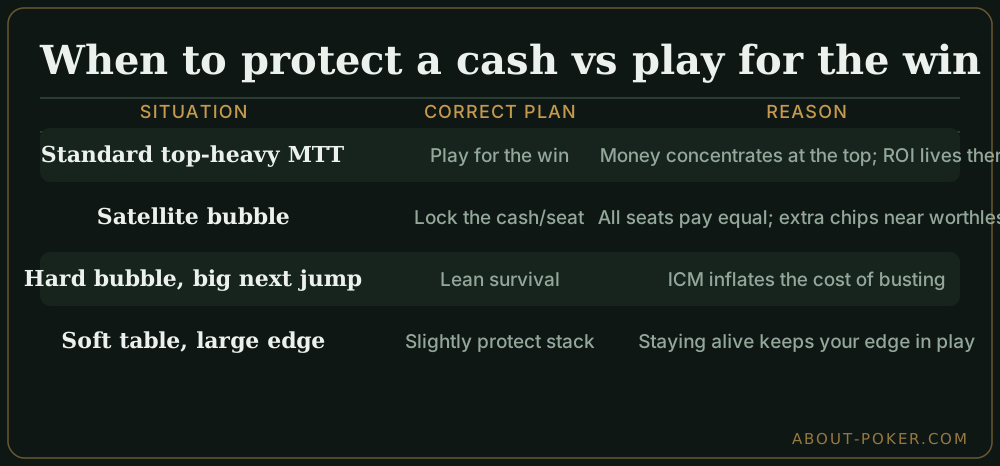
ICM — the Independent Chip Model — is the tool that tells you when survival really is worth more than upside. On a hard bubble, on a satellite where the top N finishers all win the same seat, or on a flat payout structure, the value of not busting can exceed the value of the chips you would win. In those spots, folding a hand that is a slight chip-EV favorite is correct because the dollar-EV favors survival.
The clearest case is the satellite bubble, where every seat pays exactly the same and extra chips beyond the amount needed to lock a seat are close to worthless. There, min-cashing — locking the seat — is the entire game and gambling for chips is a mistake.
A worked example
Two spots left before a huge pay jump, and you hold AK on a 20 big blind stack. A covering big stack jams into you. Against a jamming range, AK is often around 55 to 60 percent equity, so in a cash game or by pure chip EV this is a snap call.
But suppose the next pay jump is 40 percent more money and busting here drops you to nothing above the current tier. ICM shrinks the value of the chips you would win and inflates the cost of busting. Run it through an ICM calculator and a hand that is a chip-EV call can become a fold, because you risk a large real-dollar loss to gain chips that are worth less than they look. Change the scenario — a normal middle-stage spot with linear payouts — and the same AK is an easy call, because now you should be building toward the win.
Your edge changes the answer
If you are clearly the best player at a soft table, survival gains value: staying alive lets you keep exercising a large edge, so you can lean slightly toward protecting your stack. If the table is tough and your edge is thin, you should be more willing to gamble for chips, because a big stack is what lets you push others around and manufacture spots.
Recreational players buying into a major for a shot at a life-changing score reasonably value the min-cash more, since it returns their investment. That is a legitimate personal preference, but understand it costs long-run EV. The math and the money both live at the top, as detailed in the min-cash vs first-place breakdown.
A framework for the decision
- Default to playing for the win — top-heavy payouts reward it and it maximizes ROI over a large sample.
- Lean toward protecting a cash only when ICM says so: satellite bubbles, hard bubbles, flat structures, or when you dominate a soft table.
- Use an ICM calculator to check call-offs near big pay jumps rather than trusting your gut, which overvalues survival.
- Never confuse the emotional pain of busting with the actual dollar value of a decision.
- Build stacks in linear-value stages so you have the ammunition to contend when it matters.
Frequently asked
Is it better to min-cash or play to win?
For pure chip EV, playing to win is usually correct because the top payouts dwarf the min-cash. But ICM, a soft table where your edge is large, or a satellite structure can make protecting a cash the higher expected-value choice in specific spots.
When should I just take the min-cash?
When the marginal chips you would risk are worth far less than the pay jump you would lose, such as on a satellite bubble or a flat payout structure. Also when you are a recreational player prioritizing a return on a big buy-in.
Does going for the win hurt my ROI?
No. Over a large sample, a strategy oriented toward top-heavy finishes produces the highest ROI because that is where the money is. Min-cashing every time caps your upside and slowly bleeds ROI even though it feels safe.