Nash Equilibrium Shoving in Tournaments
Nash equilibrium shove charts give you an unexploitable push-fold baseline for short stacks. Here's how they work, their limits, and a worked 10bb example.
On this page · 5 sections
Nash equilibrium shove charts are a game-theory tool for short-stack tournament play. They tell you, for a given stack depth and position, the widest range you can move all-in with — and the range an opponent should call you with — such that neither of you can profit by deviating. They’re the mathematical backbone underneath every good push-fold strategy, and understanding them makes your short game far more precise.
What “equilibrium” actually means
A Nash equilibrium is a pair of strategies where each player is doing the best they can given what the other is doing. In push-fold terms: the shover jams exactly the range that’s profitable against the caller’s calling range, and the caller calls exactly the range that’s profitable against the shover’s jamming range. Lock both in and neither can improve by shoving wider, calling looser, or tightening up.
The practical payoff is that Nash ranges are unexploitable. If you shove the Nash range, an opponent can’t punish you no matter what they do — the worst they can do is break even against you. That makes Nash a rock-solid default when you don’t have a read.
How the charts are built
Nash push-fold charts are computed for heads-up, chip-EV situations. The inputs are stack depth in big blinds and the number of players yet to act. The output is two ranges:
- The shoving range — how wide the aggressor can jam.
- The calling range — how wide the defender can call.
As your stack gets shorter, both ranges widen. At 5bb the shove range is enormous — from the button it’s well over half of all hands. At 15bb it tightens considerably, because opponents can call you more selectively when calling costs less of their stack relative to the pot.
The big caveat: ICM and real opponents
Here’s where players get burned. Nash charts assume every chip is worth the same and that opponents call perfectly. Neither is true in a tournament.
- ICM pressure. Near a bubble or a pay jump, busting costs you more equity than doubling gains you. That means you should shove tighter than Nash and call much tighter than Nash. See how ICM works for the underlying reasoning.
- Imperfect callers. If your opponents call too tight, you can shove wider than Nash and profit. If they call too loose, you tighten your shoves and let them make mistakes. Nash is the baseline; reads move you off it.
So treat Nash as your unexploitable starting point, then adjust in whichever direction the situation demands.
Worked example: 10bb on the button
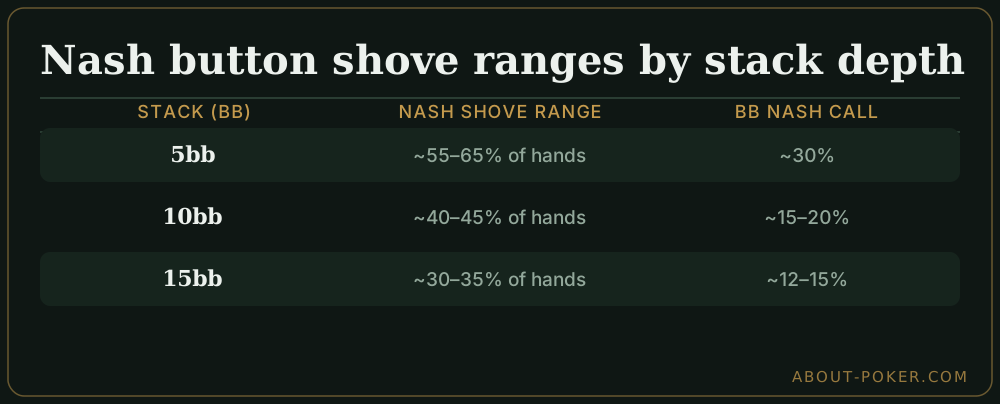
You have 10bb on the button, folded to you, and you’re deciding whether to jam. A standard Nash chart says a 10bb button shove range is roughly 40–45% of all hands — every pair, every ace, most suited kings and queens, most suited connectors, and a chunk of offsuit broadways.
Say you hold Kc-9c. That’s comfortably inside a 40% range, so it’s a clear Nash jam. The big blind, per the equilibrium, should only call around 15–20% of hands here — mostly pairs and strong aces. Against that tight calling range, K9s does fine: it wins the blinds and antes when they fold and holds meaningful equity when they call.
Now change the situation: it’s the money bubble and the big blind is a big stack who covers you. ICM says you should shave the bottom of your range — hands like K9s become closer, and truly marginal jams like Q7s or J8s should be folded even though Nash green-lights them. The chart didn’t change; the tournament context did.
Using Nash charts the right way
Memorizing exact ranges matters less than internalizing their shape: shove wider from later positions, wider as you get shorter, and call much tighter than you shove. Pair that intuition with an awareness of stack sizes around you, as covered in short-stack tournament strategy, and you’ll make the right push-fold decision far more often than a player relying on feel alone.
Frequently asked
What is Nash equilibrium shoving in poker?
Nash equilibrium shoving refers to push-fold ranges derived from game theory, where the shover's range and the caller's range are in balance so that neither player can improve by unilaterally changing their strategy. The result is an unexploitable baseline for short-stack all-in decisions.
Are Nash charts always correct?
No. Nash charts assume a heads-up, chip-EV world with no ICM pressure and opponents who call perfectly. In real tournaments, ICM, bubble dynamics, and opponents who call too tight or too loose all shift the correct range away from Nash.
Should beginners memorize Nash charts?
Learning the general shape of Nash ranges by position and stack depth is valuable, but rote memorization is less useful than understanding the logic. Use them to build intuition for how wide you can shove, then adjust for ICM and opponent tendencies.