Re-Steal Zone Tournament Strategy
The re-steal zone (~15-25bb) is where you punish loose openers by jamming over the top. Here's the range, the math, and a worked 20bb re-steal spot.
On this page · 8 sections
The re-steal zone is the stack range — roughly 15 to 25 big blinds — where your best preflop weapon is the all-in re-raise over an opponent’s open. You’re too shallow to comfortably flat and outplay people after the flop, but deep enough that your jam still carries real fold equity. Used well, the re-steal turns other players’ loose stealing into free chips for you.
Why this stack range is special
Below 15bb you’re mostly open-shoving yourself; above 25bb you can flat and 3-bet small because there’s room to fold to a 4-bet. The 15–25bb band sits in between. Here, a normal 3-bet to 6bb commits so much of your stack that you can’t fold to a shove — so you skip the middle step and jam directly. That’s the re-steal.
The play targets one specific tendency: late-position players opening too wide. When the button or cutoff raises to 2.2bb with a wide stealing range, most of their hands can’t call a 20bb jam. Every time they fold, you scoop their raise plus the blinds and antes.
The re-steal math
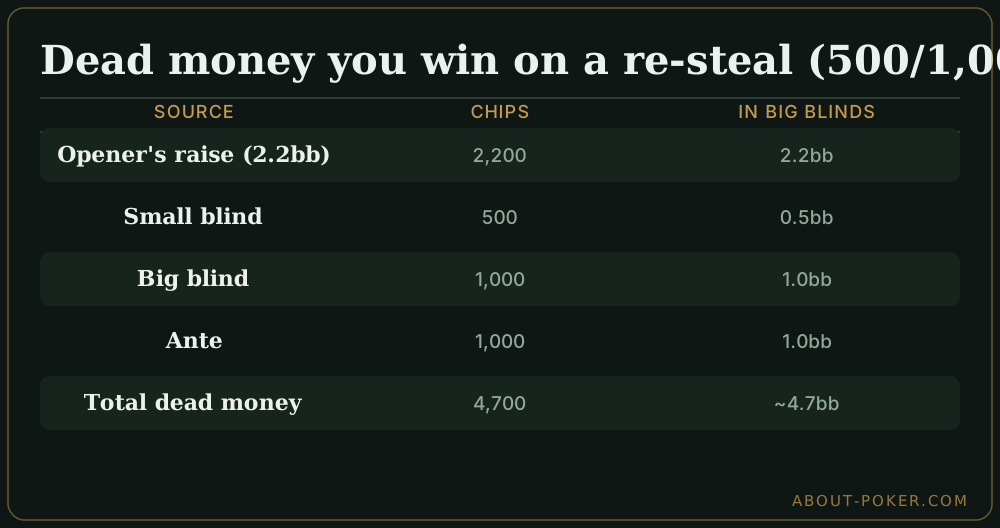
The re-steal is a fold-equity play. Break down what’s in the middle when a button opens to 2.2bb at 500/1,000 with a 1,000 ante:
- Opener’s raise: 2,200
- Small blind: 500
- Big blind: 1,000
- Ante: 1,000
- Total dead money: 4,700 — about 4.7bb
If you jam 20bb over the top and win it uncontested, you gain 4.7bb, or roughly a 24% stack increase, risking nothing at showdown. You don’t need a strong hand to profit; you need a hand that (a) folds out enough of their range and (b) still has equity when called. That combination — not raw hand strength — is what defines a good re-steal.
Which hands to jam
The ideal re-steal hands are ones that make poor flat-calls but fine jams:
- Suited aces (A2s–A9s): blocker to their strong aces, plus a live over-card and flush potential.
- Suited kings and broadways (KTs, KJs, QJs, KQ): decent equity, good blockers.
- Small-to-medium pairs (55–99): you’re rarely dominated, and you flip against most calling hands.
You generally want to avoid re-stealing with the very top of your range — hands like AA, KK, AK — against a wide opener, because those want the opener to keep betting. Trap or 3-bet small with those; jam the medium-strength hands that gain most from fold equity. This distinction is the same logic behind three-bet and four-bet ranges.
Worked example: 20bb in the big blind
Blinds 500/1,000, 1,000 ante. The cutoff opens to 2,200 with what you read as a wide 30% steal range. You’re in the big blind with 20,000 chips (20bb) holding As-7s.
Flatting is awful — you’d be out of position with a 17.8bb stack and a hand that flops top pair only sometimes. Instead you jam all 20bb. The cutoff must now risk 18,800 more to win the pot, so they fold most of their 30% range — all the small suited connectors, offsuit broadways, and weak aces. When they do call, it’s usually with a pair or a strong ace, and A7s still has around 30–35% equity there plus a live ace and the nut-flush draw.
Add up the outcomes: you win 4.7bb outright most of the time and you’re never drawing dead when called. That’s a clearly profitable jam, and it’s invisible on the table sheet — it just looks like a shove.
The fold-equity math you actually need
You don’t have to solve anything at the table, but one back-of-envelope idea makes re-steals click. When you jam 20bb to win 4.7bb of dead money, you’re risking 20 to win 4.7, so you need the opener to fold roughly 20 / (20 + 4.7), or about 81% of the time, for the jam to break even on fold equity alone. That sounds high — but you’re not relying on folds alone. Every time you get called you still carry 30-40% equity with a hand like A7s, so your real break-even fold frequency is well under that. Against a 30% opener who folds most of that range to a shove, you clear the bar comfortably. The takeaway: the more dead money in the middle (bigger antes, blind-vs-blind spots), the lower the fold frequency you need, and the wider you can re-steal.
How position and stack depth shift the range
The 15-25bb band isn’t uniform. At the top of it (23-25bb) you have a little more rope, so you can occasionally three-bet non-all-in with your very strongest hands and keep a jam-heavy strategy for the medium ones. At the bottom (15-17bb) almost everything becomes a jam, because a small three-bet commits you anyway and stripping out the fold-to-a-4-bet option costs nothing.
Position matters just as much. Re-stealing from the big blind is cheapest — you already have 1bb invested and you close the action. From the small blind you still close against a lone late opener but risk a bit more. Re-stealing from the cutoff over a hijack open is fine too, but now there are players behind who can wake up, so tighten your jamming range and lean harder on hands with real equity when called.
Common re-steal mistakes
- Jamming into a nit. Against a 12% UTG opener your fold equity is near zero and you’re flipping or dominated. Save re-steals for wide late-position raisers.
- Re-stealing your monsters. Blasting AA or AK over a wide opener folds out the exact hands you want to keep in. Trap or three-bet small with the top of your range.
- Ignoring stacks behind you. A big stack in the blinds who can call light kills your fold equity. Re-steal when the opener is the only player who can act.
- Picking hands with no backup. Offsuit junk like J8o folds out hands but is drawing thin when called. Prefer suited aces, suited kings, and pairs that flip.
Reading the opener before you fire
The re-steal lives and dies on your read. Jam it against players who open wide and fold to pressure. Against a nit who opens 12% under the gun, your re-steal has almost no fold equity and you’re flipping or dominated. Track who’s stealing light, note their position, and save your re-steals for the loose late-position raisers who are handing you the chips. When you slip below 15bb, the tool changes — see short-stack tournament strategy for open-shoving ranges, and blind stealing and steal defense for reading which opens are light enough to punish.
Frequently asked
What is the re-steal zone in poker?
The re-steal zone is roughly 15 to 25 big blinds, where your stack is too shallow to flat and play postflop comfortably but deep enough to have real fold equity when you jam over an opponent's raise. In this zone the re-steal — shoving all-in over a suspected steal — becomes a core weapon.
What hands should I re-steal with?
The best re-steal hands play poorly as flat calls but have decent equity when called: suited aces, suited kings, small-to-medium pairs, and hands like KJ or QT suited. You are jamming for fold equity first and backup equity second.
Why not just call the raise instead of re-stealing?
At 15 to 25 big blinds, flatting leaves you with an awkward stack-to-pot ratio and forces you to play out of position postflop. Jamming captures the dead money immediately when they fold and removes all difficult decisions.