Rebuy Period Strategy
How to play the rebuy period profitably: when to gamble for chips, when to preserve, whether to auto-rebuy, and why the add-on is almost always worth taking.
On this page · 6 sections
The rebuy period is the opening stretch of certain tournaments during which you can buy more chips if you fall to or below the starting stack, capped by a time limit or a set number of rebuys. Because you can reload, the usual rule that your stack is sacred is relaxed, and that changes correct strategy in ways that trip up players used to freezeouts.
How the rebuy option changes chip value
In a freezeout, losing your chips ends your tournament, so survival is paramount from the first hand. During a rebuy period, busting simply means paying to reload, so the downside of losing a stack is bounded by the cost of a rebuy rather than by elimination. That lowered downside means chips you already hold are worth a bit less in survival terms, which justifies a moderately looser, more aggressive approach than you would take in an equivalent early-stage freezeout.
The right mental frame is that you are buying chip-accumulation opportunities. Getting chips in with an edge, even a thin one, is more attractive when the cost of losing is a reload rather than a bust. But this is a nudge, not a license to punt.
When to gamble and when to preserve
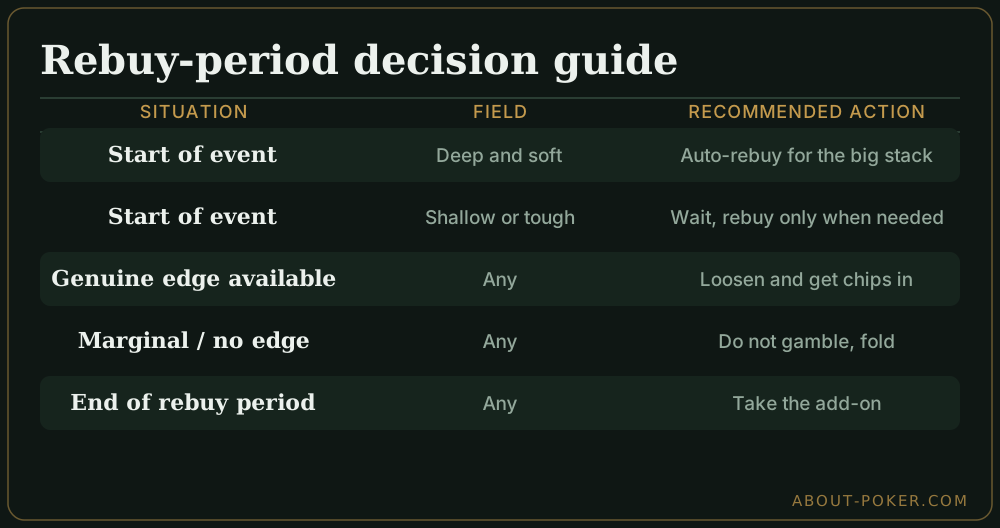
Loosen up for genuine edges: draws with fold equity, coin-flip spots where doubling meaningfully improves your position, and thin value bets against players who cannot fold. Building a big stack early in a rebuy event is valuable because it lets you pressure the table once the rebuy period closes and everyone else tightens.
Do not, however, treat the rebuy period as a slot machine. Every rebuy is real money, and a player who reloads five times has spent five buy-ins to reach the same point a disciplined player reached for one. The profitable version of loose play is edge-seeking aggression, not blind gambling. If your reads are soft or your hand is genuinely bad, folding is still correct.
The auto-rebuy question, worked out
Many events let you sit down and immediately double your starting stack via an optional first rebuy. Suppose the event starts everyone at 5,000 chips and the rebuy is available at any point at or below 5,000 for the same price as the buy-in. Taking it at the start gives you 10,000 chips for two buy-ins.
Whether to auto-rebuy depends on the field and the structure. In a deep, soft field where a big stack lets you run over weak opponents, the extra chips are worth well more than their price, and auto-rebuying is strong. In a shallow or tough field, doubling your investment before playing a hand is a bigger financial risk with a smaller edge, so waiting until you actually need chips is more prudent. There is no universal answer, but the deeper and softer the field, the more attractive the immediate reload.
Why the add-on is almost automatic
At the end of the rebuy period you are usually offered a one-time add-on: a chance to buy a fixed chunk of chips, often more than a rebuy grants, at a fixed price. The add-on is typically the cheapest chips in the entire tournament, priced far below their real tournament value, and it carries no risk because the reloading window is over and you have already survived. Take it in nearly every case.
The only marginal exception is when your stack is already so dominant that the add-on chips barely change your equity, and even then the low price usually makes it correct. The detailed math on this decision lives in the rebuy and add-on strategy guide, and the broader reloading picture is covered in rebuy and re-entry strategy.
Common rebuy-period mistakes
The most expensive mistake is treating rebuys as free chances and gambling recklessly, burning through buy-ins to end up average-stacked. Each reload has a real dollar cost and a real breakeven.
The second mistake is playing the rebuy period exactly like a freezeout, missing the profitable spots where the reload option justifies a looser call. The third is skipping the add-on to save money, which forfeits the cheapest and safest chips available. The fourth is failing to budget: decide before you sit down how many rebuys you are willing to fund, so tilt does not turn one buy-in into six.
Rebuy-period checklist
Ask yourself: How many rebuys am I willing to fund, and have I set that limit in advance? Is this a genuine edge worth loosening for, or am I gambling because I can reload? How soft and deep is the field, which tells me whether an early or auto rebuy is worth the extra investment? And when the period ends, am I taking the add-on, which is nearly always correct? Discipline plus edge-seeking aggression, not reckless reloading, is what turns the rebuy period into an advantage.
Frequently asked
Should I always take the add-on in a rebuy tournament?
Almost always, yes. The add-on is usually the cheapest chips you can buy in the whole event, priced far below their tournament value, and there is no risk since you already survived the rebuy period. The main exception is if your stack is already so enormous that the extra chips barely move your equity, and even then taking it is rarely a mistake.
Is it correct to gamble more during the rebuy period?
Somewhat. Because you can buy back in, your stack is less precious than in a freezeout, so marginally loosening to build chips can be right. But do not spew: a rebuy costs real money, and stacking chips through good play is better than repeatedly reloading. Gamble with an edge, not for its own sake.
What is the difference between a rebuy and a re-entry?
In a rebuy you buy more chips at the same table without leaving your seat, usually while sitting at or below the starting stack. In a re-entry you must bust out completely and then register again as a new entry, often at a fresh seat. Rebuys tend to allow topping up mid-hand-cycle; re-entries require elimination first.