Turbo MTT Adjustments
How to adjust for turbo MTTs: play looser and earlier, master push-fold, and accept more variance as fast blinds shrink stacks and shorten every decision.
On this page · 6 sections
A turbo multi-table tournament uses fast blind levels, so the deep-stacked, postflop-heavy phase you get in a normal event barely exists. Within a few levels everyone is short, decisions collapse to shove-or-fold, and the tournament becomes a rapid-fire contest of preflop aggression and equity. Adjusting means playing looser, playing earlier, and accepting that variance is the price of admission.
Why fast blinds compress everything
Chip stacks are measured in big blinds, not in raw chips, and in a turbo the big blind climbs quickly while your stack does not. A stack that starts at 100 big blinds can be 25 big blinds in an hour and 12 not long after, purely from the escalating levels and antes eating into it. That compression drags you into short-stack territory far sooner than a standard structure, so the skills that matter shift from deep-stacked maneuvering to disciplined all-in play. The mechanics of the fastest formats are covered in the turbo and hyper-turbo strategy guide.
The practical consequence is that you cannot afford to wait. Folding for orbits hoping for aces will simply blind you down to a stack with no fold equity. You must generate chips actively and early.
Loosen up and attack earlier
Because premium hands are scarce and time is short, your opening and shoving ranges should widen. Steal blinds and antes relentlessly from late position, re-steal against opponents who open too much, and take marginal edges you might pass up in a slow event. The antes matter enormously here: the dead money in every pot rewards aggression, and stealing it repeatedly is often the difference between grinding up and blinding out.
This does not mean playing badly. It means recognizing that the correct range for a given stack depth is wider when you have fewer orbits to act, and that passivity is punished faster in a turbo than in any other format.
Master push-fold, with a worked spot
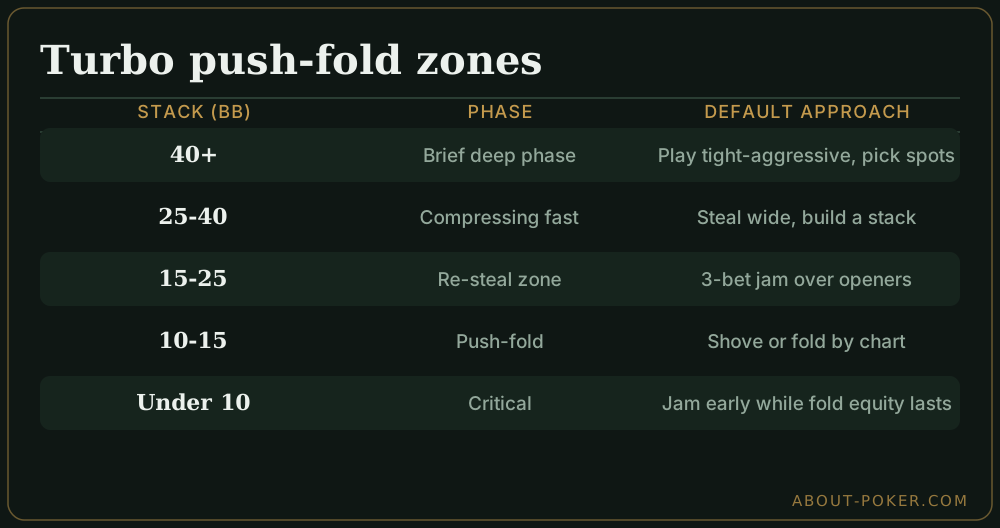
Once you drop below roughly 15 big blinds, most of your preflop decisions become shove or fold, and getting these right is the single most important turbo skill. Study a shoving chart until it is second nature; the short-stack push-fold framework and Nash equilibrium shoving ranges give you the reference ranges.
Here is a concrete spot. It folds to you on the button with 10 big blinds and a hand like Kh 9h. In a deep game this is a routine raise-fold; with 10 big blinds and only the blinds behind you, it is a clear jam. Your fold equity plus the antes and blinds make shoving profitable against the two random ranges in the blinds, and K9 suited has enough equity when called that the play prints. Waiting for a better hand costs you the antes and shrinks your fold equity every orbit. In turbos, that jam is standard, not aggressive.
Accept and manage the variance
Turbos are high-variance by design. When most pots are preflop flips, a single card can end your day no matter how well you played the hand. Over one tournament, luck dominates; over a large sample your edge shows up. That means two things. First, do not let a bad beat in a turbo shake your process, because the format guarantees swings. Second, manage your bankroll for the higher variance by playing more events and smaller stakes relative to your roll than you would for slow structures. Volume smooths the ride.
Common turbo mistakes
The biggest mistake is importing slow-structure patience into a turbo and blinding out while waiting for hands that never come. The second is misplaying the push-fold zone, either shoving hands that are too weak or, more commonly, folding shoves that are clearly profitable. The third is neglecting fold equity: once you drop under about 8 to 10 big blinds your shoves get called far too light, so it is often correct to jam a bit earlier while you still have real fold equity. The fourth is emotional: reacting to turbo variance as if it reflects your skill, and tilting off buy-ins as a result.
Turbo adjustment checklist
Run through this each event: What is my stack in big blinds, and am I already in the push-fold zone? Am I attacking blinds and antes aggressively enough given how few orbits I have? Do I still have fold equity, or do I need to jam earlier before it evaporates? Is this a spot where a standard chart says shove even though the hand feels marginal? And am I bankrolled and mentally prepared for the variance a turbo guarantees? Get those right and the fast structure becomes an edge over players still trying to play it slow.
Frequently asked
How is a turbo MTT different from a regular one?
A turbo has much shorter blind levels, often five to eight minutes instead of fifteen or twenty, so stacks shrink in big-blind terms far faster. That compresses the whole tournament into a shove-heavy, short-stack game much sooner, and it dramatically increases variance because you make fewer, higher-leverage decisions.
Should I play tighter or looser in a turbo?
Looser and more aggressively, especially preflop. With less time to wait for premium hands, you must attack blinds and antes and get chips in with a wider range. Tight, patient play that works in a slow structure will blind you out of a turbo before the good hands arrive.
Why is variance higher in turbo tournaments?
Because stacks stay short, most pots resolve as preflop all-ins that are decided by a single flip of equity rather than skillful postflop play. Fewer decision points means luck plays a larger role in any one event, so your results swing more even if your edge is real over a large sample.