Turbo Tournament Push-Fold
Turbo tournament push-fold strategy: why fast blinds force early jam-or-fold play, which ranges to shove by position, and how to use Nash charts in turbos.
On this page · 6 sections
Turbo tournament push-fold is the defining skill of fast-structure MTTs. Because the blinds climb every few minutes, stacks stay shallow relative to the pot for almost the entire tournament, and the correct strategy collapses into a simple but demanding question: jam all-in or fold. Master the ranges and you will outperform players with better postflop skills, because in a turbo there is often no postflop to play.
The whole game speeds up. There is little time to grind small edges or wait for premium hands, so you must act on stacks that are already short and keep acting before the blinds eat you alive. Hesitation and passivity are punished harder in turbos than anywhere else in tournament poker.
Why turbos force push-fold early
In a standard-speed event you might play deep-stacked for hours. In a turbo, levels are short and antes arrive quickly, so a starting stack of 30 to 50 big blinds can shrink to 15 in a single orbit of folding. Once you dip below roughly 12 to 15 big blinds, min-raising becomes dangerous: you commit a chunk of your stack and then face shoves with no good options.
Shoving all-in solves this. It maximizes fold equity, denies opponents the chance to outplay you postflop, and turns every hand into a clean equity question. This is why the short-stack push-fold strategy is not a niche tactic in turbos — it is the main event. You spend most of the tournament in or near jam-or-fold territory.
Ranges by position and stack
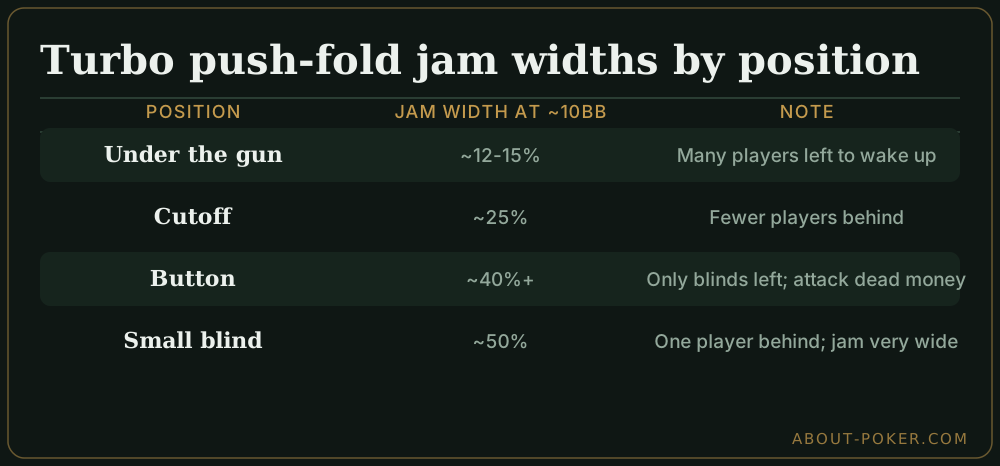
Your shoving range widens dramatically as you move toward the button and as your stack shrinks. From under the gun with 12 big blinds you jam a fairly tight range of pairs, strong aces, and good Broadways. From the button or small blind with the same stack, you jam a huge range because there are fewer players left to wake up with a hand and the blinds are dead money worth taking.
As a rough guide at around 10 big blinds with antes: under the gun you might jam roughly the top 12 to 15 percent of hands, the cutoff around 25 percent, the button 40 percent or more, and the small blind close to half of all hands. These widths come straight from Nash push-fold solutions and are the backbone of turbo and hyper-turbo strategy.
A worked example
You have 9 big blinds on the button in a turbo, antes are in, and it folds to you with A5 offsuit. Both blinds are competent and covering you.
This is a clear jam. A5 offsuit is well inside a button shoving range at 9 big blinds because you win the blinds and antes outright a large share of the time, and when called you still have a live ace with decent equity. Consider the alternative: min-raising to 2 big blinds leaves you 7 behind, and if either blind jams you are priced in to call off with a mediocre hand out of position. Shoving avoids that trap entirely. The blinds must have a genuine calling hand to continue, and folding A5 here would surrender fold equity you cannot afford to waste in a turbo.
Using Nash charts the right way
Nash push-fold charts give the unexploitable equilibrium: if both you and your opponent play the chart ranges, neither can gain by deviating. In turbos where you rarely have reads and the clock is ticking, defaulting to Nash is excellent and low-risk. Memorize the jam ranges by stack depth and position, and the call ranges for when you face a shove.
Then adjust to exploit. If a player is clearly calling too tight, widen your jams further because your fold equity is higher. If someone is a calling station, tighten your value-oriented shoves and stop bluff-jamming into them. The chart is your baseline; observed tendencies are your edge on top of it.
Common turbo push-fold mistakes
The biggest leak is playing too tight. Turbos reward action, and folding a correct button jam because the hand looks weak surrenders chips you will never recover as the blinds rise. The second leak is min-raising when short and then being unable to fold to a re-jam, spewing your stack in the worst possible way. The third is ignoring position — the same hand that is a fold under the gun is a mandatory jam on the button.
Finally, respect ICM near pay jumps. Even in a turbo, a covering big stack on the bubble should widen jams and a short stack should tighten call-offs, so blend the Nash baseline with the pay-structure realities covered across the tournament hub.
Turbo push-fold checklist
- Switch to jam-or-fold under about 12 to 15 big blinds; in turbos that is most of the event.
- Widen shove ranges sharply from late position and as your stack shrinks.
- Default to Nash ranges when you lack reads, then deviate to exploit tight or loose callers.
- Avoid min-raising short; it leaves you no fold equity and awful spots against re-jams.
- Do not play too tight — passivity is the fastest way to blind out in a turbo.
Frequently asked
When should I switch to push-fold in a turbo?
Roughly when your stack drops under 12 to 15 big blinds, or under 20 if antes are in play and the table is aggressive. In turbos this happens fast, so you are in jam-or-fold mode for much of the tournament and should have your shove ranges memorized.
Are push-fold charts accurate in turbos?
Yes. Nash push-fold charts are built for exactly the short-stack, blinds-and-antes environment that dominates turbos. They give you unexploitable jam and call ranges, though you can deviate to exploit opponents who call too tight or too loose.
Should I ever just raise-fold in a turbo?
Rarely once you are short. Min-raising leaves you with an awkward stack and no fold equity when facing a shove. Jamming all-in preserves maximum fold equity and avoids tough postflop spots, which is why turbos are a push-fold game.