Building Poker Discipline
Discipline is what turns a good strategy into a winning bankroll. Build it with pre-set rules, a stop-loss, table selection, and consistent session habits.
On this page · 7 sections
Building poker discipline is what turns a strategy you know into results you keep. Discipline is the ability to make the correct decision even when you’re bored, tired, tilted, or tempted — and it’s the single biggest difference between players with equal knowledge and unequal bankrolls. You don’t build it with willpower in the moment; you build it with rules set in advance.
Why knowledge isn’t enough
Almost every losing player knows more than enough to win. They know to fold weak hands, to respect a raise on a scary board, to quit when they’re tilting. And then they don’t do it. They call anyway, they play the marathon session anyway, they chase the loss anyway. The gap between knowing and doing is where the money leaks out — and that gap is exactly what discipline fills.
The reason willpower fails is that the moments you most need discipline are the moments your rational brain is weakest: after a bad beat, deep in a losing session, at hour six when you’re exhausted. You cannot out-willpower a tilted, tired brain. What you can do is set rules while calm that your future emotional self simply follows. That’s the whole strategy behind how to be disciplined in poker — offload the decision to a rule so you don’t have to win an argument with yourself mid-session.
Rule one: a hard stop-loss
The highest-leverage discipline rule is a stop-loss. Before you play, decide the number of buy-ins that ends your session no matter what — commonly two or three. When you hit it, you stand up. No “one more,” no “I’ll win it back,” no exceptions.
The stop-loss works because chasing losses is the most expensive thing a poker player does, and it only happens when you’re already emotional. A pre-set limit takes the decision out of your tilted hands. See setting a stop-loss for how to pick the right number for your bankroll and format. The key discipline point: the rule only works if it’s absolute. A stop-loss you sometimes ignore isn’t a rule, it’s a suggestion.
Rule two: session structure
Discipline loves structure. Decide before you sit down: how long you’ll play, how many tables, and what conditions end the session early. Fatigue quietly destroys decision quality — the last hour of a long session is where most disciplined players stop being disciplined. Cap your session at a length you can play at full attention, and treat the clock as another hard rule.
A pre-session warm-up primes this: a few minutes to review your rules, check your mental state, and commit to your quit conditions turns “I’ll play until I feel like stopping” into “I’ll play two hours or until my stop-loss, whichever comes first.”
Rule three: table and game selection
Discipline isn’t only about how you play — it’s about whether you play. The most disciplined decision is often refusing a bad game. If the table is full of tough regulars and no weak players, the disciplined move is to leave and find a softer game, even though sitting down feels easier. Ego says “I can beat these guys.” Discipline says “I don’t have to.”
This is quiet, invisible discipline that never shows up as a dramatic hand — but choosing good games and leaving bad ones is worth more over a career than any single strategic edge.
A worked example
You sit down for a planned two-hour session with a two-buy-in stop-loss. Forty minutes in, you lose a flip and then get coolered — down two buy-ins. Your rule says stop. But the game is soft, you feel fine, and quitting stings.
Here’s the discipline test. The disciplined player stands up, because the rule is absolute and the entire point of setting it while calm was to obey it while stung. The undisciplined player reloads “because the game’s good” — and that’s the exact rationalization the rule exists to defeat. Maybe this time it works out. But over hundreds of sessions, the player who honors the stop-loss avoids the handful of catastrophic tilt sessions that wipe out months of profit. Discipline is measured across the sample, not the single night.
Notice what discipline is not: it’s not folding a great hand out of fear, and it’s not refusing to reload after a normal cooler in an otherwise fresh, profitable session with no stop-loss hit. Discipline is following your pre-set rules — not playing scared.
Track adherence, not just results
Here’s the habit that compounds: grade yourself on how well you followed your rules, not on whether you won. Keep a one-line session note: “Honored stop-loss? Y/N. Quit on time? Y/N. Skipped bad games? Y/N.” Over a month, that log tells you exactly where your discipline leaks, and it rewards you for doing the right thing even on losing days.
Results are noisy — variance makes a well-played session look bad and a spewy session look great. Adherence isn’t noisy. It’s fully in your control, and it’s the true measure of whether you’re building the habit.
Discipline checklist
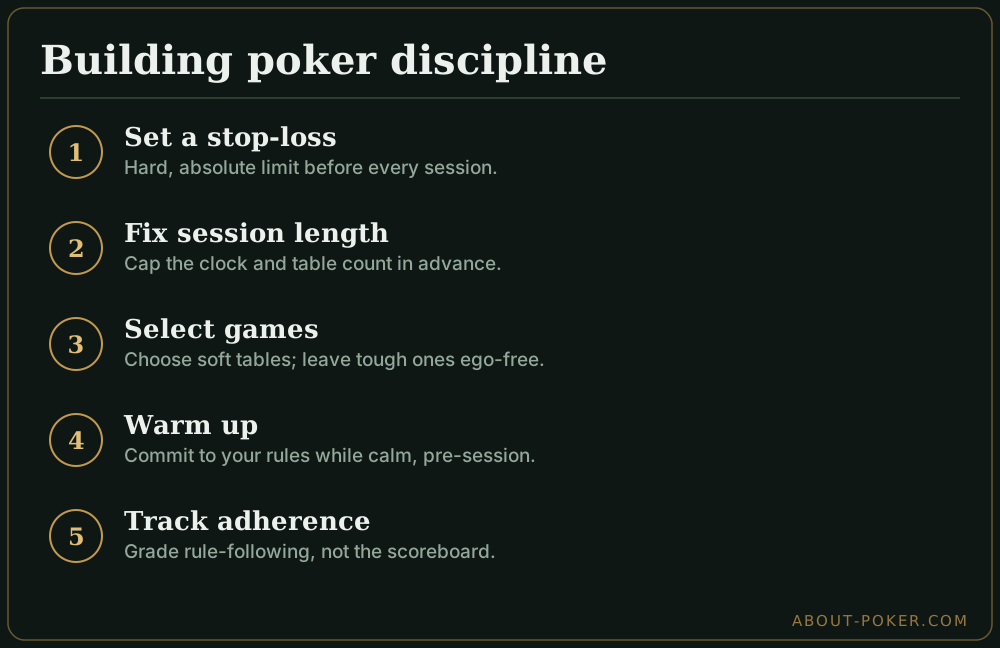
- Set a hard, absolute stop-loss before every session.
- Fix your session length and table count in advance; honor the clock.
- Choose good games and leave bad ones — ego-free.
- Run a pre-session warm-up to commit to your rules while calm.
- Grade yourself on rule adherence, not on the scoreboard.
Do this for a few months and discipline stops being an act of willpower and becomes who you are at the table — the player who quietly does the right thing while everyone else argues with themselves.
Frequently asked
Why is discipline so important in poker?
Because knowing the right play and actually making it are two different things. Discipline is what closes that gap under pressure — it's why two players with identical strategy knowledge can have completely different results. The disciplined one plays their A-game consistently; the other leaks it away when tired, bored, or tilted.
How do I build poker discipline?
Set your rules before you sit down — stop-loss, session length, table selection, quit conditions — so that in-the-moment emotion can't override them. Then track your adherence, not just your results. Discipline is a habit built by repetition, not a trait you either have or don't.
What's the fastest discipline win for a new player?
A hard stop-loss. Deciding in advance to quit after losing a set number of buy-ins protects you from the single most expensive mistake — chasing losses on tilt. It's one rule, easy to follow, and it saves more money than almost any strategic adjustment.