Board Texture Explained for Beginners
Board texture is how the community cards connect. A beginner guide to wet vs dry boards, why texture changes your bet sizing, and reading the flop fast.
On this page · 5 sections
Board texture is how the community cards fit together — whether they are connected, share suits, are paired, or sit far apart. It is the single most important thing to read after the flop, because texture tells you how many strong hands and draws are possible for everyone at the table. The same pair of hole cards can be a monster on one flop and garbage on another, and the difference is texture. Learn to read it and you will size your bets, pick your bluffs, and fold your losers far better than opponents who only look at their own two cards.
Wet versus dry: the core distinction
Boards live on a spectrum from dry to wet.
- Dry boards offer few draws and few ways to have a big hand. Think K-7-2 with three different suits (“rainbow”). Almost nothing connects; whoever has a King is comfortably ahead and hard to draw out on.
- Wet boards are dripping with possibilities. Think 9-8-7 with two hearts. Straights, straight draws, flush draws, and two pair are everywhere. Hands change fast from street to street.
Everything about how you play flows from where the board sits on that spectrum. Dry boards are calm and cheap to play; wet boards are chaotic and expensive.
Why texture changes your bet size
On a dry board, very few of your opponent’s hands can continue, so you do not need to bet much to get the job done — a small bet applies pressure without risking chips you do not need to. On a wet board, draws are everywhere, and every card that peels off can flip the hand. You bet larger to charge those draws, to protect a made hand from being outdrawn cheaply, and to build the pot with your strong hands before a scary card kills the action.
A simple rule of thumb for beginners:
- Dry board → smaller bets, more often.
- Wet board → larger bets with your good hands and draws, more selectively.
This connects to counting outs: wet boards exist precisely because there are so many outs floating around, and flush draw odds are a big part of why two-tone flops play so differently from rainbow ones.
A worked example
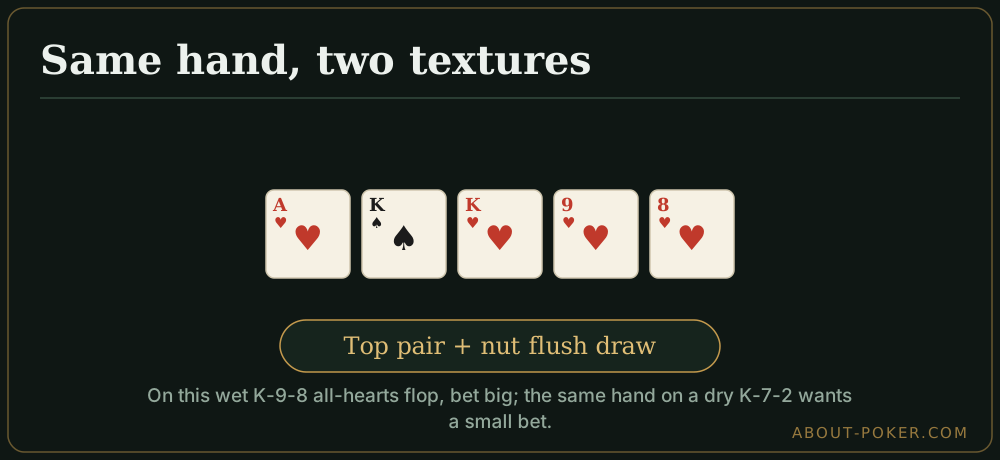
You hold A♥ K♠. Compare two flops.
Flop one — K♦ 7♣ 2♠ (dry). You have top pair, top kicker on a rainbow board with no straight or flush draws in sight. Almost nothing beats you, and few draws can catch you. A small bet, around a third of the pot, is plenty. You are milking value from worse Kings and second pairs while barely giving anyone correct odds to chase, because there is almost nothing to chase.
Flop two — K♥ 9♥ 8♥ (wet). Now you have top pair and the nut flush draw, but the board is soaked. Straights and made flushes are possible, and any heart, Ten, Jack, or Queen changes the hand. Here you bet big — often two-thirds pot or more — to charge the many draws and to build a pot you are happy to play with a hand this strong. The exact same A♥ K♠ calls for a totally different bet size, purely because the texture changed.
Notice the pattern: on the dry flop your top pair is close to the nuts, so protection is cheap; on the wet flop your equity is high but fragile, so you bet more to protect it and to get value while you are ahead. This is range equity thinking applied to the board — the texture decides how much your strong hands are really worth.
Reading texture in three quick checks
You can classify almost any flop in a second or two:
- Connected? Are the cards close in rank (like 9-8-7 or T-9-6)? More connection means more straights and straight draws.
- Suited? Are two or three the same suit? Two-tone boards add flush draws; monotone boards add made flushes.
- Paired? A paired board (like 8-8-3) removes some draws but adds trips and full houses, changing who is strong.
The more “yes” answers, the wetter the board — and the more you should lean toward larger bets with your good hands, tighter continuing, and caution with marginal holdings.
The beginner takeaway
Before you decide how much to bet, look at the board and ask whether it is calm or chaotic. On calm, dry boards, bet small and often — there is little to fear and little to protect. On wet, connected, suited boards, respect the danger: bet big with your strong hands and draws, and be ready to let go of hands that a bad card just crushed. Once you read texture on instinct, you will stop overpaying on scary boards and start extracting more on safe ones — which is exactly where the money is.
Frequently asked
What is board texture in poker?
Board texture describes how the community cards relate to each other — whether they are connected, suited, paired, or spread out. Texture tells you how many strong hands and draws are possible, which shapes how everyone should bet.
What is the difference between a wet and a dry board?
A wet board has many possible draws and strong hands, such as connected or two-tone cards like 9-8-7 with a flush draw. A dry board has few draws, such as K-7-2 rainbow. Wet boards favor big bets and caution; dry boards favor small bets.
Why does board texture change bet sizing?
On dry boards few hands can continue, so small bets do the job cheaply. On wet boards draws are everywhere, so you bet larger to charge those draws and protect your strong hands from being outdrawn.
How do you read board texture quickly?
Check three things fast: are the cards connected, are two or more the same suit, and is the board paired. The more yes answers, the wetter the board and the more caution and larger bets it calls for.