Range vs Range Explained for Beginners
Range vs range means comparing every hand you could hold against every hand they could hold. A beginner guide to thinking in ranges instead of single hands.
On this page · 5 sections
Range vs range is the idea that poker is not one hand against another hand — it is every hand you could have against every hand your opponent could have. When you sit in a pot, you do not know your opponent’s exact two cards, and they do not know yours. What each of you really faces is a set of possible hands, called a range. Learning to compare those two sets, rather than guessing at one specific holding, is the single biggest mental upgrade a beginner can make.
From hands to ranges
Beginners naturally think, “I have top pair, does he have a set?” That question has no answer, because he might have a set, or a worse pair, or a draw, or air. A stronger question is, “Against everything he could be holding here, how does my hand do?” That is a range-vs-hand comparison. Go one step further — “against everything he could have, how does my whole betting range do?” — and you are thinking range vs range, the way strong players and solvers actually reason.
A range is just a list of hands weighted by how likely each one is. Preflop, a tight player’s opening range might be big pairs, strong Aces, and premium suited cards. As streets go by and bets fly, ranges narrow, because most hands would have played differently.
Range equity: the key number
When two ranges collide, the meaningful measurement is range equity — the average share of the pot your entire range wins against your opponent’s entire range at showdown. It is the range-level version of single-hand equity. A hand can be strong while your overall range is weak, or vice versa, and range equity captures the difference. For a fuller treatment, see range equity.
The practical upshot: you do not bet just because your hand is good. You bet because your range wants to bet, and you defend because your range needs defending. Individual hands are role-players inside a larger plan.
A worked example
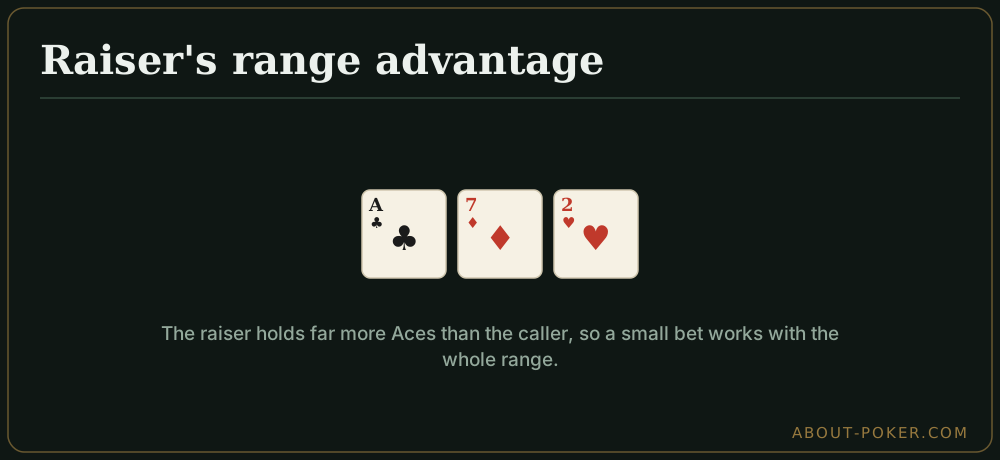
You raise before the flop with a normal opening range and one player calls. The flop comes Ac 7d 2h — a dry board with a top card that favors the raiser. Whose range is stronger here?
Think about the Aces. As the raiser, your range contains lots of hands with an Ace: AK, AQ, AJ, AT, plus all your big pairs. The caller, having only called, holds far fewer strong Aces — a raiser-friendly board like this smashes your range and misses theirs. Even though any single hand you hold might be weak, your range connects with this flop much better than theirs does.
That is why a small bet from you works well on Ac 7d 2h: your range is so far ahead that you can bet almost everything cheaply, and the caller can rarely fight back. You are not thinking “do I have an Ace?” You are thinking “my range has way more Aces than his, so betting is correct across the board.” That is range vs range in action, and counting how many combinations of each hand exist — the domain of combinatorics — is what makes the comparison concrete.
How to estimate a range at the table
You will not build exact ranges in real time, and you do not need to. Use a rough, updating picture:
- Start with position and player type. Tight player under the gun? Narrow, strong range. Loose player in the big blind? Wide range.
- Cross off hands that would have played differently. If they only called a raise, remove the hands they would have re-raised.
- Update every street. A big bet on a scary turn shrinks the range toward hands that like that card.
By the river, most ranges are small enough to reason about clearly, which is exactly why river decisions reward careful range thinking.
The beginner takeaway
Stop asking “what does he have?” and start asking “what could he have, and how do I do against all of it?” That shift stops you from folding good hands to imaginary monsters and stops you from paying off obvious value. You will never know the exact two cards — but you can almost always estimate the range, and against a range you can always find the profitable play. Thinking range vs range is how you turn uncertainty from a handicap into an edge.
Frequently asked
What does range vs range mean in poker?
Range vs range means measuring how all the hands you could have perform against all the hands your opponent could have, rather than pitting one specific hand against another. It reflects how equity actually works when neither player knows the other's cards.
Why should beginners think in ranges instead of hands?
Because you rarely know your opponent's exact hand. Thinking in ranges lets you make correct decisions on average across everything they could hold, which is the only information you truly have.
What is range equity?
Range equity is the average share of the pot your entire range wins against your opponent's entire range if the hand ran to showdown. It is the range vs range version of single-hand equity.
How do you estimate an opponent's range?
Start with the hands consistent with their actions so far, given their position and tendencies. Narrow that set as more streets and bets come in. Betting patterns and board texture do most of the work.