PLO Set Play
Sets are strong in PLO but not the lock they are in Hold'em. Learn how to play top set, dodge set-over-set, and read wet boards before committing.
On this page · 6 sections
In Hold’em, flopping a set is close to printing money. In Pot-Limit Omaha it is still a strong hand, but the math is different enough that treating every set like the nuts will cost you stacks. Four hole cards mean opponents make straights, flushes, and higher sets far more often, so set play in PLO is about betting hard while you are ahead and knowing when your set has quietly become second best.
Why sets are weaker than they feel
The reason is simple: everyone has four cards, so the density of made hands and monster draws on any given board is much higher. A set that would be a 90-percent favorite in Hold’em is often only a modest favorite, sometimes even an underdog, against the big wraps and flush draws PLO players routinely hold. Bottom and middle set are the most dangerous because they lose to higher sets and give opponents more room to have you drawing to a boat while they are already made. This is core PLO postflop strategy: the strength of a hand depends heavily on how wet the board is.
Bet for value and protection
Because boards run out so dangerously, top set almost always wants to bet rather than trap. Every free card you give lets a wrap or flush draw improve, and many of those draws are close to a coin flip with your set to begin with. Betting charges them the maximum and, in pot-limit, lets you build a pot you are favored to win. Slow-playing top set is one of the most common leaks new PLO players carry over from Hold’em, and it turns a hand that should be a big favorite into a flip.
A worked example
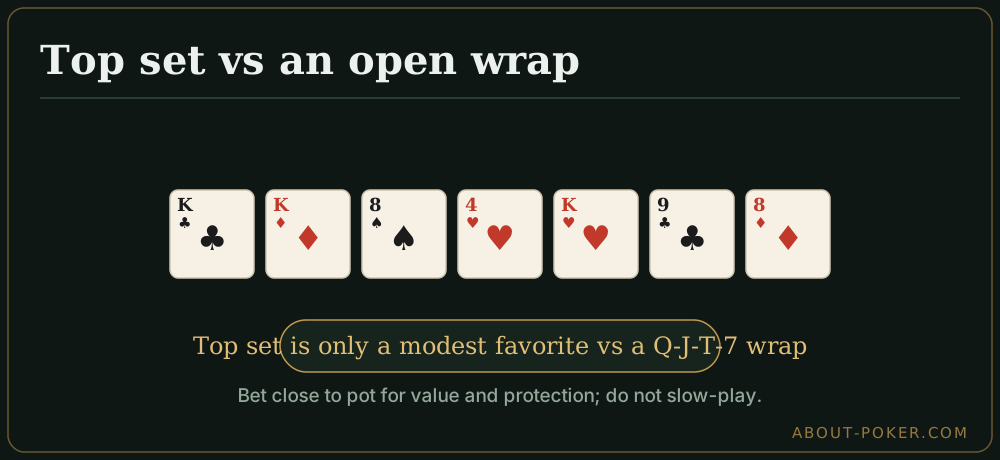
You hold Kc Kd 8s 4h and the flop comes Kh 9c 8d, giving you top set of kings. This looks huge, but consider a hand like Qd Jd Tc 7c: that opponent has an open wrap (any Q, J, T, 7, plus more) that is essentially a coin flip against your set, sometimes a slight favorite. Your correct play is to bet close to pot to charge that draw and deny equity. If you check, you let them realize a draw that is nearly 50 percent for free. Now compare bottom set: if you instead held 8h 8c on that same K-9-8 board, you are behind any set of nines or kings and drawing thin, and against the wrap you are in the same flip but with far more reverse-implied danger. Same trips, very different situations, all driven by where your set sits and how wet the board is.
Reading the board texture
Before committing, ask how connected and suited the board is. Top set on a dry, rainbow board (like K-7-2 with no flush possible) is close to the Hold’em experience and you can play fast and confidently. Top set on a wet board (connected, two-tone, or paired) is far more fragile, and you should weigh how much money to commit against how likely opponents are to be drawing live or already ahead. Understanding which draws are out there is exactly what our PLO blockers and draws guide is built around; holding a blocker to the nut flush or nut straight makes committing with a set much safer.
Set-over-set and multiway danger
Set-over-set happens far more in PLO than Hold’em, and it is the fastest way to lose a stack. When the money gets deep and action gets heavy on a board where higher sets are possible, be honest about whether your set is the top one. In multiway pots the risk compounds: with more players, the chance that someone has the top set, a made straight, or a monster draw rises sharply, so middle and bottom set lose value quickly. Our PLO multiway pots guide covers how to tighten up when several players see the flop.
Checklist for playing sets
- Bet top set for value and protection; do not slow-play into wet boards.
- Respect board texture: dry boards play fast, wet boards demand caution.
- Distinguish top set from middle and bottom set; the lower ones are trap-prone.
- Watch for set-over-set when action is heavy and stacks are deep.
- In multiway pots, tighten your commitment threshold on all but the nut set.
Play your sets with the aggression they deserve when the board is dry, and the humility they demand when it is wet, and you will keep the profit while avoiding the coolers that sink so many PLO players.
Frequently asked
How strong is a set in PLO?
Top set is a strong made hand and often a favorite over a single big draw, but it is far less of a lock than in Hold'em because wraps and combo draws in PLO frequently hold more than 50 percent equity against it. On wet boards a set can be a modest favorite at best.
Should you slow-play sets in PLO?
Rarely. Boards run out dangerously in Omaha, so top set usually wants to bet for value and protection while it is still ahead. Slow-playing lets draws get there cheaply and turns a big favorite into a coin flip.
What beats a set in Omaha?
Straights, flushes, full houses, and higher sets all beat a set, and all of them come in more often than in Hold'em. Because four hole cards make draws hit more, a set that is not the top set is especially vulnerable to set-over-set and completed wraps.