22 Poker Nickname & Meaning
Pocket twos (22) is nicknamed 'Ducks' and 'Deuces.' Here's where the names come from and how the smallest pocket pair actually plays preflop.
On this page · 6 sections
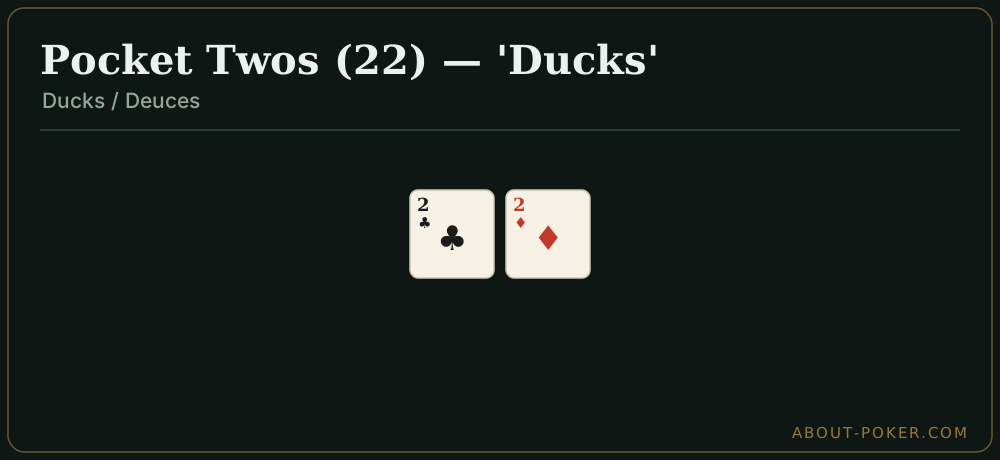
Pocket twos (22) is the smallest pocket pair in Hold’em, and it comes with two well-worn nicknames. The most common is “Ducks,” because a 2 looks like a duck floating on water — the curved neck and flat base. Players also call them “Deuces,” since “deuce” is the classic card term for a two. The names are pure table flavor, but they’re part of the shared vocabulary you’ll pick up over time.
Where the nicknames come from
“Ducks” is a visual joke that anyone can see once it’s pointed out: the loop at the top of a 2 is the head and neck, the flat bottom stroke is the body gliding across the pond, so two of them become a pair of ducks. “Deuces” comes from the old French deux and Latin duo for two — it’s been the standard name for the card in gambling for centuries, so a pair of them is simply “deuces.” You’ll occasionally hear “quackers” or “the twos” as well. As with every pocket-pair nickname, none of this changes strategy; it’s cosmetic slang sitting alongside the rest of the terms in poker slang explained.
Where 22 ranks as a starting hand
Among the 169 possible starting hands, 22 sits at the very bottom of the pocket pairs — no pair is lower. It technically beats every unpaired hand before the flop, but only by a hair, and its unimproved ceiling is the lowest in the game: a lone pair of twos loses to any higher pair and to essentially every board that brings even one overcard. That makes it the purest set-mining hand there is:
- Preflop, it edges out unpaired holdings, but it’s barely ahead and only when nobody has a bigger pair.
- Postflop, it almost always needs to improve. Nearly every flop brings an overcard, so twos are second-best right away. The lone payoff is flopping a third deuce for an invisible set.
How 22 plays preflop
Twos are a marginal open from late position and a call against a single raise only when stacks are deep enough to justify chasing a set. The core numbers:
- Any pocket pair flops a set or better about 11.8% of the time — roughly once every 8.5 flops.
- All-in preflop, 22 is about a 4-to-1 underdog to any higher pair.
- Against two overcards like A-K, 22 is a slight favorite, around 52% — even the smallest pair is a coin flip against two big cards.
Because twos win so rarely without help, their whole value is set-mining, and set-mining needs depth. A reliable guideline: only call a raise when the effective stack is at least 10 to 15 times your call, so a single set flop can win enough to cover the roughly seven misses out of eight.
Worked example: ducks that stack a big pair
You’re in the cutoff with 2♣ 2♦. A player opens to 3 big blinds, and effective stacks are 120 big blinds. You call for 3.
The flop comes 2♥ A♠ 9♦ — about as good as it gets for the deuces. You’ve flopped bottom set on a board where your opponent is likely to have paired that ace. Sure enough, they hold A♥ K♣ for top pair top kicker and bet. You call, the turn is the 6♠, they bet again, and you raise. With top pair and a premium kicker, they have every reason to commit, and the deep stacks let you win a stack with the smallest pair in the deck. That one hand covers many folded set-mines — the exact reason twos are worth a cheap call when the money is deep, and a fold when it isn’t.
Common mistakes with 22
- Set-mining without depth. If you can’t win 10 to 15 times your call when you hit, fold. The one-in-eight set rate can’t pay for the misses in a shallow pot.
- Overplaying an unimproved pair. A lone pair of twos beats almost nothing that’s firing at you on an overcard board. Don’t bluff-catch with it.
- Calling 3-bets to chase a set. Facing a raise and a re-raise, the range against you is loaded with big pairs, and the price is usually too high. Let the ducks fly.
Keep going
Pocket twos are the smallest pair in the deck, yet they still win stacks on the roughly one-in-eight flops where they hit a set. See how that works in the set explainer, pick up more table shorthand in poker slang explained, and browse the full poker terms glossary to keep growing your vocabulary.
Frequently asked
What is the nickname for 22 in poker?
Pocket twos (22) is most commonly called 'Ducks,' because a 2 looks like a duck's profile — the curved head and flat body. It's also known as 'Deuces,' since a two is called a deuce in card terminology.
Is 22 the worst pocket pair?
Yes. Pocket twos is the lowest-ranked pocket pair, so any other pair beats it at showdown when neither improves. It's still ahead of every unpaired hand before the flop, but it relies almost entirely on set-mining to win big pots.
How often does 22 flop a set?
Pocket twos flops a set or better about 11.8% of the time, roughly once every 8.5 flops. The rate is the same for all pocket pairs; twos just have the least value the rest of the time.
Should I play pocket twos?
Play them selectively. Twos are worth a late-position open and a cheap call against a raise with deep stacks, but they're an easy fold to 3-bets, early-position raises, or shallow-stacked spots.