AQ Poker Nickname & Meaning
AQ is nicknamed Big Chick or Little Slick. What ace-queen means, why the nickname stuck, and how to avoid the domination traps this hand walks into.
On this page · 8 sections
AQ — ace-queen — goes by Big Chick (and sometimes Little Slick). Both nicknames tie the hand to its more famous relative, ace-king, which is called Big Slick. AQ is the next rung down: a strong hand, but one that lives in the shadow of AK and carries a reputation as a trap.
Where “Big Chick” comes from
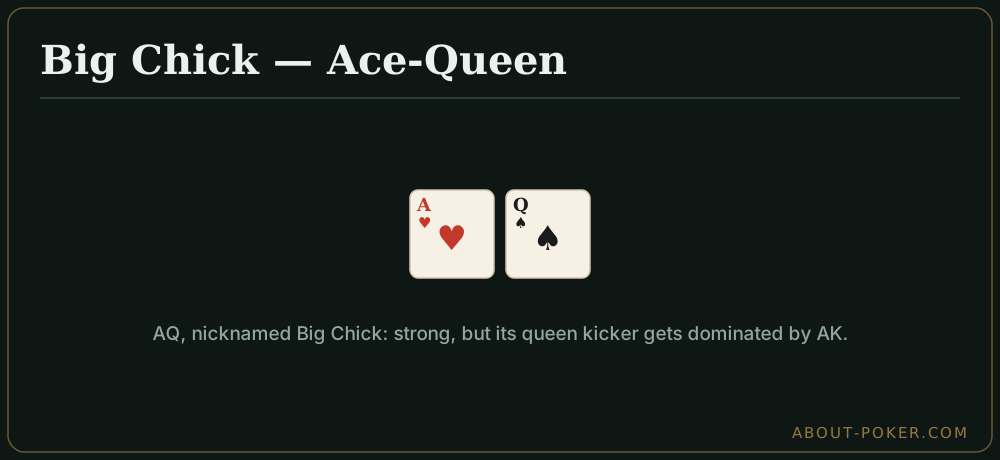
The name is a play on words. Ace-king is Big Slick; ace-queen rhymes into Big Chick, with the queen standing in as the “chick” — the female face card. “Little Slick” works the same way, marking AQ as the smaller, slightly weaker sibling of Big Slick. Both names carry a built-in warning: this hand looks like AK, but it isn’t.
Why AQ has a “trap” reputation
Ace-queen is genuinely strong, but it suffers from one structural problem: domination. When you flop top pair with an ace, your kicker is a queen — good, but beaten by any king or ace kicker. The hands that keep playing back at you often have you out-kicked.
- Versus AK: If an ace flops, both of you have top pair, but AK’s king kicker beats your queen. You’re drawing thin.
- Versus AA or QQ: You’re dominated preflop and usually crushed.
- Versus a smaller pair: AQ is a slight underdog in a race, roughly 43-45%.
The trap isn’t that AQ is weak — it’s that AQ makes strong-looking hands that are quietly second-best. Compare this to AK, which flops the best kicker and rarely gets out-kicked.
Worked example: the domination trap
You raise with A♥ Q♠ and a tight opponent 3-bets. You call.
Flop: A♦ 8♣ 3♠. You flop top pair, and it feels great. But your opponent’s 3-betting range is heavy with AK, AA, and AQ. Against A♣K♣ here, you hold top pair queen-kicker while they hold top pair king-kicker — you’re drawing to two remaining queens, roughly 8-9% equity to improve. That’s the trap in one hand: a beautiful-looking flop that’s actually a disaster.
The lesson isn’t to fold AQ preflop. It’s to slow down when a tight, aggressive player commits big money on an ace-high board. Your top pair is often not good.
How to play ace-queen
Play it aggressively, but read the room:
- Open-raise it freely. From most positions, AQ is a standard raise. It’s too strong to fold or limp.
- Be careful facing 3-bets and 4-bets. Tight players 3-betting for value often have you dominated. AQs can call more 3-bets than AQo thanks to its flush potential.
- Value-bet, but respect resistance. Top pair queen-kicker is worth betting — until an opponent shows real strength on an ace-high board.
- Suited is meaningfully better. The flush and straight potential of AQs adds equity and makes the hand easier to play postflop.
AQ versus AK: know the gap
New players often treat AQ like AK. They shouldn’t. Ace-king flops the nut kicker and races well; ace-queen flops a dominated kicker and races the same but loses more when it makes a pair against a strong range. The nicknames say it best — AK is Big Slick, AQ is only Big Chick. It’s a strong hand, one class below premium, and it rewards players who know when to let go.
Big Chick changes by position
The same two cards behave very differently depending on where you sit. From early position, AQ is a raise but a cautious one: the players still to act have tight ranges, so a 3-bet you face is more likely to dominate you. From late position — the cutoff or button — AQ is far more comfortable. Fewer players remain, their ranges are wider and weaker, and you have position to control the pot after the flop. A queen kicker that is scary against an under-the-gun 3-bettor is perfectly fine against a button-versus-blinds steal.
In the blinds, AQ is a strong defending hand but a poor flatting-and-check-calling hand out of position. Against a late-position open you should usually 3-bet it rather than flat, both to take initiative and to avoid the awkward dominated spots that come from playing top pair out of position for three streets.
A second example: when the trap doesn’t spring
You raise A♣Q♣ on the button and the big blind calls. Flop: Q♦ 7♠ 2♥. You have top pair, good kicker, against a caller’s range that is full of worse queens, pairs, and draws — not the tight 3-betting range from the first example. Here your queen kicker is an asset, not a liability: you are ahead of QJ, QT, KQ some of the time, 77 rarely, and a pile of missed hands. Bet for value across the streets.
The contrast is the whole point. The AQ trap only fires when a tight, aggressive range piles money in on an ace-high board. Against a wide, capped range on a queen-high board in position, AQ is simply a strong made hand you should bet confidently. Reading which situation you are in — narrow strong range versus wide weak range — is what separates players who fear AQ from players who profit with it.
Keep going
AQ is Big Chick — a strong, aggressive hand that raises well but walks into kicker traps against tight ranges. Play it hard preflop, but slow down when the pot balloons on an ace-high board against a tight range, and bet it for value against wide, capped ranges. See how its bigger sibling plays in the AK guide, and study proper ranges for ace-queen suited and ace-queen offsuit. Browse the full poker glossary for more.
Frequently asked
What is the nickname for AQ in poker?
Ace-queen is most often called Big Chick or Big Slick's little brother — 'Little Slick.' The 'chick' plays on 'slick' (AK's nickname) while nodding to the queen as the female face card.
Why is AQ called Big Chick?
It rhymes with Big Slick, the nickname for ace-king, and the queen is the 'chick.' The name marks AQ as AK's slightly weaker cousin — strong, but a rung down.
Is AQ a strong hand?
AQ is a strong starting hand and a clear raise from most positions. But it's notably weaker than AK and gets dominated by AK and AA more often than beginners expect.
Why do people say AQ is a trap hand?
Because it flops top pair with a good-but-not-best kicker. When another ace hits and someone else holds AK, your top pair loses to their bigger kicker — a costly, hard-to-fold spot.