How to Play Ace-Queen Offsuit (AQo)
AQo is a strong offsuit broadway that opens from any seat and 3-bets for value, but plays carefully against tight 4-bets. Learn AQo preflop and postflop.
On this page · 6 sections
Ace-queen offsuit (AQo) is one of the strongest non-pair, non-AK hands in the deck. It opens comfortably from every position, 3-bets for value against most opponents, and flops the kind of dominating top pairs that win big pots. Its one recurring weakness is that when the money goes in preflop against a tight range, AQo is usually the hand that’s behind — dominated by AK and crushed by the big pairs. Playing it well means being aggressive early in the hand and disciplined when a tight opponent fights back.
Where AQo belongs preflop
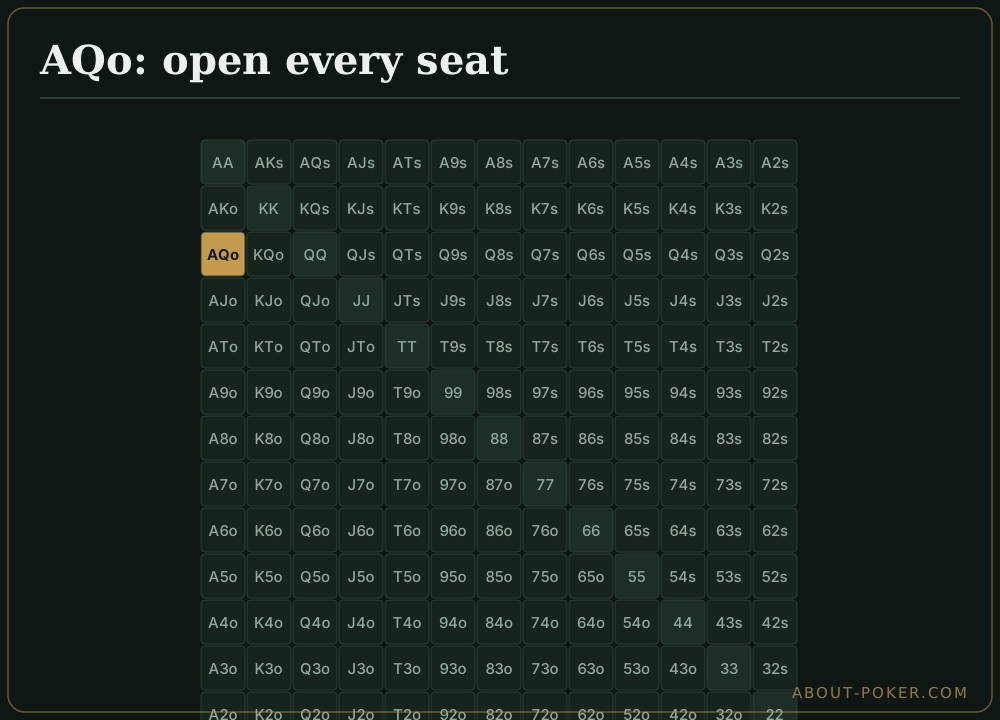
Unlike the marginal hands, AQo is a universal open:
- Early position (UTG): open. AQo is strong enough to raise from the very first seat, even at a full table. It’s near the top of your UTG range.
- Middle and late position: an easy, standard open every time.
- Small blind: raise (never limp) when the action folds to you.
- Big blind: defend widely, and mix in 3-bets against late openers.
Because AQo is always in your opening range, the seat-by-seat detail matters more for how you play it than whether you play it. Ground the opening frequencies in the preflop opening ranges and see how much AQo dominates the wide button-calling ranges in poker ranges by position.
3-betting AQo for value
AQo is a value 3-bet in most spots, not a bluff. When a cutoff or button opens a wide range, 3-betting AQo isolates you against a single opponent whose calling range is full of worse aces, worse queens, and broadway hands you dominate. That’s exactly the situation you want.
The nuance is against tight early-position openers. When UTG raises at a full table, their range is heavy with AK, AA, KK, and QQ — the precise hands that dominate AQo. Here, 3-betting bloats the pot against a range that’s ahead of you, so mixing in flat calls keeps the pot smaller and lets you realize equity. The 3-bet range breakdown covers how these value-versus-flat decisions shift with the opener’s seat.
The 4-bet problem
The moment your AQo 3-bet gets 4-bet by a tight player, the hand’s biggest weakness shows up. A tight 4-betting range is roughly AA, KK, QQ, and AK — and AQo is behind every single one of them, dominated by AK and drawing thin against the pairs. Against that range, the default is to fold.
Against a known-aggressive opponent who 4-bets light, the math changes: you can call in position or, at short stacks, occasionally 5-bet shove because their range now contains bluffs you’re ahead of. But you need a real read to deviate. The 4-betting strategy guide walks through how to size these decisions and read your opponent’s 4-bet range.
A worked example
You open A♠Q♦ from the cutoff. The button 3-bets. You call, keeping the pot manageable in position. The flop comes A♥ 9♣ 4♠ — you’ve flopped top pair with the second-best kicker, a strong holding.
The button continuation-bets and you call, planning to get value while controlling the pot. Turn is the 6♦. The button checks; you bet for value, targeting worse aces, ace-x that floated, and pairs like 99 that will pay. River is the 2♣. If the button now leads big into you, pause — a passive player suddenly betting large often means two pair, a set, or exactly the AK that dominates you. AQo top pair is strong, but it’s a one-pair hand, and the whole point of playing it well is knowing when a queen kicker is beating worse aces versus when it’s the second-best hand paying off AK. Against most players you call one reasonable bet and fold to obvious strength.
Postflop in one paragraph
AQo’s postflop life is mostly about top pair, good kicker. When you flop top pair, bet for value and be willing to go three streets against worse aces and broadway pairs, but slow down when a passive opponent shows real aggression — your kicker beats worse aces but loses to AK and two pair. When you flop a pair of queens with an overcard on board, treat it more like a bluff-catcher. When you miss, AQo has two overcards and backdoor equity, making it a fine hand to continuation-bet once and give up if it doesn’t improve. The hand is strong, but it’s still one pair; discipline on the later streets is what separates winning AQo play from spew.
Where to go next
AQo is a premium-adjacent hand: open it everywhere, 3-bet it for value against wide ranges, and fold it to tight 4-bets. Calibrate your opens with preflop opening ranges, sharpen the value-3-bet spots in the 3-bet range guide, learn the 4-bet defense in 4-betting strategy, and connect it all through the preflop strategy hub.
Frequently asked
Is AQ offsuit a good hand?
Yes, AQo is a strong hand and a clear open from every seat, including under the gun. It makes strong top pairs and dominates the broadway hands people call with. It's a notch below AKo and the big pairs, so it should be played firmly but not recklessly against heavy aggression.
Should I 3-bet with AQ offsuit?
Often, yes. AQo is a standard value 3-bet against late-position opens and a good hand to 3-bet against wide openers. Against very tight early-position raisers it can be closer, since you're dominated by AK and the big pairs, so mixing in some flat calls is reasonable.
How do I play AQ offsuit against a 4-bet?
Usually fold. When you 3-bet AQo and face a 4-bet from a tight player, you're often against AA, KK, QQ, and AK, all of which crush or dominate you. Against a known aggressive 4-bettor you can call or occasionally 5-bet shove short, but the default versus a tight 4-bet is to fold.