T9 Poker Nickname & Meaning
T9 — ten-nine — is a premium suited connector. What players call it, why T9 suited flops so many strong draws, and how to play it before the flop.
On this page · 8 sections
T9 — ten-nine — is widely regarded as the best suited connector in Texas Hold’em. It doesn’t have a single famous nickname (some players jokingly call it “Tenderloin”), but it earns its reputation the hard way: no other connector can make more straights, which makes T9 suited a favorite among strong players.
What players call it
T9 is a workhorse hand, and like most non-face holdings it’s usually named by function rather than slang:
- Ten-nine suited — the standard way to say it.
- Tenderloin — an occasional, playful nickname you’ll hear at some tables.
- The top connector — acknowledging its status as the strongest suited connector.
Don’t expect everyone to know “Tenderloin.” Say “ten-nine suited” and you’ll always be understood.
Why T9 is the best connector
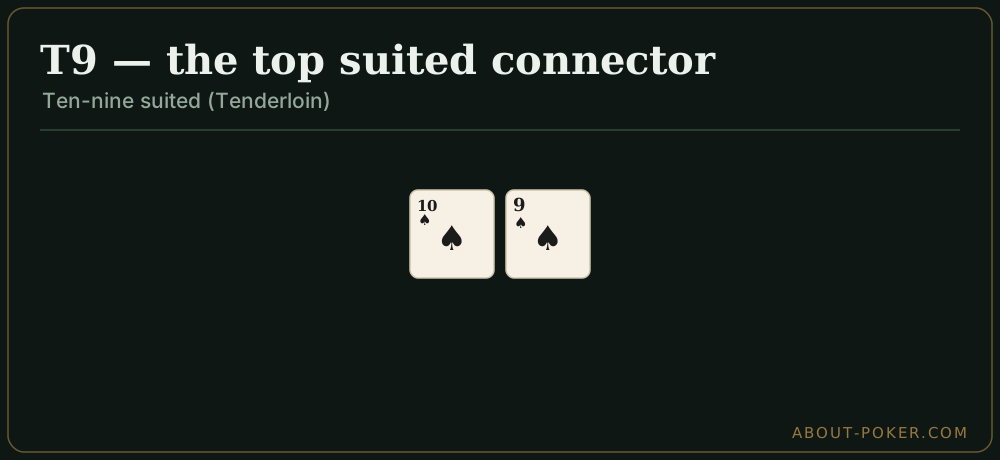
A suited connector’s value comes from how many straights it can make, and T9 makes the most. Its ranks sit squarely in the middle of the deck, so the cards around it — from 6-7-8 up through J-Q-K — form more straight combinations than any other connector reaches. On top of that, T9 keeps full flush potential and its straights are well disguised, since opponents often can’t tell whether the board helped you or not.
That combination makes T9 suited a strong middle- and late-position open and an excellent hand to call raises with in position. It rarely dominates a bigger hand, but it also rarely gets dominated in a way that costs you a big pot, and it flops draws relentlessly.
Worked example: the double gutter and beyond
You call a raise in position with T♠ 9♠ and the flop comes Q♦ 8♥ 7♣.
Look at everything you’ve flopped. You have an open-ended straight draw — any jack or six completes it — which is eight outs and improves to a straight by the river about 32% of the time. You also have two overcards to some of the board and backdoor potential. If the flop instead came J♦ 8♣ 2♠, you’d hold a double-belly-buster (a nine or a queen makes the straight), again eight outs but from a completely different shape. This is what makes T9 special: because its ranks reach in both directions, it keeps hitting these strong straight draws where lower connectors would flop air. Against a made top pair, that eight-out draw is close to a coin flip by the river, giving you the equity to play back aggressively.
See the full plan in how to play ten-nine suited.
Why “most straights” is a real edge
The claim that T9 makes the most straights isn’t marketing — it’s a countable fact about where its ranks sit. A straight needs five consecutive ranks, and any hand can only be part of straights that include both of its cards. Because ten and nine live in the middle of the deck, they participate in more five-card runs than any other connector:
- T9 can complete straights running from 6-7-8-9-10 all the way up to 9-10-J-Q-K — several distinct straights.
- A low connector like 45 reaches down toward the ace but is cut off at the top; a high connector like JT is strong but blocked at the very top of the deck.
- T9 sits in the one spot where nothing blocks it on either side, so it flops open-enders and double-belly-busters more often than any neighbor.
That’s the mechanical reason strong players single it out. More straight combinations means more flopped draws, and more flopped draws means more chances to apply pressure with real equity behind it.
Suited vs. offsuit, and how position changes T9
Like every connector, T9 is really two hands. T9 suited keeps its full flush potential and is a genuine middle- and late-position open. T9 offsuit loses the flush, and with it a large share of the combo-draw power that makes the suited version special — it’s playable from late position and as a blind defend, but it is a clear step down and mostly a fold from earlier seats.
Position governs how you deploy the suited version:
- Middle and late position: open it and look to see flops in position, where you realize your equity best.
- Blind defense: a comfortable big-blind call against a late raise, since you close the action and get a price.
- Out of position in a bloated pot: be more cautious — a draw-heavy hand loses value when you can’t control the betting.
Stack depth reinforces this. T9 suited is at its best deep, where the straights and flushes it makes can win a full stack (strong implied odds). Short-stacked, its speculative draws are worth less because there’s no deep money to win, so its ranking as “best connector” fades and high-card strength matters more.
A quick T9 checklist
- Suited or offsuit? Suited is a premium connector; offsuit is a marginal late-position hand.
- Position? Open from middle and late position; fold offsuit from early seats.
- Deep or shallow? Deep stacks reward T9’s draws; short stacks blunt them.
- Flop a draw? With eight-out straight draws and combo draws, play aggressively and build the pot.
Using the term at the table
You’ll hear it in lines like “flopped the open-ender with ten-nine suited and got there on the river,” or “ten-nine’s my favorite hand to call a raise with in position.” Say “ten-nine suited” and everyone will know you’re talking about a premium speculative hand.
The lesson: T9 suited is the connector that keeps on giving — play it in position, chase its many draws, and don’t be shy about building a pot when you connect. See how to play ten-nine suited for the complete approach.
Keep going
T9 is the king of suited connectors — no big nickname, just the most straights of any connector in the deck. Learn more vocabulary in the poker terms glossary, explore colorful table talk in poker slang explained, and get the strategy in how to play ten-nine suited.
Frequently asked
What is the nickname for T9 in poker?
Ten-nine doesn't have one dominant nickname the way face-card hands do. You'll sometimes hear 'Tenderloin' as a playful name, but most players just call it 'ten-nine,' or describe it as a top suited connector.
Is T9 a good poker hand?
T9 suited is one of the best suited connectors — it makes the most possible straights of any connector and has strong flush potential. T9 offsuit is playable from late position but noticeably weaker.
Why is T9 suited so highly rated?
Because it's the connector that can complete the most straights. Its cards fall right in the middle of the deck, so it flops open-enders, gutshots, and combo draws very often, and its straights are hard to read.
How should I play T9 suited?
Open it comfortably from middle and late position, call raises in position, and be ready to play a big pot when you flop a strong draw or a made hand. It's one of the most profitable speculative hands.