How to Play Ten-Nine Suited (T9s)
Ten-nine suited is a premium suited connector that flops big draws and disguised straights. Here is how to open, 3-bet bluff, and play T9s postflop.
On this page · 6 sections
Ten-nine suited (T9s) is a premium suited connector — arguably the best in the game. Because the ten and nine are fully connected and share a suit, T9s makes the maximum number of straights available to a suited-connector class hand while also carrying flush potential. Its value has almost nothing to do with high-card strength and everything to do with playability: it flops draws constantly, hits disguised straights that stack opponents, and rarely finds itself dominated the way an offsuit broadway is. That combination makes T9s an aggressive, profitable hand in the right seats.
Where T9s belongs preflop
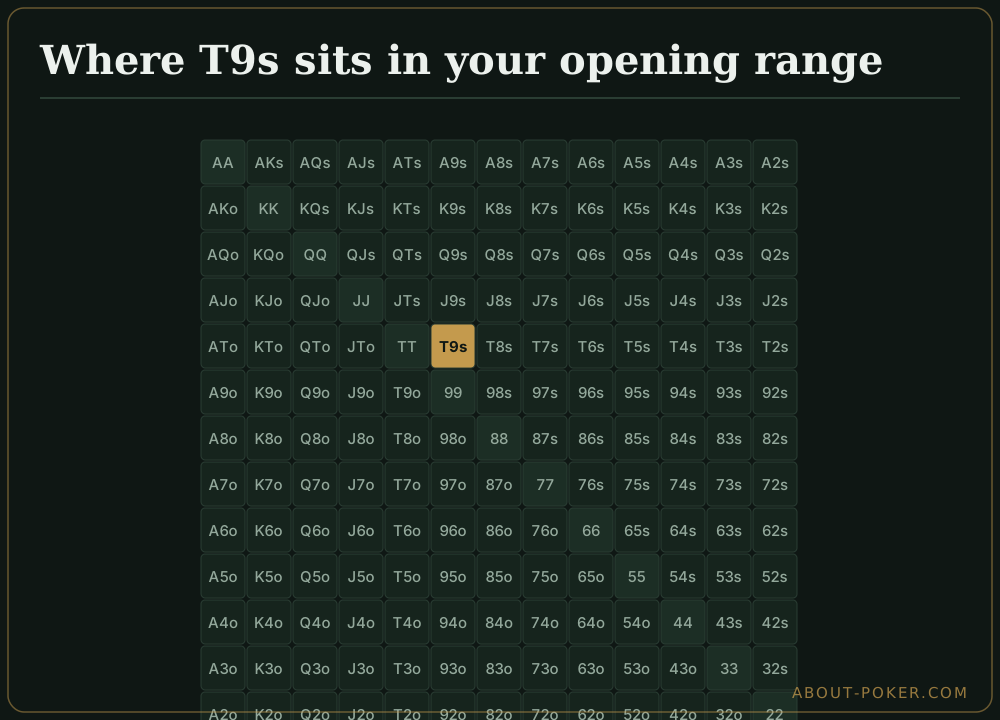
By seat, T9s is a middle-and-late open that also defends the blinds well:
- Early position: a marginal open or fold in tight 6-max games; too many players behind.
- Middle position: a comfortable open in most games.
- Cutoff and button: an easy open every time — position plus straight-and-flush equity is a strong mix.
- Small blind: open (raise) when it folds to you.
- Big blind: defend widely against opens; this is a great spot for T9s.
Anchor the borders in the preflop opening ranges, and note how T9s sits right below jack-ten suited in the suited-connector pecking order.
Why suited connectors like T9s win money
T9s earns through equity distribution, not raw showdown value. It flops an open-ended straight draw, a flush draw, or better far more often than a high-card hand, and when it completes those draws the strength is hidden — opponents holding top pair or an overpair pay it off. It also has reverse-domination protection: unlike an offsuit broadway, T9s is rarely crushed preflop, so its equity realizes cleanly in position. The tradeoff is that its made pairs are weak, so the hand wants to play in position where it can control the pot when it whiffs and press hard when it connects.
Facing a raise
Against an opener, T9s is a strong 3-bet bluff and a fine flat. From the blinds or the button against a late opener, 3-bet bluffing T9s is excellent: it has good equity when called, blocks ten-x and nine-x hands, and plays beautifully postflop. In position at a good price, calling a single raise is standard because you flop so many draws and realize equity well. Out of position against a tight, early raiser, folding is often correct — even a great connector struggles without position. Fit T9s into your bluffing structure with the 3-bet range.
A worked example
You open T♥9♥ from the button and the big blind calls. The flop comes J♠ 8♦ 2♥ — you have flopped an open-ended straight draw (any queen or seven completes a straight, giving you eight outs). The big blind checks. You continuation-bet as a semi-bluff: with eight outs you have roughly 31% equity to reach the river with two cards to come, plus fold equity when a weak hand folds now. The big blind calls. The turn is the 7♣ — you make a well-disguised straight. You bet for value, and because the board looks like a blank to a jack or an eight, you get paid by top pair and overpairs that never see the straight coming. That hidden-straight payoff is the whole reason to play T9s.
Now suppose the flop had come T♦ 6♣ 2♠ instead — top pair, ten-high. That is a marginal one-pair hand with a weak kicker; take thin value at most and be ready to fold to pressure. T9s makes its money in the draws and straights, not in its pairs.
Postflop in one paragraph
When T9s flops a straight or flush draw, semi-bluff it aggressively, because the equity and the payoff when it completes are large and disguised. When it completes a straight or flush, bet for value and expect to get paid by hands that cannot see it coming. When it flops top pair or a weak made hand, control the pot and take small value. When it whiffs, give up cheaply — its strength is potential, not showdown value. Lean into the draws and stay disciplined when it misses.
Where to go next
T9s is a premier suited connector that thrives on position and aggression. Sharpen your opens with preflop opening ranges, compare it to the slightly stronger jack-ten suited, and connect the framework at the preflop strategy hub.
Frequently asked
Is ten-nine suited a good hand?
Yes. T9s is one of the best suited connectors because it is fully connected and makes the most straights of any two-card combination in its class. It opens from middle position onward, defends the blinds well, and works as a 3-bet bluff. Its equity comes from straights, flushes, and disguised strong hands rather than high-card value.
Should you open ten-nine suited under the gun?
In most 6-max games it is a marginal open or a fold from the earliest seat, because too many players are left to act. T9s becomes a comfortable open from middle position and a clear open from the cutoff, button, and small blind, where its playability and steal equity shine.
Can you 3-bet bluff ten-nine suited?
Yes. T9s is one of the better suited-connector 3-bet bluffs. It has strong equity when called, blocks some ten-x and nine-x hands, and plays well postflop because it flops so many draws. It is most useful from the blinds and the button against late openers.