What Is Suck Out in Poker?
A suck out in poker is when a hand behind at the money catches a card to win. Learn what it means, how it differs from a bad beat, and why it happens.
On this page · 7 sections
A suck out is when a hand that is behind at the moment the money goes in catches a later card and ends up winning. If you get all-in with aces against a smaller pair and your opponent hits a set on the river, they just sucked out on you. The term captures the sting of losing a pot you were statistically supposed to win.
Understanding suck outs is important for one reason: they are inevitable. Poker is a game of edges, not certainties, and even a big favorite loses a meaningful share of the time. Players who grasp this stay calmer, make better decisions, and avoid going on tilt when variance runs against them.
What a suck out actually means
The key word is behind. A suck out only exists relative to a moment where one hand was ahead. Usually that moment is when the chips go in on an earlier street. If you are 80 percent to win when the money goes in and the last card flips the result, the winner “sucked out.”
The suck out is defined by the equity picture at the point of commitment, not by whether the eventual winner had a draw the whole time. Someone drawing to a flush who gets there did not get lucky in a vacuum, but if they called with worse odds than the pot offered, their win is still a suck out.
Suck out vs bad beat vs cooler
These three terms overlap, so it helps to separate them:
- A suck out is the action: an underdog catches up and wins.
- A bad beat is the emotional experience of being on the wrong end of a big suck out with a strong hand.
- A cooler is different entirely: two big hands collide and someone was always going to lose, with no suck out involved. Set over set is a cooler, not a suck out.
The distinction matters because coolers are unavoidable, while suck outs are simply the losing side of a favorable spot you should keep taking.
A worked example
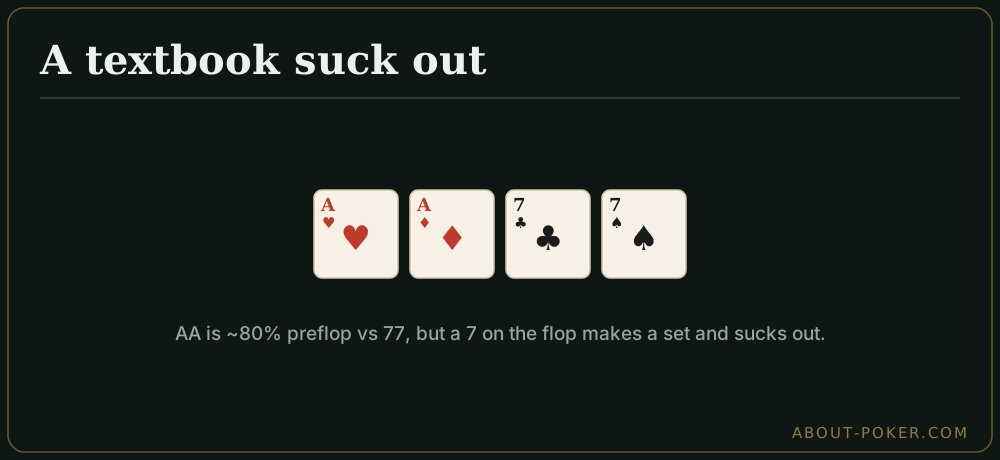
You hold Ah Ad and get all-in preflop against 7c 7s. Pocket aces are roughly an 80 to 20 favorite over a smaller pair. The dealer runs out 7d 4c 9h Ks 2c. Your opponent flopped a set of sevens and you never improved.
That is a textbook suck out. You were about 80 percent when the money went in, meaning you win four out of five times in that exact spot. You simply landed in the losing fifth this time. Over a thousand such hands you win around 800 and pocket a large profit, so getting sucked out on here is proof you were doing the right thing, not the wrong one.
Why suck outs feel worse than they are
Human memory is lopsided. You remember the river that crushed you far more vividly than the twenty times the same holding held up. This creates the illusion that you “always” get sucked out on, which is almost never true when you actually track results.
Another trap is confusing frequency with fairness. An 80 percent favorite losing feels unjust, but a 20 percent underdog is supposed to win one time in five. Many draws are even closer than that. A flush draw on the flop, for instance, is around 35 percent to complete by the river, so it “sucks out” more than a third of the time.
Common mistakes players make about suck outs
The biggest error is changing good decisions because of results. If getting aces in against a smaller pair burned you last session, folding them next time is a disaster. The outcome does not grade the play.
A related mistake is playing scared after a run of suck outs, checking strong hands or refusing to get value because you fear the river. This forfeits the exact edges that make you money. If you got someone to commit as a big underdog, you want to repeat that spot forever, even knowing they will occasionally hit.
Finally, some players stop protecting their hands. Suck outs partly happen because opponents were priced in or given a free card. Betting to charge draws does not eliminate suck outs, but it makes opponents pay to try. Learn more about how these chasing hands work in our guide to what a draw is in poker.
How to handle getting sucked out on
- Confirm you got the money in ahead. If yes, you played it right.
- Avoid immediately reviewing the hand while you are emotional. Come back to it later with a clear head.
- Take a short break if you feel tilt creeping in. One suck out should not cost you three good decisions afterward.
- Keep a results record. Seeing your favorites hold up over a large sample rebuilds the accurate picture.
- Reframe the loss as evidence you are seeking good spots, because you only get sucked out on when you were ahead.
The bottom line
A suck out is the price of admission for a game built on edges. You cannot be a favorite without occasionally being the favorite who loses. The winning approach is to keep putting money in ahead, protect your hands where you can, and let the long run do its work. Players who internalize this stop fearing the river and start focusing on the only thing they control, which is the quality of the decision.
Frequently asked
Is a suck out the same as a bad beat?
They are related but not identical. A suck out describes the action of an underdog hand catching up to win. A bad beat describes the losing player's experience of that outcome when they had a strong hand. Every bad beat involves a suck out, but not every suck out feels like a bad beat.
Does getting sucked out on mean I played badly?
No. If you got your money in ahead, you made a profitable decision. The card that beats you does not change the quality of the play. Good poker is about getting money in as a favorite as often as possible and accepting that the underdog wins sometimes.
How often does the favorite actually win?
It depends on the equity gap. A hand that is 80 percent to win still loses one time in five. Even a 95 percent favorite loses roughly one hand in twenty, so suck outs are a normal part of the math over many hands.