How to Get Better at Poker Fast
The fastest realistic way to improve at poker: fix your biggest leaks first, drill preflop, judge decisions not results, and use a tight play-review-drill loop.
On this page · 8 sections
Everyone wants to improve fast, and it’s possible — but only if you spend your limited time on what actually moves the needle. Speed comes from focus, not from cramming more hours or chasing advanced tricks. This is the fastest realistic path: attack the biggest leaks first, drill the fundamentals, judge decisions honestly, and run a tight improvement loop. A quick warning first, though.
Speed means fixing the right things
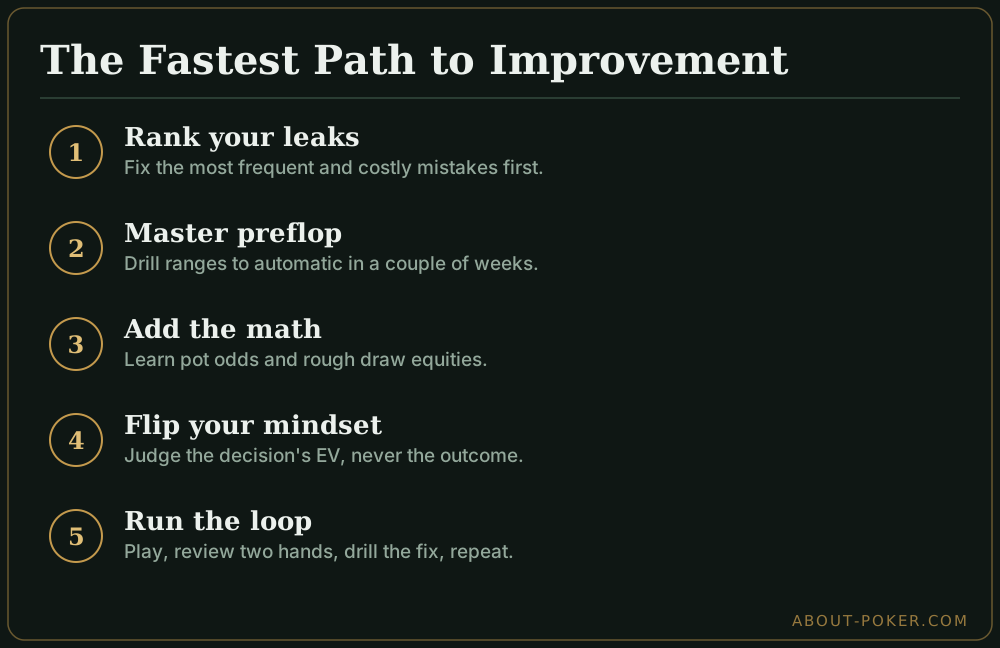
The fastest way to get better is to eliminate the mistakes that come up most often and cost the most, in that order. A flashy river-bluff concept you use once a session is nearly irrelevant compared to a preflop range you get wrong every orbit. So resist the urge to study whatever’s most interesting. Rank your leaks by frequency and cost, and fix the top of that list. Building this into a proper poker study plan keeps you honest about priorities instead of drifting toward fun-but-minor topics.
Nail preflop first — it’s the biggest, quickest win
If you do one thing, do this. Most losing players simply play too many hands from too many positions. Learning solid preflop ranges removes a large share of losing spots before the flop even comes, and it’s the single fastest measurable upgrade available. Because preflop is highly repetitive and memorizable, drilling preflop ranges with active recall and spaced repetition gets you there in a couple of focused weeks — far faster than any postflop project.
Learn pot odds and basic hand reading
After preflop, two more fundamentals give outsized, fast returns:
- Pot odds. Know that you need about 33% equity to call a pot-sized bet, ~25% against a half-pot bet, and roughly how much equity common draws have (a flush draw is about 35% with two cards to come). This alone fixes countless call/fold errors.
- Hand reading. Practice narrowing an opponent’s range street by street. Even a rough read beats playing your own two cards in a vacuum.
These are cheap to learn and pay off immediately, which is exactly what “fast” requires.
Judge decisions, not results
Here’s the mental shift that accelerates everyone who adopts it: evaluate your play by the quality of the decision, not the outcome. Poker’s short-term variance means correct plays lose often and mistakes win often. If you learn from results, you’ll “fix” good plays and keep bad ones — the opposite of improvement. Getting money in as an 82% favorite and losing is a good decision; folding the best hand because you got scared is a bad one even if it feels safe. Internalize this and every review you do becomes accurate.
Run a tight play-review-drill loop
Fast improvement is a loop, run frequently:
- Play a focused session.
- Review your two or three worst or least-certain hands — define the opponent’s range street by street and judge your action against it. The method in reviewing your poker hands keeps this sharp.
- Drill the fix — a trainer, flashcards, or a quick solver check on the exact spot.
Then play again and watch for that spot. Short, frequent cycles beat rare marathons because active learning fades when you’re tired.
A worked one-week sprint
Suppose you’re a break-even micro-stakes player who wants a fast jump. A one-week sprint:
- Day 1: Cold-test your button and cutoff opening ranges. Whatever you miss becomes this week’s preflop drill.
- Days 2–5: 15 minutes of preflop drilling each day, plus a short session. After each session, review two hands by decision quality.
- Day 3 & 6: Add a 10-minute pot-odds refresher — quiz yourself on required equity for common bet sizes.
- Day 7: Re-test your ranges cold and total up how many of the week’s review hands you’d now play differently.
By the end you’ll have tightened your preflop game, sharpened your pot-odds math, and built the exact loop that keeps producing gains. That’s a genuine, fast, and durable step up — not a gimmick.
Manage expectations and bankroll
One caution so “fast” doesn’t backfire: your decisions can improve in weeks, but results need a large sample to reveal themselves because of variance. Don’t move up stakes chasing quick money — beat your current game convincingly first, and let your bankroll and win rate justify any move. The players who improve fastest are patient with results and relentless about fixing the right leaks.
A fast-improvement checklist
- Attack your most frequent, most costly leaks first.
- Get preflop ranges automatic — the quickest big win.
- Learn pot odds and basic hand reading next.
- Judge every hand by decision quality, not the result.
- Run a short, frequent play-review-drill loop and stay patient on results.
Frequently asked
What's the fastest way to improve at poker?
Fix your biggest, most frequent leaks first — usually preflop ranges and basic pot odds — because they affect the most pots. Then run a tight loop of playing, reviewing your worst hands, and drilling the fix. Targeting high-frequency mistakes gives the fastest return on your time.
Can I get good at poker quickly?
You can improve your decisions quickly, but proving it in results takes a large sample because of variance. Expect visible skill gains in weeks with focused study, but judge your progress by decision quality over thousands of hands, not by a few sessions' winnings.
What single change helps most for beginners?
Learning and sticking to solid preflop ranges. Most beginner losses come from playing too many hands and playing them from bad positions. Tightening up preflop removes a large share of losing spots instantly and is the quickest measurable upgrade.
Should I move up stakes to improve faster?
No — that usually slows you down and risks your bankroll. You improve fastest by beating your current stake convincingly first, studying your leaks, and moving up only when your win rate and bankroll clearly support it.