Playing 10 Big Blinds in an MTT
At 10 big blinds you are in pure push-fold territory. Here's how to shove first-in, re-shove over opens, and pick up blinds to survive and rebuild.
On this page · 6 sections
Ten big blinds is the heart of tournament survival. At this depth you have left the world of postflop poker entirely — the correct play is almost always to move all-in or fold before the flop. Play 10bb well and you can hover, pick up blinds and antes, and rebuild into a real stack. Play it badly and you either bust needlessly or blind out one small raise at a time.
Why push-fold is forced at 10bb
At 10 big blinds, a standard 2.2bb open commits over a fifth of your stack. If you then face a shove, you are getting a price that makes folding painful — so you have effectively committed anyway. Rather than open small and get put to an awkward decision, you simply move all-in. Two things happen: you capture the blinds and antes when everyone folds, and you remove every postflop guessing game.
This is classic push-fold, and the full framework — M-ratio, why shoving beats raising, and range construction — lives in the short-stack push-fold strategy guide. At 10bb you are firmly inside that framework.
Open-shoving ranges
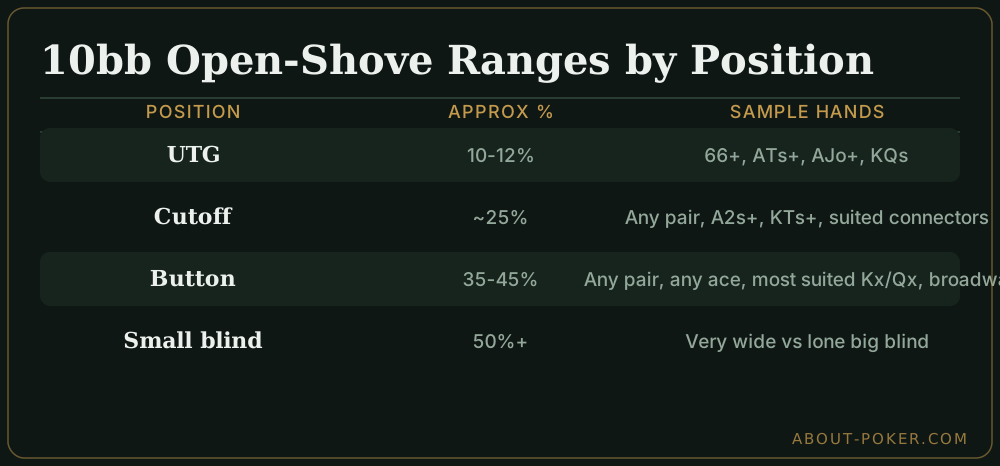
When the action folds to you, your shoving range widens dramatically as you move toward the button:
- Early position: premiums, strong aces (ATs+, AJo+), and pairs 66+. You have many players left to act.
- Middle position: add suited broadways, more aces, and pairs down to 44.
- Cutoff and button: shove very wide — any pair, any ace, most suited kings and queens, suited connectors, and many offsuit broadways. On the button with folds to you, you can jam roughly the top 35–45% of hands.
- Small blind: with only the big blind left, shove an enormous range, since you have real fold equity and a dead big blind to win.
These frequencies come straight from Nash push-fold math. For the theory behind them, see Nash equilibrium shoving in tournaments.
Re-shoving over an open
When someone opens ahead of you at 10bb, you can re-shove (jam over their raise). This works because the opener’s raise adds dead money to the pot, boosting your fold equity, and because they open wider than they call a shove. Good re-shove hands include suited aces for their blockers, pairs, and strong broadways. The re-steal zone strategy covers this in depth; at 10bb it is a jam rather than a small 3-bet.
A worked example
You are on the button with 10bb holding Kh Ts. The action folds to you. This is a clear shove — KTs is well within a button open-shoving range. The blinds together hold 1.5bb plus antes, so even folding out both blinds is a meaningful pickup that pushes you back toward 12bb.
Say the big blind, covering you, calls with Ad 9d. You are behind, but not badly: KTs has roughly 40% equity against A9s. So even when your shove gets called by a hand that beats you, you win the pot two times in five, and most of the time both blinds simply fold. That combination of frequent uncontested wins plus decent equity when called is exactly why wide button shoves are profitable at 10bb.
Common mistakes
- Limping or min-raising. These leave you committed with no fold equity and no plan. Shove or fold.
- Shoving too tight from late position. Waiting for premiums on the button lets the blinds steal you blind. Attack with a wide range.
- Calling shoves too loose. Your calling range should be tighter than your shoving range; do not stack off with hands that only shove profitably.
- Ignoring ICM near the bubble. When pay jumps loom, tighten both shoves and calls, because busting costs you real money.
Checklist for 10bb play
- Default to shove-or-fold; retire the min-raise.
- Widen your open-shoves steadily as you approach the button.
- Re-shove over opens using pairs, suited aces, and broadways.
- Call shoves tighter than you shove.
- Adjust for ICM near pay jumps.
Master 10bb and you turn the most dangerous depth in tournaments into a survival engine. Pair this with the full push-fold strategy guide to sharpen your ranges.
Frequently asked
Should I only shove or fold at 10 big blinds?
Almost always. At 10bb a min-raise commits nearly a quarter of your stack and leaves you unable to fold profitably, so moving all-in or folding is the standard. The rare exception is opening small from the button or blinds against passive opponents you know will not attack.
How wide can I open-shove at 10 big blinds?
From late position with folds to you, quite wide — most pairs, any ace, most suited kings and queens, and many suited connectors. From early position tighten to premiums, strong aces, and big pairs, because more players are left to wake up with a hand behind you.
What is fold equity and why does it matter at 10bb?
Fold equity is the chance your opponents fold to your all-in, letting you win the pot uncontested. At 10bb it is your main source of profit — the blinds and antes you pick up without a showdown keep you alive far more than the times you get called and win.